
退化性神经认知障碍和创伤性脑损伤的自杀问题。
Suicides in degenerative neurocognitive disorders and traumatic brain injuries.
机构信息
Department of Psychiatry, University of Helsinki, Helsinki, Finland.
Primary Health Care Unit, Kuopio University Hospital, Kuopio, Finland.
出版信息
Eur Psychiatry. 2024 Jan 17;67(1):e10. doi: 10.1192/j.eurpsy.2024.3.
BACKGROUND
Neuropsychiatric symptoms in major neurocognitive disorders have been strongly associated with suicidality.
METHODS
The objectives were to explore suicide rates in degenerative neurocognitive disorders (DNDs), alcohol-related neurocognitive disorders (ARNDs), and traumatic brain injuries (TBIs). Patients who received these diagnoses between 1998 and 2015 ( = 231,817) were identified from nationwide registers, and their mortality was followed up until December 31, 2018. We calculated incidences of suicides per 100,000 person-years, types of suicides, and suicide rates compared with the general population (standardized mortality ratio [SMR]).
RESULTS
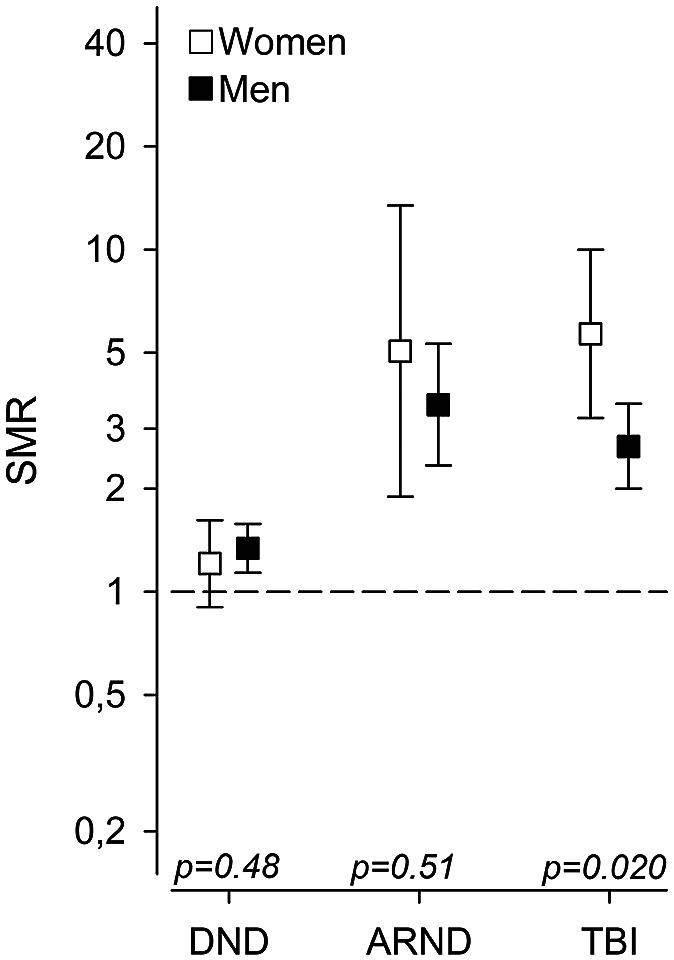
During the follow-up, 0.3% (95% confidence interval [95% CI]: 0.2-0.5) of patients with DNDs, 1.1% (0.7-1.8) with ARNDs, and 1.0% (0.7-1.3) with TBIs committed suicide. Suicide mortality rate was higher in men (58.9, 51.3, to 67.4 per 100,000) than in women (9.8, 7.5, to 12.5 per 100,000). The highest suicide rate was in ARNDs (98.8, 65.1, to 143.8 per 100,000), followed by TBIs (82.0, 62.4, to 105.8 per 100,000), and DNDs (21.2, 18.3, to 24.5 per 100,000). The SMRs (95% CI) were 3.69 (2.53-5.38), 2.99 (2.31-3.86), and 1.31 (1.13-1.51), respectively, and no sex difference emerged. The most common cause of death was self-inflicted injury by hanging or drowning (12.4, 10.3, to 14.8 per 100,000).
CONCLUSIONS
Suicide rates were higher in all three patient groups than the general population. Suicide risk remained elevated for more than 10 years after diagnosis. The suicide methods were mostly violent.
背景
在主要神经认知障碍中,神经精神症状与自杀意念强烈相关。
方法
本研究旨在探讨退行性神经认知障碍(DND)、酒精相关神经认知障碍(ARND)和创伤性脑损伤(TBI)患者的自杀率。从全国性登记处中确定了 1998 年至 2015 年间(n=231817)接受这些诊断的患者,并对其进行了随访,直至 2018 年 12 月 31 日。我们计算了每 10 万人年的自杀发生率、自杀类型和自杀率,并与普通人群进行了比较(标准化死亡率比[SMR])。
结果
在随访期间,0.3%(95%置信区间[95%CI]:0.2-0.5)的 DND 患者、1.1%(0.7-1.8)的 ARND 患者和 1.0%(0.7-1.3)的 TBI 患者自杀。男性自杀死亡率高于女性(58.9、51.3 至 67.4/10 万比 9.8、7.5 至 12.5/10 万)。自杀率最高的是 ARND(98.8、65.1 至 143.8/10 万),其次是 TBI(82.0、62.4 至 105.8/10 万)和 DND(21.2、18.3 至 24.5/10 万)。SMR(95%CI)分别为 3.69(2.53-5.38)、2.99(2.31-3.86)和 1.31(1.13-1.51),且无性别差异。最常见的死亡原因是自杀性自伤(12.4、10.3 至 14.8/10 万)。
结论
这三个患者群体的自杀率均高于普通人群。诊断后 10 多年,自杀风险仍居高不下。自杀方法大多是暴力的。

 Zotero 插件