Department of Biostatistics, University of Washington, Seattle, WA, United States of America.
Program in Molecular Medicine, University of Massachusetts Medical School, Worcester, MA, United States of America.
PLoS One. 2024 Jan 17;19(1):e0295840. doi: 10.1371/journal.pone.0295840. eCollection 2024.
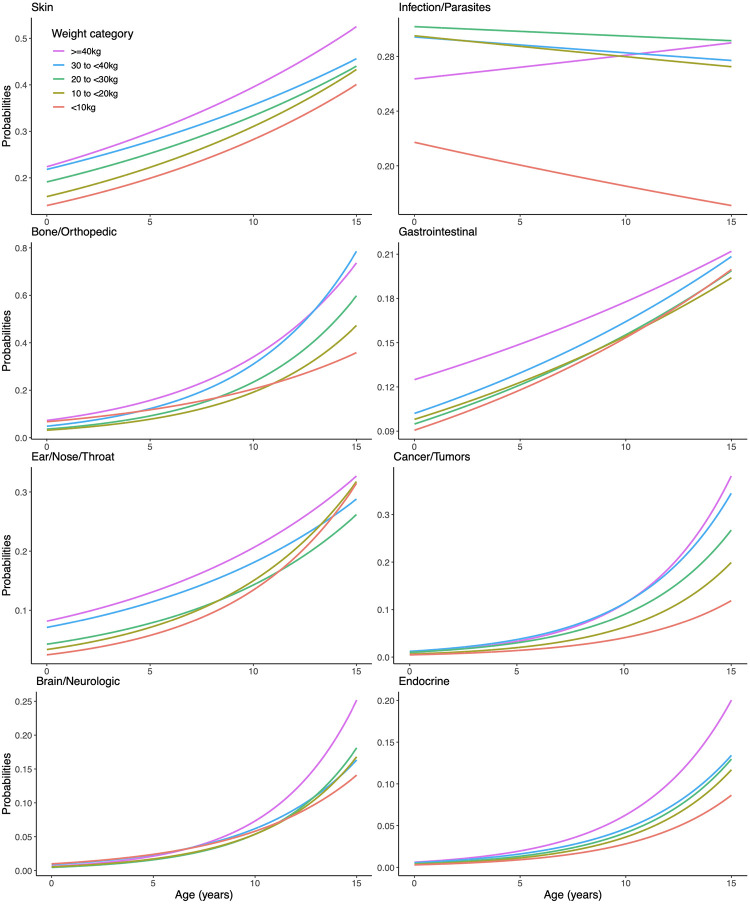
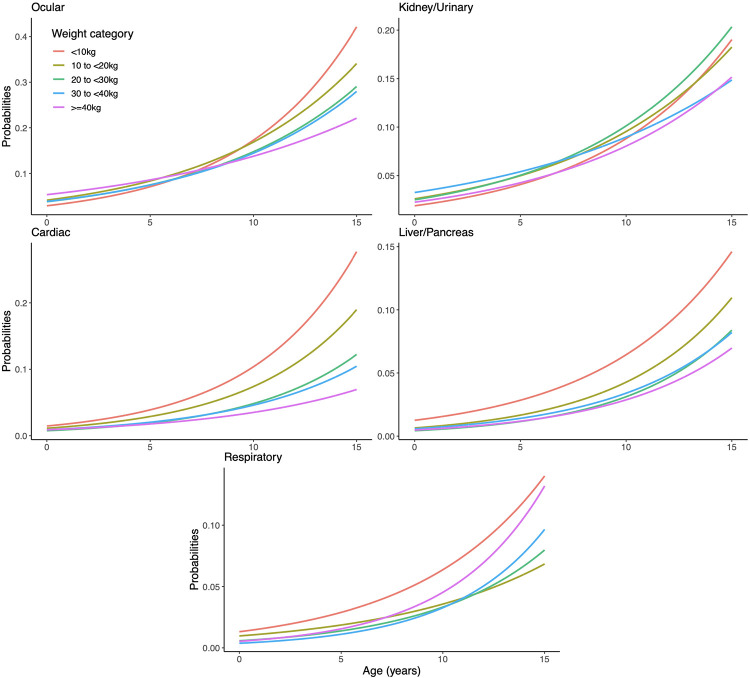
Age in dogs is associated with the risk of many diseases, and canine size is a major factor in that risk. However, the size patterns are complex. While small size dogs tend to live longer, some diseases are more prevalent among small dogs. In this study we seek to quantify how the pattern of disease history varies across the spectrum of dog size, dog age, and their interaction. Utilizing owner-reported data on disease history from a substantial number of companion dogs enrolled in the Dog Aging Project, we investigate how body size, as measured by weight, associates with the lifetime prevalence of a reported condition and its pattern across age for various disease categories. We found significant positive associations between dog size and the lifetime prevalence of skin, bone/orthopedic, gastrointestinal, ear/nose/throat, cancer/tumor, brain/neurologic, endocrine, and infectious diseases. Similarly, dog size was negatively associated with lifetime prevalence of ocular, cardiac, liver/pancreas, and respiratory disease categories. Kidney/urinary disease prevalence did not vary by size. We also found that the association between age and lifetime disease prevalence varied by dog size for many conditions including ocular, cardiac, orthopedic, ear/nose/throat, and cancer. Controlling for sex, purebred vs. mixed-breed status, and geographic region made little difference in all disease categories we studied. Our results align with the reduced lifespan in larger dogs for most of the disease categories and suggest potential avenues for further examination.
犬只的年龄与许多疾病的风险相关,而犬只的体型是该风险的一个主要因素。然而,体型模式较为复杂。虽然小型犬的寿命往往更长,但某些疾病在小型犬中更为普遍。在这项研究中,我们试图量化疾病史的模式如何在犬只体型、年龄及其相互作用的范围内发生变化。我们利用大量参与犬类衰老计划的伴侣犬的主人报告的疾病史数据,研究了体重所衡量的体型如何与报告疾病的终生患病率以及各种疾病类别的年龄分布相关。我们发现,犬只体型与皮肤、骨骼/骨科、胃肠道、耳朵/鼻子/喉咙、癌症/肿瘤、大脑/神经系统、内分泌和传染病的终生患病率之间存在显著的正相关关系。同样,犬只体型与眼睛、心脏、肝脏/胰腺和呼吸系统疾病类别的终生患病率呈负相关。肾脏/泌尿系统疾病的患病率与体型无关。我们还发现,对于许多疾病,包括眼睛、心脏、骨科、耳朵/鼻子/喉咙和癌症,年龄与终生疾病患病率之间的关联因犬只体型而异。控制性别、纯种犬与混血犬的状态以及地理区域,对我们研究的所有疾病类别影响不大。我们的研究结果与大多数疾病类别的大型犬寿命较短的情况一致,并为进一步研究提供了潜在的途径。