Gagliardi Marcantonio
Institute for Lifecourse Development (ILD), University of Greenwich, London, United Kingdom.
Front Psychol. 2024 Jan 4;14:1259415. doi: 10.3389/fpsyg.2023.1259415. eCollection 2023.
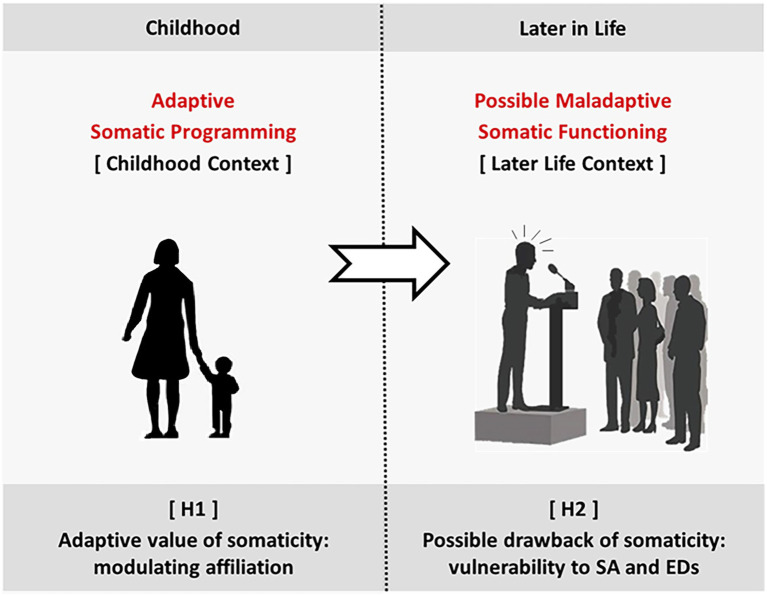
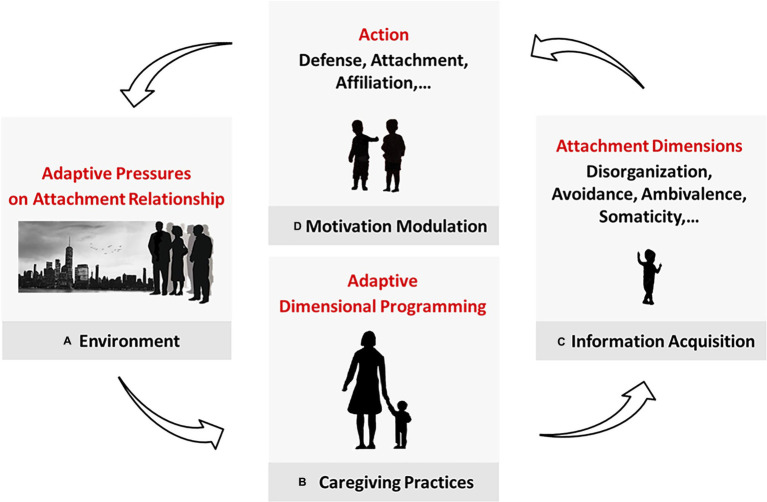
Attachment is the evolutionarily-established process through which humans create bonds with others to receive care from them. The phenomenon is as essential to our physical survival as it is to our psychological development. An increasing number of studies demonstrates that in sensitive periods during the early years of life, our brain circuitry is programmed in the interactions with our caregivers, with the imprinting of information over multiple attachment dimensions. Adopting a basic , we can think of this knowledge as the psycho-social of our mind. According to a recently proposed extension of the classical three-dimensional view, one attachment dimension - - concerns the caregiver's task of reflecting and confirming the child's (internal) states - such as sensations, emotions, and representations - to support the child's ability to identify and define those entities autonomously. Relying on multidisciplinary evidence - from neuroscientific, developmental, evolutionary, and clinical sources - we suggest that somaticity (H1) has the adaptive function to modulate our tendency to comply and affiliate with a reference group but also (H2) increases the vulnerability to developing (SA) and (EDs). We evaluate H1-H2, (1) indicating the evolutionary role of somaticity in modulating our affiliation tendency to optimize the ancestral threat-opportunity balance coming from infectious diseases and (2) showing the deep connection between SA-EDs and the features most closely related to somaticity - interoception and parenting style. Finally, we discuss three relevant implications of H1-H2: (A) Bringing into research focus the adaptive role of our knowledge system versus the (neural substrate) and (higher cognition) ones. (B) Complementing the well-grounded and , allowing us to integrate multiple levels of explanation on the etiology of psychopathology. (C) Suggesting the design of new psychological treatments. While not aiming to prove H1-H2, our analysis supports them and encourages their direct testing.
依恋是一种通过进化确立的过程,人类借此与他人建立联系以从他们那里获得照料。这一现象对我们的身体生存和心理发展都至关重要。越来越多的研究表明,在生命早期的敏感时期,我们的大脑回路在与照料者的互动中被编程,在多个依恋维度上留下信息印记。采用一种基本观点,我们可以将这种知识视为我们心智的心理社会架构。根据最近对经典三维观点的扩展,一个依恋维度——即照料者反思并确认孩子(内在)状态(如感觉、情绪和表象)的任务,以支持孩子自主识别和界定这些实体的能力。依靠来自神经科学、发展心理学、进化生物学和临床学等多学科的证据,我们认为躯体性(假设1)具有调节我们顺从和加入参照群体倾向的适应功能,但同时(假设2)也会增加患躯体形式障碍(SA)和进食障碍(EDs)的易感性。我们评估假设1 - 假设2,(1)指出躯体性在调节我们的归属倾向以优化来自传染病的祖先威胁 - 机会平衡方面的进化作用,以及(2)表明躯体形式障碍 - 进食障碍与与躯体性最密切相关的特征——内感受和养育方式之间的深层联系。最后,我们讨论假设1 - 假设2的三个相关影响:(A)将我们的躯体知识系统的适应作用与神经(神经基质)和认知(高级认知)知识系统的适应作用纳入研究重点。(B)补充有充分依据的神经科学和心理学观点,使我们能够整合对精神病理学病因的多层次解释。(C)建议设计新的心理治疗方法。虽然我们的分析并非旨在证明假设1 - 假设2,但它支持这些假设并鼓励对其进行直接检验。