Therapeutic Services, Ministry of Health, Riyadh, Saudi Arabia.
Aseer Central Hospital, Aseer Diabetes Centre, Abha, Saudi Arabia.
Adv Ther. 2024 Mar;41(3):1120-1150. doi: 10.1007/s12325-023-02772-y. Epub 2024 Jan 19.
Type 2 diabetes mellitus (T2DM) is associated with huge clinical and economic burden in the Kingdom of Saudi Arabia (KSA) which can be curtailed by efficacious treatment. In order to achieve this, current treatment pathways for T2DM and associated costs need to be assessed.
A longitudinal cohort review was conducted to collect country-specific and patient-specific clinical data, over a minimum observation period of 5 years in the KSA. Patient demographics, clinical characteristics and treatment patterns were recorded. The IQVIA Core Diabetes Model (CDM) version 9.5 Plus was used to assess the burden of illness, which included long-term projections of clinical (life expectancy [LE], quality-adjusted life-years [QALYs], event rates of diabetes-related complications) and direct medical cost (per-patient annual or lifelong [50 years]) outcomes of the most commonly used first-line (1st-line) regimens for T2DM from a payer perspective in the KSA.
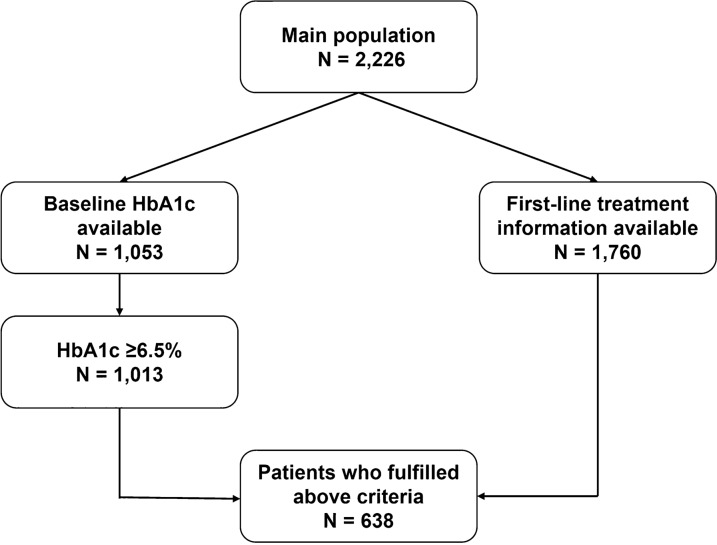
Data were collected from a subpopulation of 638 patients from 15 participating centres. There was an equal gender representation with a majority of the patients belonging to Arabian/Saudi ethnicity (71.0%). Biguanides (81.5%), sulfonylureas (51.6%), dipeptidyl peptidase 4 (DPP4) inhibitors (26.2%) and fast-acting insulins (17.2%) were the most prescribed 1st-line agents. The most frequently used 1st-line regimens resulted in an estimated LE of 25-28 years, QALYs of 18-21 years and lifelong total cost of illness of 201,377-437,371 Saudi Arabian riyal (53,700-116,632 US dollars).
Our study addresses gaps in the current research by providing a complete landscape of baseline demographic, clinical characteristics and treatment patterns from a heterogeneous group of patients with T2DM in the KSA. Additionally, the burden of illness analysis using CDM showed substantially higher cost of T2DM care from a payer perspective in the KSA.
2 型糖尿病(T2DM)在沙特阿拉伯王国(KSA)带来了巨大的临床和经济负担,但通过有效的治疗可以减轻这种负担。为了实现这一目标,需要评估 T2DM 的现行治疗途径和相关成本。
对 KSA 进行了一项纵向队列研究,以收集特定国家和特定患者的临床数据,观察期至少为 5 年。记录患者的人口统计学、临床特征和治疗模式。使用 IQVIA Core Diabetes Model(CDM)版本 9.5 Plus 评估疾病负担,包括从支付者角度评估 T2DM 最常用一线(1 线)治疗方案的临床(预期寿命 [LE]、质量调整生命年 [QALYs]、糖尿病相关并发症发生率)和直接医疗成本(每位患者每年或终身[50 年])的长期预测结果。
从 15 个参与中心的 638 名患者中收集了数据。患者性别比例均等,大多数患者属于阿拉伯/沙特种族(71.0%)。二甲双胍(81.5%)、磺酰脲类(51.6%)、二肽基肽酶 4(DPP4)抑制剂(26.2%)和速效胰岛素(17.2%)是最常开的一线药物。最常使用的一线方案估计 LE 为 25-28 年,QALYs 为 18-21 年,终身总疾病负担为 201,377-437,371 沙特里亚尔(53,700-116,632 美元)。
我们的研究通过提供 KSA 异质 T2DM 患者的基线人口统计学、临床特征和治疗模式的全貌,填补了当前研究的空白。此外,使用 CDM 进行疾病负担分析表明,从支付者的角度来看,KSA 的 T2DM 治疗费用要高得多。