Department of Ultrasound, Clinical Medical College, First Affiliated Hospital of Chengdu Medical College, Chengdu, China.
Department of Cardiovascular Medicine, First Affiliated Hospital, Xi'an Jiaotong University, Xi'an, China.
Sci Rep. 2024 Jan 19;14(1):1733. doi: 10.1038/s41598-023-50304-z.
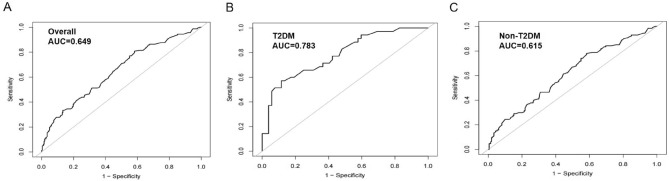
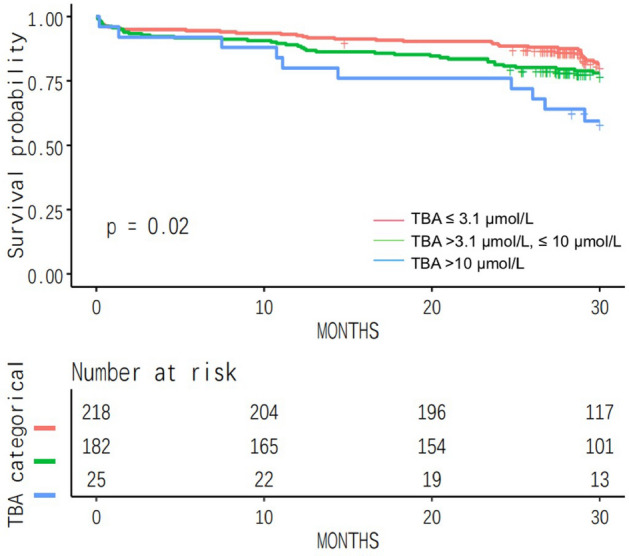
Bile acids play important roles in lipid metabolism and glucose homeostasis. Limited research exist on the association between serum total bile acid (TBA) levels and major adverse cardiovascular events (MACEs) in patients with acute coronary syndrome (ACS), particularly those with comorbid type 2 diabetes mellitus (T2DM). This study was conducted to examine the relationship between baseline serum TBA level and T2DM status in patients with ACS after percutaneous coronary intervention (PCI) and to identify the predictive value of TBA levels for a 2-year risk of MACEs. 425 ACS patients underwent PCI were recruited and divided into three groups based on baseline serum TBA concentration. An analysis of the association between the T2DM status and baseline serum TBA levels was conducted using univariate linear regression and multivariate linear regression. The predictive relevance of serum TBA levels was evaluated using the receiver operating characteristic (ROC) curve and Cox regression. Kaplan-Meier curves were employed to analyze the differences among groups in predicting MACEs over a 2-year follow-up period. Baseline serum TBA levels were higher in ACS patients who were diagnosed with T2DM (the median 3.6 µmol/L) than those without T2DM (the median 3.0 µmol/L). T2DM status in ACS patients was positively correlated with baseline serum TBA concentrations (β: 1.7, 95% confidence interval [CI] 0.3-3.0), particularly in the male (β: 2.0, 95% CI 0.3-3.6) and 50-69-year-old (β: 2.5, 95% CI 0.6-4.4) populations. The areas under the ROC curve of baseline serum TBA levels predicted MACEs in ACS and ACS-T2DM patients following PCI were 0.649 (95% CI 0.595-0.703) and 0.783 (95% CI 0.685-0.881), respectively. Furthermore, Cox regression analysis showed that baseline serum TBA level was associated with the occurrence of MACEs in patients with ACS after PCI over a 2-year follow-up period, especially in those diagnosed with T2DM, whose baseline TBA concentration was lower than 10.0 µmol/L. ACS Patients with T2DM had higher serum TBA levels. TBA level at baseline was an independent predictor of MACEs in ACS patients who underwent PCI, especially with comorbid T2DM.
胆汁酸在脂质代谢和葡萄糖稳态中发挥重要作用。关于急性冠状动脉综合征(ACS)患者血清总胆汁酸(TBA)水平与主要不良心血管事件(MACEs)之间的关联,尤其是合并 2 型糖尿病(T2DM)的患者,相关研究有限。本研究旨在探讨 ACS 患者经皮冠状动脉介入治疗(PCI)后基线血清 TBA 水平与 T2DM 状态之间的关系,并确定 TBA 水平对 2 年 MACEs 风险的预测价值。纳入 425 例接受 PCI 的 ACS 患者,根据基线血清 TBA 浓度将患者分为三组。采用单因素线性回归和多因素线性回归分析 T2DM 状态与基线血清 TBA 水平之间的关系。采用受试者工作特征(ROC)曲线和 Cox 回归评估血清 TBA 水平的预测相关性。采用 Kaplan-Meier 曲线分析 2 年随访期间各组预测 MACEs 的差异。与无 T2DM 的 ACS 患者(中位数 3.0µmol/L)相比,诊断为 T2DM 的 ACS 患者的基线血清 TBA 水平更高(中位数 3.6µmol/L)。ACS 患者的 T2DM 状态与基线血清 TBA 浓度呈正相关(β:1.7,95%置信区间 [CI] 0.3-3.0),尤其是在男性(β:2.0,95%CI 0.3-3.6)和 50-69 岁(β:2.5,95%CI 0.6-4.4)人群中。基线血清 TBA 水平预测 ACS 和 ACS-T2DM 患者 PCI 后 MACEs 的 ROC 曲线下面积分别为 0.649(95%CI 0.595-0.703)和 0.783(95%CI 0.685-0.881)。此外,Cox 回归分析表明,在接受 PCI 治疗的 ACS 患者中,基线血清 TBA 水平与 2 年随访期间 MACEs 的发生相关,尤其是在基线 TBA 浓度低于 10.0µmol/L 的合并 T2DM 的患者中。合并 T2DM 的 ACS 患者血清 TBA 水平较高。基线 TBA 水平是接受 PCI 的 ACS 患者发生 MACEs 的独立预测因子,尤其是合并 T2DM 的患者。