
系统性动脉僵硬度介导的血清尿酸与肾功能下降的关系:日本的一项回顾性队列研究
Relationship of Serum Uric Acid with Kidney Function Decline Mediated by Systemic Arterial Stiffness: A Retrospective Cohort Study in Japan.
作者信息
Nagayama Daiji, Watanabe Yasuhiro, Fujishiro Kentaro, Suzuki Kenji, Shirai Kohji, Saiki Atsuhito
机构信息
Department of Internal Medicine, Nagayama Clinic, Oyama-City 323-0032, Tochigi, Japan.
Center of Diabetes, Endocrinology and Metabolism, Toho University, Sakura Medical Center, Sakura-City 285-0841, Chiba, Japan.
出版信息
Diagnostics (Basel). 2024 Jan 16;14(2):195. doi: 10.3390/diagnostics14020195.
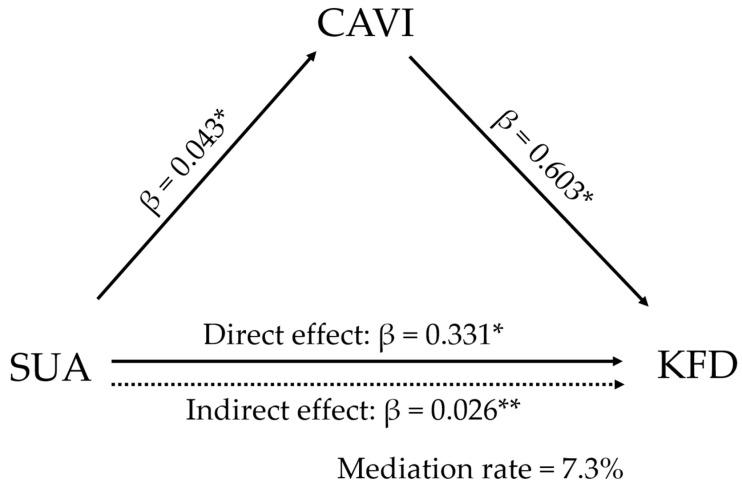
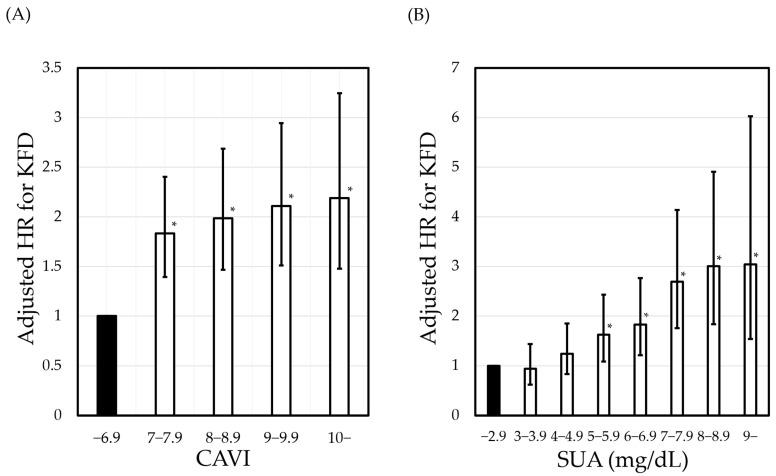
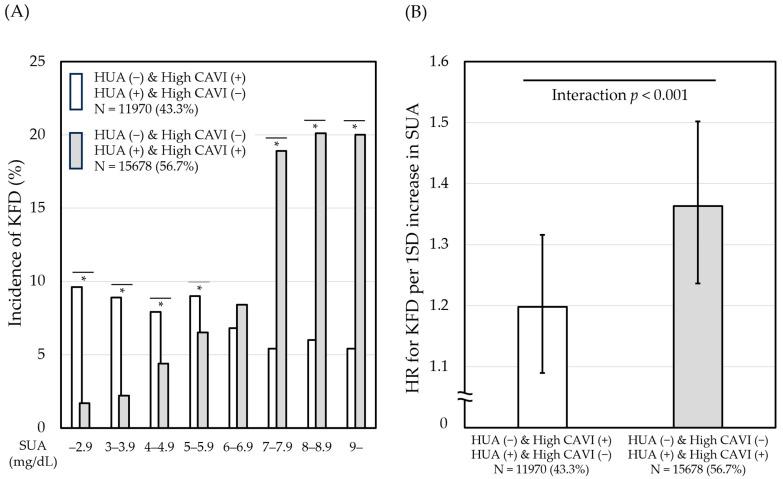
Hyperuricemia is associated with kidney function decline (KFD), although whether hyperuricemia directly causes nephrotoxicity or is indirectly mediated by systemic arterial stiffening remains unclear. We examined the detailed relationship of serum uric acid (SUA) with KFD and potential mediation by arterial stiffness. Study population was 27,648 urban residents with an estimated glomerular filtration rate (eGFR) of ≥60 mL/min/1.73 m at baseline, and they participated in a median of three consecutive annual health examinations. Arterial stiffness was assessed using cardio-ankle vascular index (CAVI). KFD was defined as a decrease in eGFR to below 60. Multivariate analysis showed an association between baseline SUA and CAVI independent of eGFR. During the study period, 6.6% of participants developed KFD. Stratified analysis revealed a linear relationship between the contribution of CAVI or SUA and KFD. ROC analysis determined a cutoff CAVI of 8.0 (males) or 7.9 (females) and a cutoff SUA of 6.3 (males) or 4.5 mg/dL (females) for predicting KFD. The linkage between SUA and CAVI was associated with a greater increase in the hazard ratio for KFD with an increase in SUA. CAVI showed the mediating effect on the relationship of SUA with KFD after an adjustment for confounders. SUA was associated positively with CAVI-mediated KFD. Further studies should verify whether intensive SUA-lowering treatment prevents KFD via improving vascular function.
高尿酸血症与肾功能下降(KFD)相关,尽管高尿酸血症是直接导致肾毒性还是由全身动脉僵硬间接介导尚不清楚。我们研究了血清尿酸(SUA)与KFD的详细关系以及动脉僵硬的潜在介导作用。研究人群为27648名城市居民,基线时估计肾小球滤过率(eGFR)≥60 mL/min/1.73 m²,他们平均连续参加了三次年度健康检查。使用心踝血管指数(CAVI)评估动脉僵硬程度。KFD定义为eGFR降至60以下。多变量分析显示,基线SUA与CAVI之间存在独立于eGFR的关联。在研究期间,6.6%的参与者出现了KFD。分层分析揭示了CAVI或SUA的贡献与KFD之间的线性关系。ROC分析确定预测KFD的CAVI临界值为8.0(男性)或7.9(女性),SUA临界值为6.3(男性)或4.5 mg/dL(女性)。SUA与CAVI之间的联系与随着SUA升高KFD的风险比增加更大有关。在调整混杂因素后,CAVI显示出对SUA与KFD关系的中介作用。SUA与CAVI介导的KFD呈正相关。进一步的研究应验证强化降低SUA治疗是否通过改善血管功能预防KFD。
 Zotero 插件