Wang Ke, Lu Yuanyuan, Bai Ming, Sun Yuanxing, Hao Yanan
Biocontrol Engineering Laboratory of Crop Diseases and Pests of Gansu Province, College of Plant Protection, Gansu Agricultural University, Lanzhou 730070, China.
Key Laboratory of Zoological Systematics and Evolution, Institute of Zoology, Chinese Academy of Sciences, Beijing 100000, China.
Insects. 2024 Jan 9;15(1):46. doi: 10.3390/insects15010046.
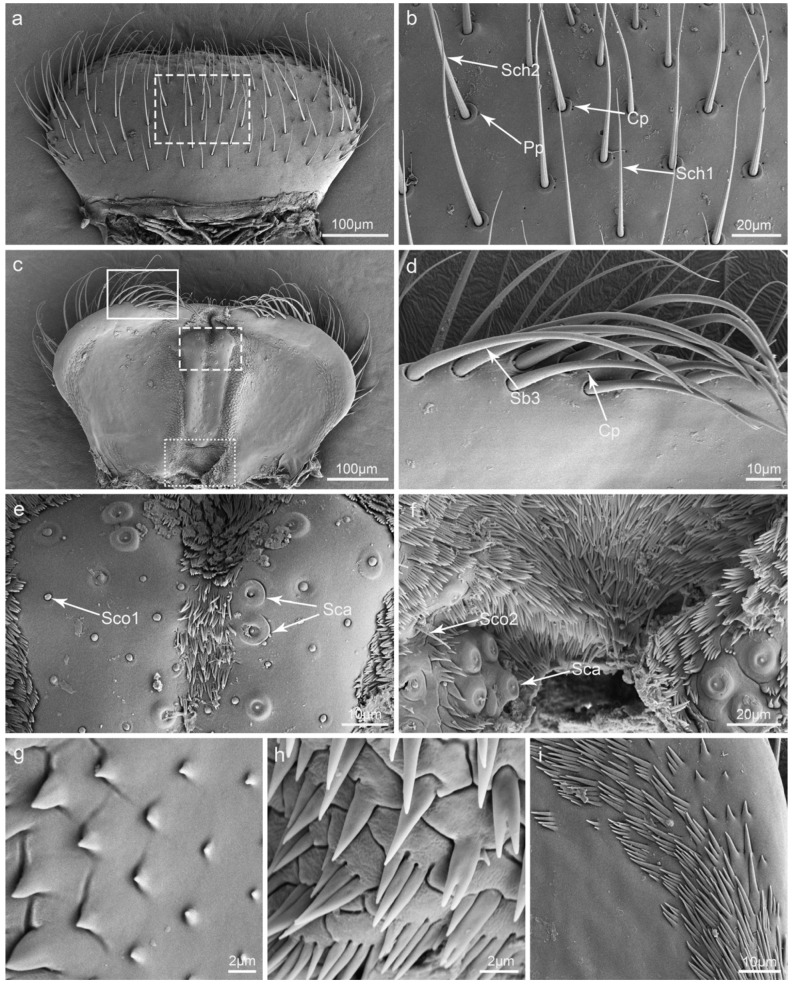
The morphological diversity of insect mouthparts is closely related to changes in food sources and diets. Research into the structures of insect mouthparts may help to establish a fundamental basis for a better understanding of insect feeding mechanisms. In this study, we examined the fine morphology of the mouthparts of using scanning electron microscopy. We paid particular attention to the types, quantities, and distribution of sensilla on the mouthparts. Our results showed that the basic components of the mouthparts of are the same as those in other lady beetles, i.e., the labrum, mandible, maxillae, labium, and hypopharynx. We also found structural specialization indicating adaptation to fungal feeding. On the mouthparts, there are eight kinds of sensilla and two kinds of glandular structures, including sensilla chaetica, sensilla basiconica, sensilla styloconica, sensilla coeloconica, sensilla campaniformia, sensilla placodea, sensilla digitiformia, Böhm bristles, perforated plates, and cuticular pores. This is the first time that sensilla digitiformia has been reported in ladybirds. Finally, variations in mouthparts among ladybirds with differing diets, as well as the putative functions of each of the mouthparts and sensilla, were discussed. This research can provide a reference for understanding the functions of the mouthparts in ladybird feeding behavior and thereby contribute to the development of precise insect behavior regulation and management strategies.
昆虫口器的形态多样性与食物来源和食性的变化密切相关。对昆虫口器结构的研究可能有助于建立一个基础,以便更好地理解昆虫的取食机制。在本研究中,我们使用扫描电子显微镜检查了[昆虫名称未给出]口器的精细形态。我们特别关注了口器上感器的类型、数量和分布。我们的结果表明,[昆虫名称未给出]口器的基本组成部分与其他瓢虫相同,即上唇、上颚、下颚、下唇和下咽。我们还发现了表明适应真菌取食的结构特化。在口器上,有八种感器和两种腺体结构,包括毛形感器、锥形感器、栓锥形感器、腔锥形感器、钟形感器、板形感器、指形感器、博氏鬃毛、穿孔板和表皮孔。这是首次在瓢虫中报道指形感器。最后,讨论了不同食性瓢虫口器的差异,以及每个口器和感器的假定功能。本研究可为理解瓢虫取食行为中口器的功能提供参考,从而有助于制定精确的昆虫行为调控和管理策略。