Lee Michele D, Pasricha Neel, Driver Todd H, Lopez Sarah E, Seitzman Gerami D
Department of Ophthalmology, University of Washington School of Medicine, Seattle, WA, USA.
Department of Ophthalmology, University of California San Francisco, San Francisco, CA, USA.
Med Hypothesis Discov Innov Ophthalmol. 2020 Winter;9(4):221-230. doi: 10.51329/mehdiophthal1409. Epub 2021 Feb 28.
To determine if there is a difference in the quantity of microbial flora of the conjunctiva in individuals practicing head submersion ("dunk") versus no head submersion ("no-dunk") during hot tub use.
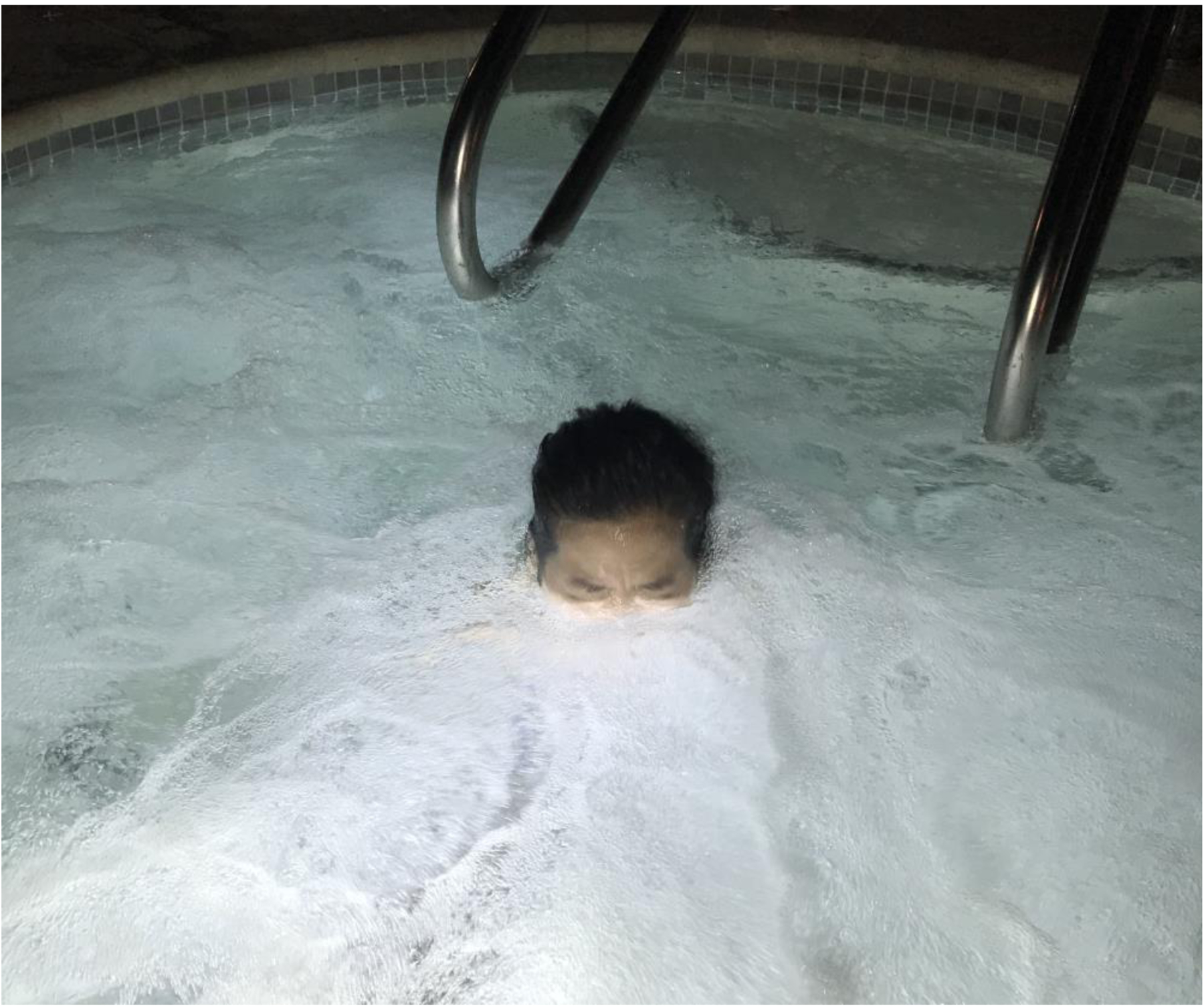
In this double-blind randomized clinical trial, healthy volunteers aged ≥ 18 years were recruited. Participants were randomized to head submersion versus no head submersion during a 15-minute hot tub soak. Study personnel, masked to the dunk or no-dunk group assignment, obtained conjunctival cultures before and immediately after hot tub use. De-identified specimens were submitted to the clinical microbiology laboratory for culture and analysis. The main outcome measure was the difference in the quantity of organisms cultured from the conjunctiva before and after hot tub exposure, as determined using a defined ordinal scale. A two-tailed Student's t-test was performed to compare the total microbial colony counts between the two arms. Simpson's diversity was used to measure the changes in organism diversity between the arms.
Of 36 enrolled subjects, 19 were randomly assigned to the dunk and 17 were assigned to the no-dunk groups. Water samples obtained from all hot tubs were culture negative. Eleven of 19 eyes (58%) from the dunk group and eight of 17 eyes (47%) from the no-dunk group had negative conjunctival bacterial cultures before and after hot tub exposure. However, six of 19 eyes (32%) and four of 17 eyes (24%) of the dunk and no-dunk groups, respectively, were culture-positive after, but not before hot tub exposure. The quantity of organisms before and after hot tub exposure was not significantly different between the two arms ( = 0.12). However, the dunk group only showed a small increase in the quantity of organisms after as compared to before hot tub use ( = 0.03). None of the samples from subjects or hot tubs were culture-positive for .
Head submersion in a public hot tubs during a 15-minute soak does not appear to change conjunctival flora, as determined by culture plate yield, this does not eliminate the association between hot tub use and devastating and painful corneal blindness. Therefore, our recommendation is to remove contact lenses prior to hot tub use, avoid head submersion in a hot tub, and urgently seek ophthalmological help if any eye pain and/or decrease in vision is experienced after hot tub use.
确定在使用热水浴缸时,头部浸入(“浸泡”)的人与不头部浸入(“不浸泡”)的人结膜微生物菌群数量是否存在差异。
在这项双盲随机临床试验中,招募了年龄≥18岁的健康志愿者。参与者在15分钟的热水浴缸浸泡过程中被随机分为头部浸入组和不头部浸入组。对浸泡或不浸泡组分配情况不知情的研究人员在使用热水浴缸之前和之后立即获取结膜培养物。经过去识别处理的标本被提交至临床微生物学实验室进行培养和分析。主要结局指标是使用定义的有序量表确定的热水浴缸暴露前后结膜培养出的生物体数量差异。进行双尾学生t检验以比较两组之间的总微生物菌落计数。辛普森多样性用于衡量两组之间生物体多样性的变化。
在36名登记受试者中,19人被随机分配到浸泡组,17人被分配到不浸泡组。从所有热水浴缸获取的水样培养均为阴性。浸泡组19只眼中有11只(58%),不浸泡组17只眼中有8只(47%)在使用热水浴缸前后结膜细菌培养均为阴性。然而,浸泡组19只眼中有6只(32%),不浸泡组17只眼中有4只(24%)在使用热水浴缸后培养呈阳性,但使用前为阴性。两组之间热水浴缸暴露前后的生物体数量无显著差异(P = 0.12)。然而,浸泡组与使用热水浴缸前相比,使用后生物体数量仅略有增加(P = 0.03)。受试者或热水浴缸的样本均未培养出[具体病原体名称未给出]呈阳性。
通过培养平板产量确定,在公共热水浴缸中15分钟浸泡期间头部浸入似乎不会改变结膜菌群,但这并不能消除使用热水浴缸与毁灭性和疼痛性角膜失明之间的关联。因此,我们的建议是在使用热水浴缸前摘下隐形眼镜,避免在热水浴缸中头部浸入,如果在使用热水浴缸后出现任何眼痛和/或视力下降,应紧急寻求眼科帮助。