Pérez-Castro Sonia, D'Auria Giuseppe, Llambrich Maria, Fernández-Barrés Sílvia, Lopez-Espinosa Maria-Jose, Llop Sabrina, Regueiro Benito, Bustamante Mariona, Francino M Pilar, Vrijheid Martine, Maitre Léa
Microbiology Department, Complexo Hospitalario Universitario de Vigo (CHUVI), Vigo, Spain.
Microbiology and Infectology Research Group, Galicia Sur Health Research Institute (IIS Galicia Sur), SERGAS-UVIGO, Vigo, Spain.
Front Microbiol. 2024 Jan 5;14:1258988. doi: 10.3389/fmicb.2023.1258988. eCollection 2023.
Early life determinants of the development of gut microbiome composition in infants have been widely investigated; however, if early life pollutant exposures, such as tobacco or mercury, have a persistent influence on the gut microbial community, its stabilization at later childhood remains largely unknown.
In this exposome-wide study, we aimed at identifying the contribution of exposure to tobacco and mercury from the prenatal period to childhood, to individual differences in the fecal microbiome composition of 7-year-old children, considering co-exposure to a width of established lifestyle and clinical determinants.
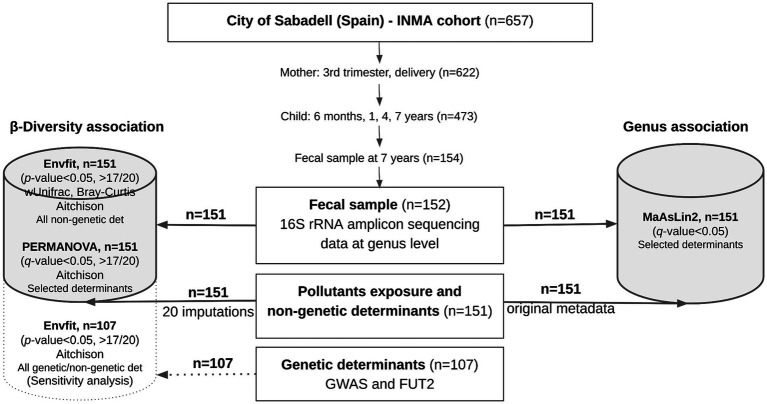
Gut microbiome was studied by 16S rRNA amplicon sequencing in 151 children at the genus level. Exposure to tobacco was quantified during pregnancy through questionnaire (active tobacco consumption, second-hand smoking -SHS) and biomonitoring (urinary cotinine) at 4 years (urinary cotinine, SHS) and 7 years (SHS). Exposure to mercury was quantified during pregnancy (cord blood) and at 4 years (hair). Forty nine other potential environmental determinants (12 at pregnancy/birth/infancy, 15 at 4 years and 22 at 7 years, such as diet, demographics, quality of living/social environment, and clinical records) were registered. We used multiple models to determine microbiome associations with pollutants including multi-determinant multivariate analysis of variance and linear correlations (wUnifrac, Bray-Curtis and Aitchison ß-diversity distances), single-pollutant permutational multivariate analysis of variance adjusting for co-variates (Aitchison), and multivariable association model with single taxa (MaAsLin2; genus). Sensitivity analysis was performed including genetic data in a subset of 107 children.
Active smoking in pregnancy was systematically associated with microbiome composition and ß-diversity ( 2-4%, < 0.05, Aitchison), independently of other co-determinants. However, in the adjusted single pollutant models (PERMANOVA), we did not find any significant association. An increased relative abundance of and decreased relative abundance of were associated with smoking during pregnancy ( < 0.05).
Our findings suggest a long-term sustainable effect of prenatal tobacco exposure on the children's gut microbiota. This effect was not found for mercury exposure or tobacco exposure during childhood. Assessing the role of these exposures on the children's microbiota, considering multiple environmental factors, should be further investigated.
婴儿肠道微生物群组成发展的早期生活决定因素已得到广泛研究;然而,早期生活中的污染物暴露,如烟草或汞,是否会对肠道微生物群落产生持续影响,以及其在儿童后期的稳定性在很大程度上仍不清楚。
在这项全暴露组研究中,我们旨在确定从孕期到儿童期接触烟草和汞对7岁儿童粪便微生物群组成个体差异的影响,同时考虑到多种既定生活方式和临床决定因素的共同暴露。
通过16S rRNA扩增子测序在属水平上对151名儿童的肠道微生物群进行研究。孕期通过问卷(主动吸烟、二手烟暴露)和生物监测(4岁时尿可替宁、7岁时尿可替宁和二手烟暴露)对烟草暴露进行量化。孕期(脐血)和4岁时(头发)对汞暴露进行量化。记录了其他49个潜在环境决定因素(孕期/出生/婴儿期12个、4岁时15个、7岁时22个,如饮食、人口统计学、生活质量/社会环境和临床记录)。我们使用多种模型来确定微生物群与污染物的关联,包括多决定因素多变量方差分析和线性相关性(加权UniFrac、Bray-Curtis和Aitchisonβ多样性距离)、针对协变量进行调整的单污染物置换多变量方差分析(Aitchison)以及单分类群多变量关联模型(MaAsLin2;属)。在107名儿童的子集中进行了包括基因数据的敏感性分析。
孕期主动吸烟与微生物群组成和β多样性系统性相关(2 - 4%,P < 0.05,Aitchison),独立于其他共同决定因素。然而,在调整后的单污染物模型(PERMANOVA)中,我们未发现任何显著关联。孕期吸烟与[具体菌属1]相对丰度增加和[具体菌属2]相对丰度降低相关(P < 0.05)。
我们的研究结果表明,产前烟草暴露对儿童肠道微生物群有长期可持续影响。儿童期汞暴露或烟草暴露未发现这种影响。考虑多种环境因素评估这些暴露对儿童微生物群的作用,应进一步研究。