
急性咖啡因摄入对进食状态下运动时脂肪氧化率的影响:系统评价和荟萃分析。
Effect of Acute Caffeine Intake on Fat Oxidation Rate during Fed-State Exercise: A Systematic Review and Meta-Analysis.
机构信息
Sport Sciences Research Centre, Rey Juan Carlos University, 28943 Madrid, Spain.
GO fitLAB, Ingesport, 28003 Madrid, Spain.
出版信息
Nutrients. 2024 Jan 8;16(2):207. doi: 10.3390/nu16020207.
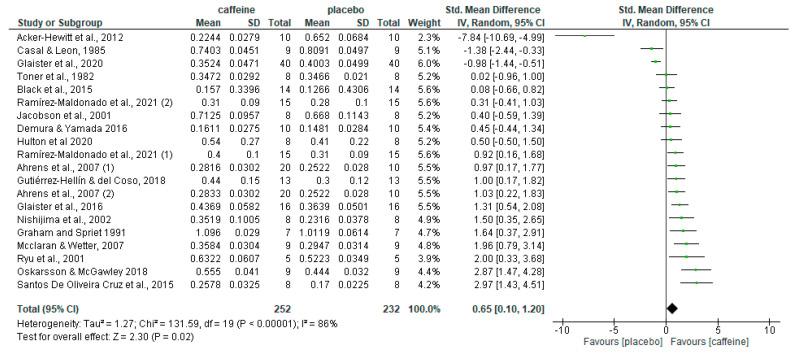
Pre-exercise intake of caffeine (from ~3 to 9 mg/kg) has been demonstrated as an effective supplementation strategy to increase fat oxidation during fasted exercise. However, a pre-exercise meal can alter the potential effect of caffeine on fat oxidation during exercise as caffeine modifies postprandial glycaemic and insulinemic responses. Hypothetically, the effect of caffeine on fat oxidation may be reduced or even withdrawn during fed-state exercise. The present systematic review aimed to meta-analyse investigations on the effect of acute caffeine intake on the rate of fat oxidation during submaximal aerobic exercise performed in the fed state (last meal < 5 h before exercise). A total of 18 crossover trials with randomised and placebo-controlled protocols and published between 1982 and 2021 were included, with a total of 228 participants (185 males and 43 females). Data were extracted to compare rates of fat oxidation during exercise with placebo and caffeine at the same exercise intensity, which reported 20 placebo-caffeine pairwise comparisons. A meta-analysis of the studies was performed, using the standardised mean difference (SMD) estimated from Hedges' , with 95% confidence intervals (CI). In comparison with the placebo, caffeine increased the rate of fat oxidation during fed-state exercise (number of comparisons (n) = 20; = 0.020, SMD = 0.65, 95% CI = 0.20 to 1.20). Only studies with a dose < 6 mg/kg of caffeine (n = 13) increased the rate of fat oxidation during fed-state exercise ( = 0.004, SMD = 0.86, 95% CI = 0.27 to 1.45), while no such effect was observed in studies with doses ≥6 mg/kg (n = 7; = 0.97, SMD = -0.03, 95% CI = -1.40 to 1.35). The effect of caffeine on fat oxidation during fed-state exercise was observed in active untrained individuals (n = 13; < 0.001, SMD = 0.84, 95% CI = 0.39 to 1.30) but not in aerobically trained participants (n = 7; = 0.27, SMD = 0.50, 95% CI = -0.39 to 1.39). Likewise, the effect of caffeine on fat oxidation was observed in caffeine-naïve participants (n = 9; < 0.001, SMD = 0.82, 95% CI = 0.45 to 1.19) but not in caffeine consumers (n = 3; = 0.54, SMD = 0.57, 95% CI = -1.23 to 2.37). In conclusion, acute caffeine intake in combination with a meal ingested within 5 h before the onset of exercise increased the rate of fat oxidation during submaximal aerobic exercise. The magnitude of the effect of caffeine on fat oxidation during fed-state exercise may be modulated by the dose of caffeine administered (higher with <6 mg/kg than with ≥6 mg/kg), participants' aerobic fitness level (higher in active than in aerobically trained individuals), and habituation to caffeine (higher in caffeine-naïve than in caffeine consumers).
在禁食运动期间,运动前摄入咖啡因(约 3 至 9 毫克/公斤)已被证明是增加脂肪氧化的有效补充策略。然而,运动前的一餐可以改变咖啡因对运动期间脂肪氧化的潜在影响,因为咖啡因会改变餐后血糖和胰岛素反应。从理论上讲,在进食状态下运动时,咖啡因对脂肪氧化的影响可能会降低甚至消失。本系统评价旨在荟萃分析急性咖啡因摄入对在进食状态下进行的亚最大有氧运动期间脂肪氧化率的影响(最后一餐在运动前 <5 小时)。共纳入了 18 项交叉试验,采用随机和安慰剂对照方案,发表于 1982 年至 2021 年之间,共有 228 名参与者(185 名男性和 43 名女性)。提取数据以比较运动强度相同的运动时安慰剂和咖啡因的脂肪氧化率,报告了 20 个安慰剂-咖啡因配对比较。使用 Hedges' 估计的标准化均数差(SMD)对研究进行荟萃分析,并使用 95%置信区间(CI)。与安慰剂相比,咖啡因增加了进食状态下运动时的脂肪氧化率(比较次数(n)=20; =0.020,SMD=0.65,95%CI=0.20 至 1.20)。只有剂量 <6mg/kg 咖啡因的研究(n=13)增加了进食状态下运动时的脂肪氧化率( =0.004,SMD=0.86,95%CI=0.27 至 1.45),而剂量≥6mg/kg 咖啡因的研究则没有观察到这种效果(n=7; =0.97,SMD=-0.03,95%CI=-1.40 至 1.35)。咖啡因对进食状态下运动时脂肪氧化的影响在活跃的未训练个体中观察到(n=13; <0.001,SMD=0.84,95%CI=0.39 至 1.30),但在有氧训练参与者中未观察到(n=7; =0.27,SMD=0.50,95%CI=-0.39 至 1.39)。同样,咖啡因对脂肪氧化的影响在咖啡因未使用者(n=9; <0.001,SMD=0.82,95%CI=0.45 至 1.19)中观察到,但在咖啡因使用者(n=3; =0.54,SMD=0.57,95%CI=-1.23 至 2.37)中未观察到。总之,在运动前 5 小时内摄入的急性咖啡因与摄入的一餐相结合,增加了亚最大有氧运动期间的脂肪氧化率。咖啡因对进食状态下运动时脂肪氧化的影响的幅度可能受到咖啡因给药剂量的调节(<6mg/kg 时比 ≥6mg/kg 时更高)、参与者的有氧健身水平(活跃者比有氧训练者更高)和对咖啡因的适应(咖啡因新手比咖啡因使用者更高)。




 Zotero 插件