Guan Minhui, Deliberto Thomas J, Feng Aijing, Zhang Jieze, Li Tao, Wang Shuaishuai, Li Lei, Killian Mary Lea, Praena Beatriz, Giri Emily, Deliberto Shelagh T, Hang Jun, Olivier Alicia, Torchetti Mia Kim, Tao Yizhi Jane, Parrish Colin, Wan Xiu-Feng
Center for Influenza and Emerging Infectious Diseases (CIEID), University of Missouri, Columbia, MO, USA.
Department of Molecular Microbiology and Immunology, School of Medicine, University of Missouri, Columbia, MO 65212.
bioRxiv. 2024 Jan 3:2024.01.02.573990. doi: 10.1101/2024.01.02.573990.
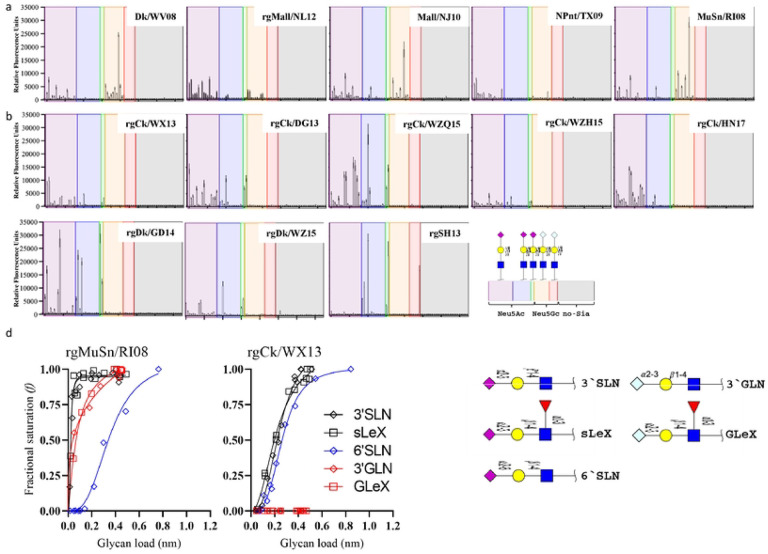
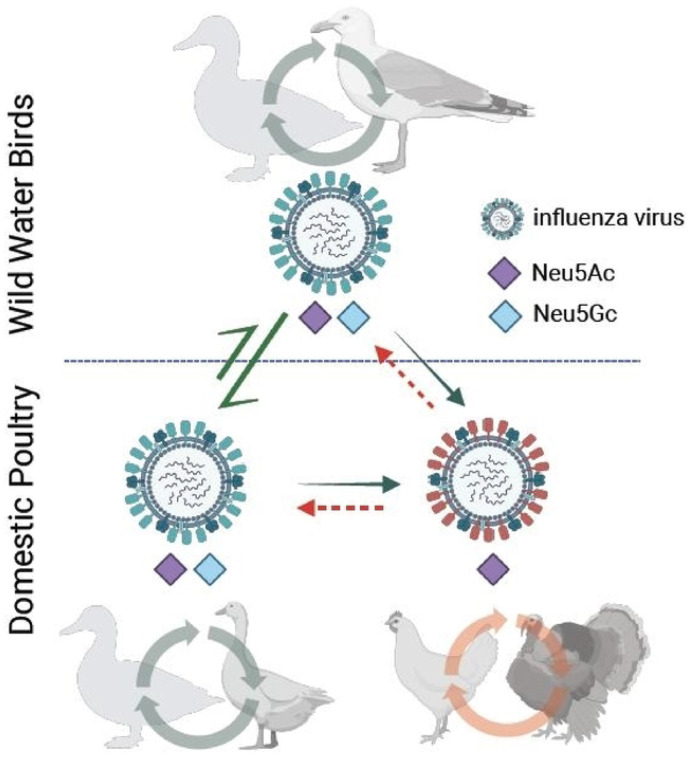
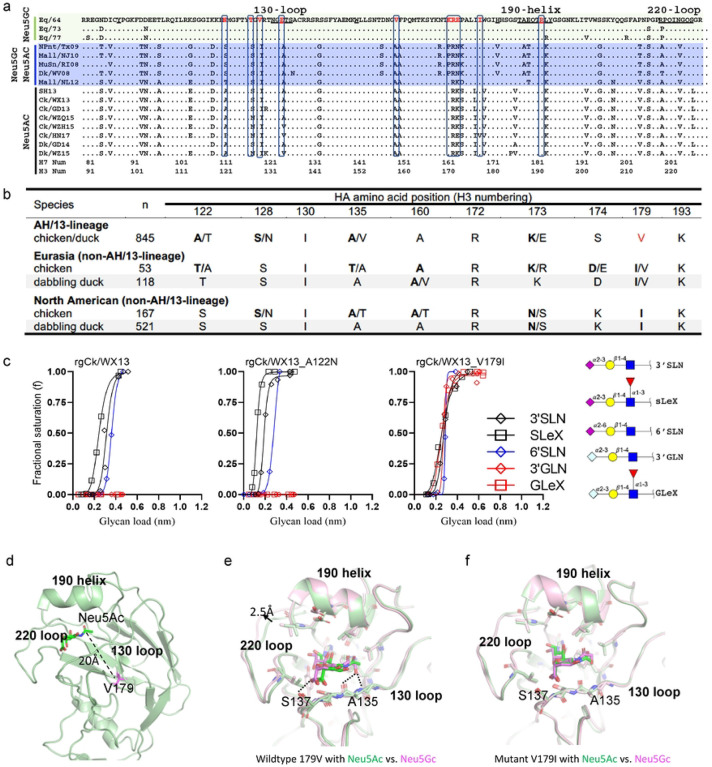
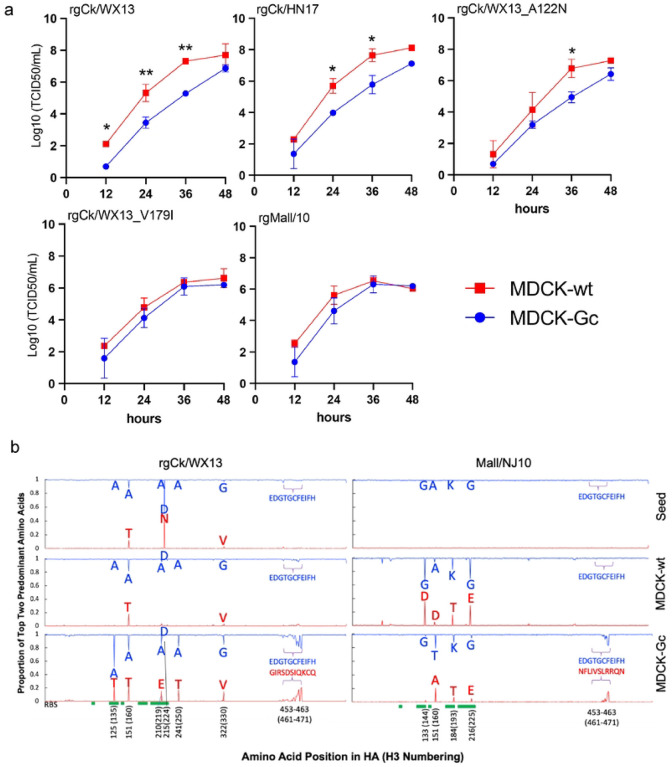
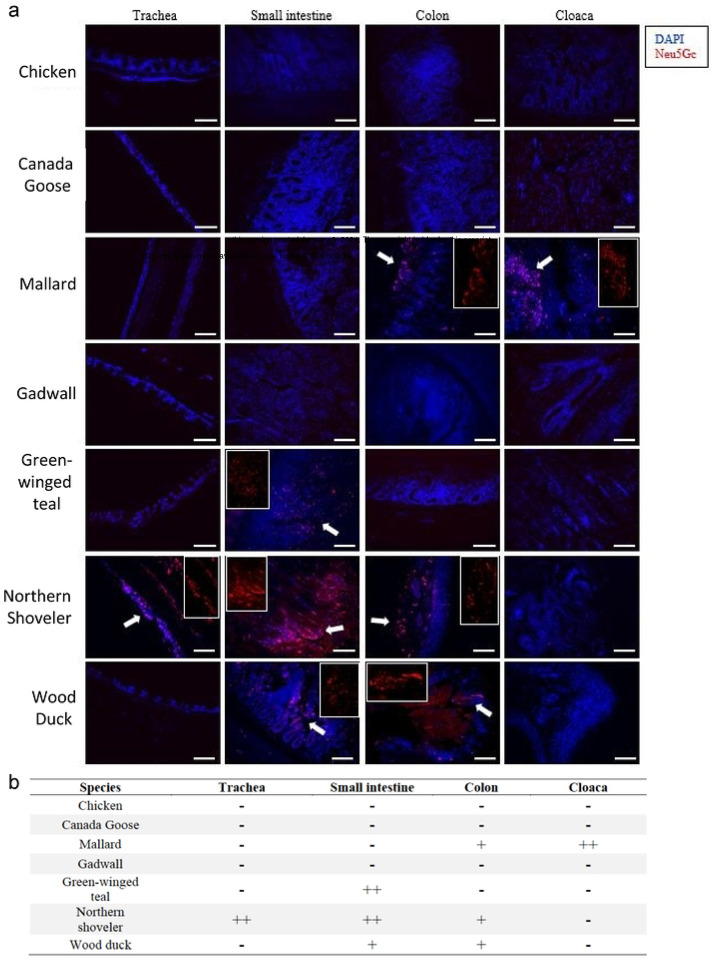
Migratory waterfowl, gulls, and shorebirds serve as natural reservoirs for influenza A viruses, with potential spillovers to domestic poultry and humans. The intricacies of interspecies adaptation among avian species, particularly from wild birds to domestic poultry, are not fully elucidated. In this study, we investigated the molecular mechanisms underlying avian species barriers in H7 transmission, particularly the factors responsible for the disproportionate distribution of poultry infected with A/Anhui/1/2013 (AH/13)-lineage H7N9 viruses. We hypothesized that the differential expression of N-glycolylneuraminic acid (Neu5Gc) among avian species exerts selective pressure on H7 viruses, shaping their evolution and enabling them to replicate and transmit efficiently among gallinaceous poultry, particularly chickens. Our glycan microarray and biolayer interferometry experiments showed that AH/13-lineage H7N9 viruses exclusively bind to Neu5Ac, in contrast to wild waterbird H7 viruses that bind both Neu5Ac and Neu5Gc. Significantly, reverting the V179 amino acid in AH/13-lineage back to the I179, predominantly found in wild waterbirds, expanded the binding affinity of AH/13-lineage H7 viruses from exclusively Neu5Ac to both Neu5Ac and Neu5Gc. When cultivating H7 viruses in cell lines with varied Neu5Gc levels, we observed that Neu5Gc expression impairs the replication of Neu5Ac-specific H7 viruses and facilitates adaptive mutations. Conversely, Neu5Gc deficiency triggers adaptive changes in H7 viruses capable of binding to both Neu5Ac and Neu5Gc. Additionally, we assessed Neu5Gc expression in the respiratory and gastrointestinal tissues of seven avian species, including chickens, Canada geese, and various dabbling ducks. Neu5Gc was absent in chicken and Canada goose, but its expression varied in the duck species. In summary, our findings reveal the crucial role of Neu5Gc in shaping the host range and interspecies transmission of H7 viruses. This understanding of virus-host interactions is crucial for developing strategies to manage and prevent influenza virus outbreaks in diverse avian populations.
迁徙水鸟、海鸥和滨鸟是甲型流感病毒的天然宿主,有可能将病毒传播到家禽和人类身上。鸟类物种间适应的复杂性,尤其是从野生鸟类到家禽的适应过程,尚未完全阐明。在本研究中,我们调查了H7病毒传播过程中鸟类物种屏障的分子机制,特别是导致感染A/安徽/1/2013(AH/13)谱系H7N9病毒的家禽分布不均的因素。我们假设鸟类物种间N-羟乙酰神经氨酸(Neu5Gc)的差异表达对H7病毒施加了选择性压力,塑造了它们的进化,并使它们能够在鸡形目家禽(特别是鸡)中高效复制和传播。我们的聚糖微阵列和生物层干涉实验表明,与既结合Neu5Ac又结合Neu5Gc的野生水鸟H7病毒不同,AH/13谱系H7N9病毒只与Neu5Ac结合。值得注意的是,将AH/13谱系中的第179位氨基酸缬氨酸(V)变回野生水鸟中常见的异亮氨酸(I),扩大了AH/13谱系H7病毒的结合亲和力,使其从只与Neu5Ac结合变为既与Neu5Ac又与Neu5Gc结合。当在具有不同Neu5Gc水平的细胞系中培养H7病毒时,我们观察到Neu5Gc的表达会损害Neu5Ac特异性H7病毒的复制,并促进适应性突变。相反,Neu5Gc缺乏会引发能够同时结合Neu5Ac和Neu5Gc的H7病毒的适应性变化。此外,我们评估了包括鸡、加拿大鹅和各种涉禽在内的七种鸟类的呼吸道和胃肠道组织中Neu5Gc的表达。鸡和加拿大鹅中不存在Neu5Gc,但其在鸭类中的表达有所不同。总之,我们的研究结果揭示了Neu5Gc在塑造H7病毒宿主范围和种间传播中的关键作用。这种对病毒-宿主相互作用的理解对于制定管理和预防不同鸟类群体中流感病毒爆发的策略至关重要。