
监狱人群中慢性非传染性疾病的检测、监测和管理干预措施:一项国际系统评价。
Interventions for the detection, monitoring, and management of chronic non-communicable diseases in the prison population: an international systematic review.
机构信息
Health and Justice Research Network, University of Manchester, Manchester, UK.
Greater Manchester Mental Health NHS Foundation Trust, Manchester, UK.
出版信息
BMC Public Health. 2024 Jan 24;24(1):292. doi: 10.1186/s12889-024-17715-7.
BACKGROUND
High rates of health inequalities and chronic non-communicable diseases exist amongst the prison population. This places people in and/or released from prison at heightened risk of multimorbidity, premature mortality, and reduced quality of life. Ensuring appropriate healthcare for people in prison to improve their health outcomes is an important aspect of social justice. This review examines the global literature on healthcare interventions to detect, monitor and manage chronic non-communicable diseases amongst the prison population and people recently released from prison.
METHODS
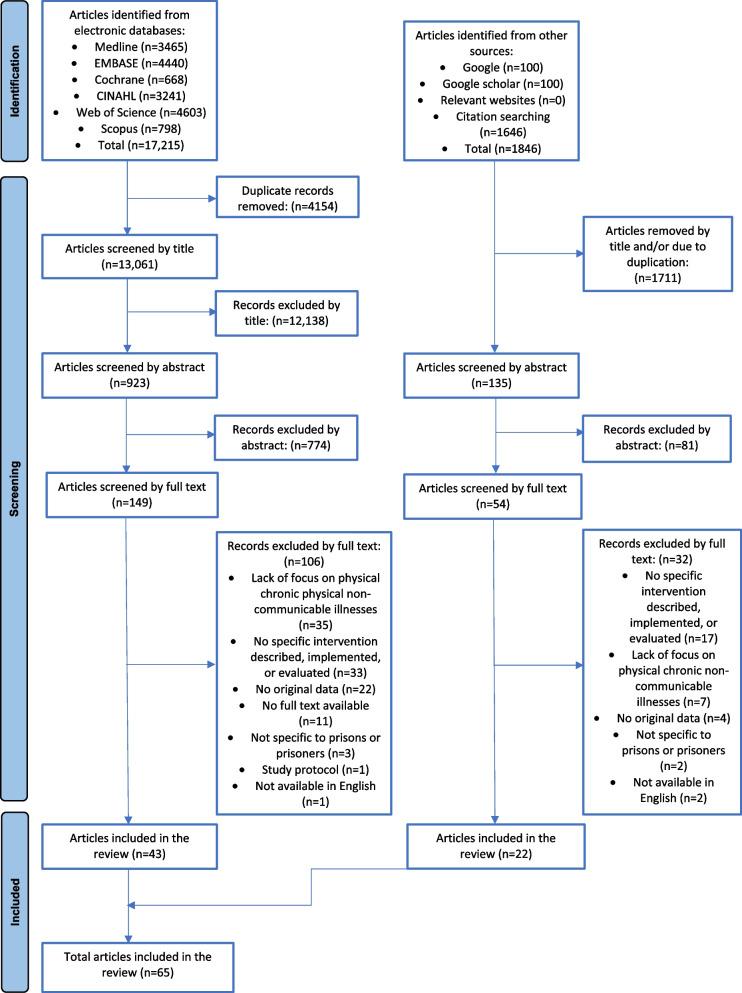
Systematic searches of EMBASE, MEDLINE, CINAHL, Web of Science, Scopus, and the Cochrane Library were conducted and supplemented by citation searching and review of the grey literature. The literature searches attempted to identify all articles describing any healthcare intervention for adults in prison, or released from prison in the past 1 year, to detect, monitor, or manage any chronic non-communicable illness. 19,061 articles were identified, of which 1058 articles were screened by abstract and 203 articles were reviewed by full text.
RESULTS
Sixty-five studies were included in the review, involving 18,311 participants from multiple countries. Most studies were quasi-experimental and/or low to moderate in quality. Numerous healthcare interventions were described in the literature including chronic disease screening, telemedicine, health education, integrated care systems, implementing specialist equipment and staff roles to manage chronic diseases in prisons, and providing enhanced primary care contact and/or support from community health workers for people recently released from prison. These interventions were associated with improvement in various measures of clinical and cost effectiveness, although comparison between different care models was not possible due to high levels of clinical heterogeneity.
CONCLUSIONS
It is currently unclear which interventions are most effective at monitoring and managing chronic non-communicable diseases in prison. More research is needed to determine the most effective interventions for improving chronic disease management in prisons and how these should be implemented to ensure optimal success. Future research should examine interventions for addressing multimorbidity within prisons, since most studies tested interventions for a singular non-communicable disease.
背景
监狱人口中存在着较高的健康不平等和慢性非传染性疾病。这使得在押人员和/或刚出狱的人员面临多种疾病、过早死亡和生活质量下降的风险增加。为改善在押人员的健康状况,为其提供适当的医疗保健是社会公正的一个重要方面。本综述考察了全球监狱人口和最近刚出狱人员的慢性非传染性疾病检测、监测和管理的医疗干预措施文献。
方法
系统检索了 EMBASE、MEDLINE、CINAHL、Web of Science、Scopus 和 Cochrane 图书馆,并通过引文搜索和灰色文献综述进行了补充。文献检索旨在确定所有描述监狱内成年囚犯或过去 1 年内刚出狱的人接受任何医疗干预措施以检测、监测或管理任何慢性非传染性疾病的文章。共确定了 19061 篇文章,其中 1058 篇文章通过摘要进行了筛选,203 篇文章通过全文进行了审查。
结果
该综述共纳入了 65 项研究,涉及来自多个国家的 18311 名参与者。大多数研究为准实验研究和/或质量为低到中等。文献中描述了许多医疗干预措施,包括慢性病筛查、远程医疗、健康教育、综合护理系统、在监狱中实施管理慢性病的专业设备和人员角色,以及为刚出狱的人提供更多的初级保健接触和/或社区卫生工作者的支持。这些干预措施与各种临床和成本效益指标的改善相关,但由于临床异质性水平较高,无法对不同护理模式进行比较。
结论
目前尚不清楚哪些干预措施在监狱中监测和管理慢性非传染性疾病最有效。需要进一步研究以确定改善监狱内慢性病管理的最有效干预措施,以及如何实施这些措施以确保最佳效果。未来的研究应考察监狱内解决多种疾病的干预措施,因为大多数研究测试的干预措施都是针对单一的非传染性疾病。
 Zotero 插件