
高通量功能分析眼压相关基因揭示了青光眼的不同网络。
High throughput functional profiling of genes at intraocular pressure loci reveals distinct networks for glaucoma.
机构信息
Menzies Institute for Medical Research, University of Tasmania, 17 Liverpool Street, Hobart, Tasmania 7000, Australia.
Centre for Eye Research Australia, University of Melbourne, Royal Victorian Eye and Ear Hospital, 32 Gisborne St, East Melbourne 3002, Australia.
出版信息
Hum Mol Genet. 2024 Apr 18;33(9):739-751. doi: 10.1093/hmg/ddae003.
INTRODUCTION
Primary open angle glaucoma (POAG) is a leading cause of blindness globally. Characterized by progressive retinal ganglion cell degeneration, the precise pathogenesis remains unknown. Genome-wide association studies (GWAS) have uncovered many genetic variants associated with elevated intraocular pressure (IOP), one of the key risk factors for POAG. We aimed to identify genetic and morphological variation that can be attributed to trabecular meshwork cell (TMC) dysfunction and raised IOP in POAG.
METHODS
62 genes across 55 loci were knocked-out in a primary human TMC line. Each knockout group, including five non-targeting control groups, underwent single-cell RNA-sequencing (scRNA-seq) for differentially-expressed gene (DEG) analysis. Multiplexed fluorescence coupled with CellProfiler image analysis allowed for single-cell morphological profiling.
RESULTS
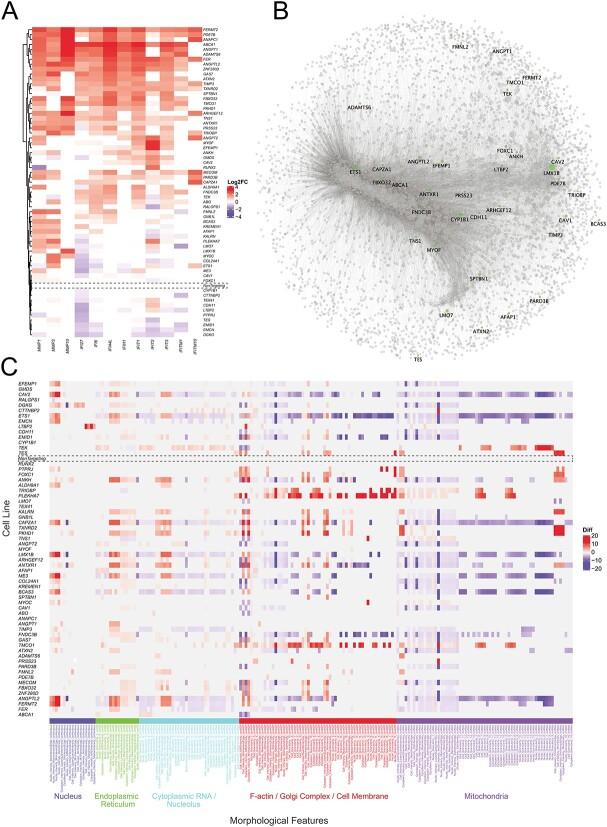
Many gene knockouts invoked DEGs relating to matrix metalloproteinases and interferon-induced proteins. We have prioritized genes at four loci of interest to identify gene knockouts that may contribute to the pathogenesis of POAG, including ANGPTL2, LMX1B, CAV1, and KREMEN1. Three genetic networks of gene knockouts with similar transcriptomic profiles were identified, suggesting a synergistic function in trabecular meshwork cell physiology. TEK knockout caused significant upregulation of nuclear granularity on morphological analysis, while knockout of TRIOBP, TMCO1 and PLEKHA7 increased granularity and intensity of actin and the cell-membrane.
CONCLUSION
High-throughput analysis of cellular structure and function through multiplex fluorescent single-cell analysis and scRNA-seq assays enabled the direct study of genetic perturbations at the single-cell resolution. This work provides a framework for investigating the role of genes in the pathogenesis of glaucoma and heterogenous diseases with a strong genetic basis.
简介
原发性开角型青光眼(POAG)是全球致盲的主要原因。其特征为视网膜神经节细胞进行性退化,确切的发病机制尚不清楚。全基因组关联研究(GWAS)已经发现了许多与眼内压升高相关的遗传变异,眼内压升高是 POAG 的一个关键危险因素。我们旨在确定与小梁网细胞(TMC)功能障碍和 POAG 中升高的眼压相关的遗传和形态学变异。
方法
在原代人 TMC 系中敲除了 62 个基因中的 55 个基因座。每个敲除组,包括五个非靶向对照组,都进行了单细胞 RNA 测序(scRNA-seq)以进行差异表达基因(DEG)分析。多重荧光与 CellProfiler 图像分析相结合,实现了单细胞形态分析。
结果
许多基因敲除导致了与基质金属蛋白酶和干扰素诱导蛋白相关的 DEG。我们已经确定了四个感兴趣的基因座中的基因,以确定可能导致 POAG 发病机制的基因敲除,包括 ANGPTL2、LMX1B、CAV1 和 KREMEN1。鉴定出了三个具有相似转录组谱的基因敲除遗传网络,表明在小梁网细胞生理学中具有协同作用。TEK 敲除导致形态分析中核粒度显著上调,而 TRIOBP、TMCO1 和 PLEKHA7 的敲除增加了肌动蛋白和细胞膜的粒度和强度。
结论
通过多重荧光单细胞分析和 scRNA-seq 检测对细胞结构和功能进行高通量分析,使我们能够直接在单细胞分辨率下研究遗传扰动的作用。这项工作为研究基因在青光眼和具有强烈遗传基础的异质性疾病发病机制中的作用提供了一个框架。


 Zotero 插件