Panchal Viraj S, Patel Yatri S, Dalal Yagnya D, Parikh Amrita P, Dalal Archana D, Rana Devang A
Department of Medicine, Smt. N.H.L. Municipal Medical College, Ahmedabad, Gujarat, India.
Department of Medicine, G.C.S. Medical College, Ahmedabad, Gujarat, India.
Indian Dermatol Online J. 2023 Dec 1;15(1):55-63. doi: 10.4103/idoj.idoj_495_22. eCollection 2024 Jan-Feb.
Tranexamic acid (TXA) has recently shown promising results in the treatment of melasma. The objective of this study was to generate statistical evidence on the efficacy of TXA with different routes.
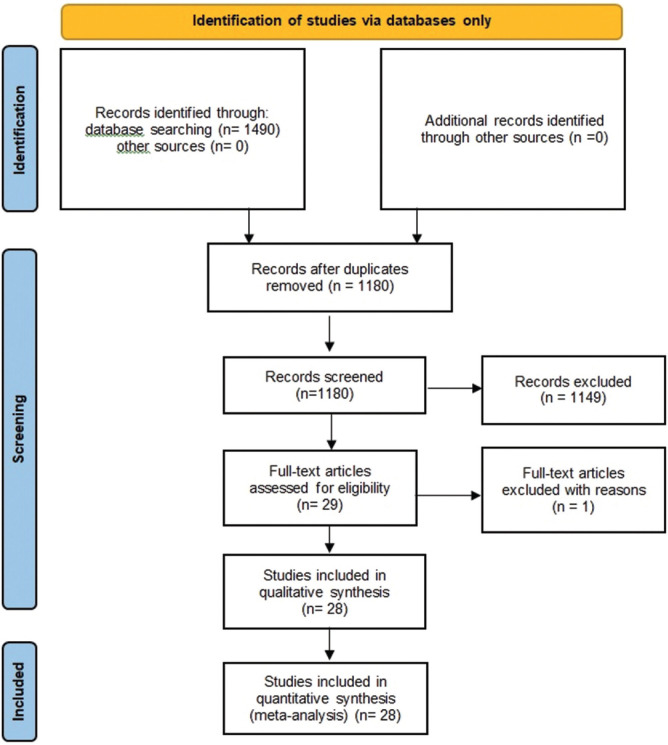
We searched studies in PubMed, Cochrane, ClinicalTrials.gov, and Scopus using the Preferred Reporting Items for Systematic Reviews and Meta-Analyses 2020 guidelines. A change in melasma area and severity index (MASI)/modified MASI score from the baseline at the end of 8 and 12 weeks was seen. Inverse variance method was used for continuous data to measure standard mean difference (SMD) at a 95% confidence interval (CI). RevMan version 5.4 was used for analysis, and statistical heterogeneity across studies was reported using I statistics. < 0.05 was considered significant.
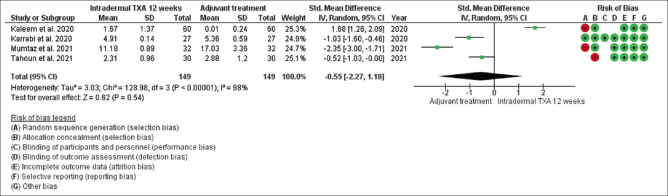
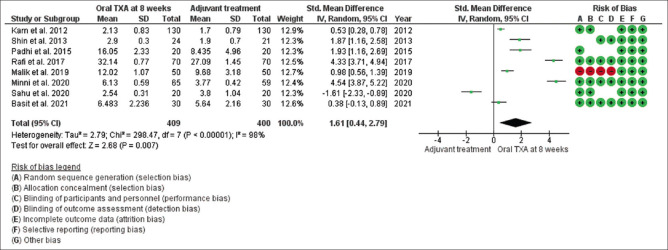
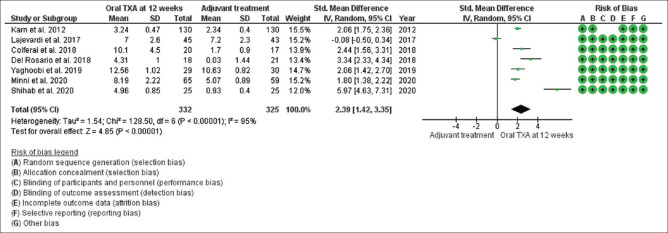
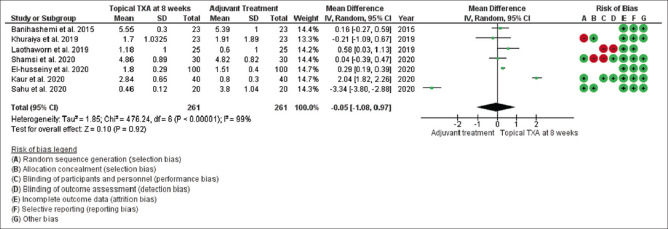
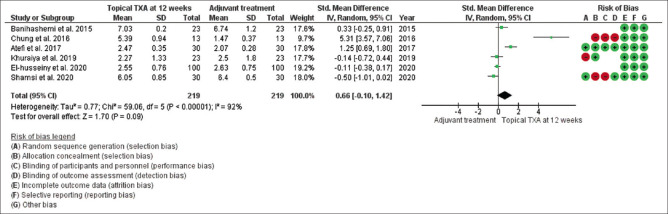
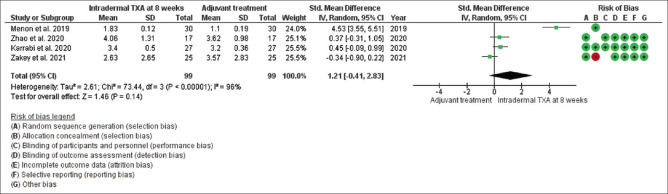
Totally, 28 randomized control trials were included. At 8 weeks, oral TXA showed a significant change in SMD of 1.61, 95% CI 0.44-2.79, = 0.007; at 12 weeks, oral TXA showed SMD of 2.39, 95% CI 1.42-3.35, < 0.00001 compared to adjuvant treatment. At 8 weeks, topical TXA did not show a significant change with SMD of -0.05, 95% CI -1.08-0.97, = 0.92; at 12 weeks, topical TXA did not show a significant change with SMD of 0.66, 95% CI -0.10-1.42, = 0.09 compared to adjuvant treatment. Similarly, for intradermal TXA at 8 weeks, results were not significant with SMD of 1.21, 95% CI -0.41-2.83, = 0.14, and at 12 weeks, SMD was -0.55, 95% CI -2.27-1.18, = 0.54 compared to adjuvant treatment.
Tranexamic acid in an oral formulation can be used along with adjuvant treatment for the management of melasma. Data are still required for topical and intradermal routes. Owing to the fact that our included studies had a lot of heterogeneity, more research is needed along with addressing the adverse effects of tranexamic acid as well as its variation in different skin colors.
氨甲环酸(TXA)最近在黄褐斑治疗中显示出了有前景的效果。本研究的目的是生成关于不同给药途径的氨甲环酸疗效的统计学证据。
我们按照系统评价和Meta分析的首选报告项目2020指南,在PubMed、Cochrane、ClinicalTrials.gov和Scopus中检索研究。观察了8周和12周结束时黄褐斑面积和严重程度指数(MASI)/改良MASI评分相对于基线的变化。对于连续数据,采用逆方差法在95%置信区间(CI)下测量标准均数差(SMD)。使用RevMan 5.4版本进行分析,并使用I统计量报告各研究间的统计异质性。P<0.05被认为具有统计学意义。
总共纳入了28项随机对照试验。在8周时,口服氨甲环酸的SMD有显著变化,为1.61,95%CI为0.44 - 2.79,P = 0.007;在12周时,与辅助治疗相比,口服氨甲环酸的SMD为2.39,95%CI为1.42 - 3.35,P<0.00001。在8周时,外用氨甲环酸的SMD为 - 0.05,95%CI为 - 1.08 - 0.97,P = 0.92,未显示出显著变化;在12周时,与辅助治疗相比,外用氨甲环酸的SMD为0.66,95%CI为 - 0.10 - 1.42,P = 0.09,未显示出显著变化。同样,对于皮内注射氨甲环酸,在8周时,SMD为1.21,95%CI为 - 0.41 - 2.83,P = 0.14,结果不显著;在12周时,与辅助治疗相比,SMD为 - 0.55,95%CI为 - 2.27 - 1.18,P = 0.54。
口服氨甲环酸可与辅助治疗一起用于黄褐斑的管理。外用和皮内途径的数据仍需进一步研究。由于我们纳入的研究存在很多异质性,因此需要更多的研究,同时解决氨甲环酸的不良反应及其在不同肤色中的差异问题。