Schulte Christina, Sextl-Plötz Theresa, Baumeister Harald, Titzler Ingrid, Sander Lasse B, Sachser Cedric, Steubl Lena, Zarski Anna-Carlotta
Technical University of Munich, Department of Sports and Health Sciences, Professorship Psychology and Digital Mental Health Care, Georg-Brauchle-Ring 60, 80992 Munich, Germany.
Ulm University, Department of Clinical Psychology and Psychotherapy, Lise-Meitner-Str. 16, 89081 Ulm, Germany.
Internet Interv. 2024 Jan 24;35:100710. doi: 10.1016/j.invent.2024.100710. eCollection 2024 Mar.
Despite severely burdened individuals, often being excluded from research studies on internet- and mobile-based interventions (IMIs), negative events (NEs) including suicidal thoughts and behaviors (STBs) can still occur during a trial. NEs require monitoring and adequate safety measures. However, study protocols frequently lack comprehensive descriptions of procedures for managing NEs.
This study aimed to illustrate the assessment, monitoring, and procedures for addressing NEs in two studies on IMIs in adults and youth using case reports, to identify strengths and weaknesses of the NE management approaches, and to derive key learnings and recommendations.
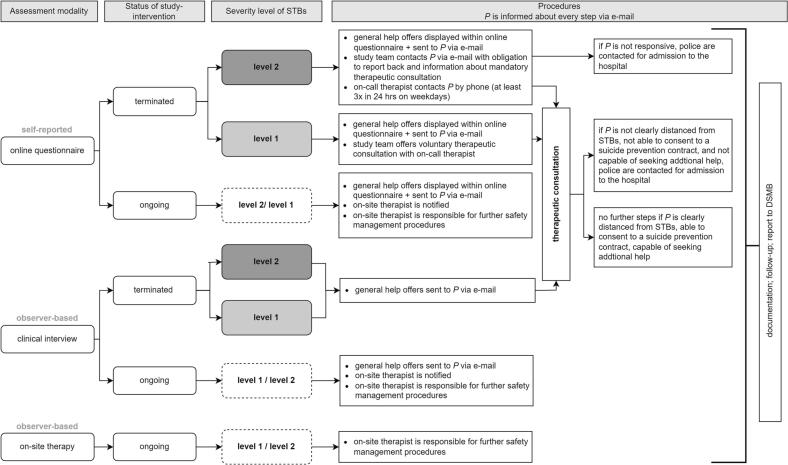
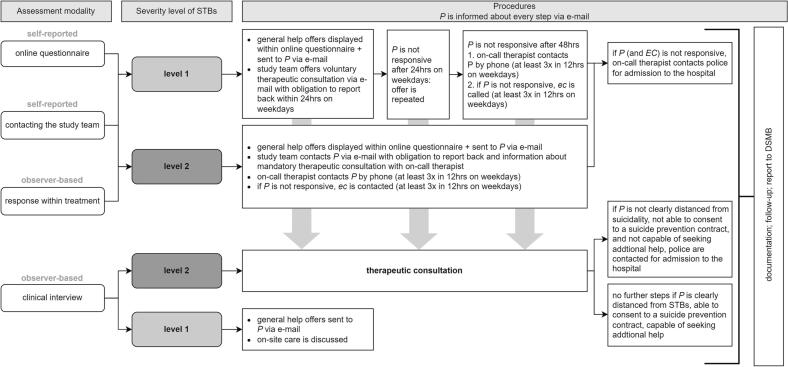
Two case reports were drawn from two distinct IMI studies. The first study, PSYCHOnlineTHERAPY, evaluates the combination of an IMI with on-site psychotherapy for anxiety and depressive disorders in adults (adult blended study). The second study evaluates a standalone, therapist-guided IMI for post-traumatic stress disorder (PTSD) in youth (youth standalone study). Potential NEs were predefined depending on the study sample. The case studies thoroughly document the systematic recording and ongoing monitoring of NEs through self-report and observer-based assessments during the interventions. The cases illustrate a variety of NE management strategies, including automated and personalized approaches, adapted to the specific nature and severity of the NEs. The NE management approaches are visualized using decision trees.
In the adult blended case study, online questionnaires detected STBs and triggered automated support information. As on-site therapy had already ended, a telephone consultation session allowed for the identification and discussion of the heightened intensity of suicidal thoughts, along with the development of specific additional help options. In the youth standalone case study, heightened tension in an adolescent with PTSD during trauma processing could be addressed in a telephone therapeutic session focusing on resource activation and emotion regulation. The referral to on-site treatment was supported. Overall, advantages of the NE management included automated procedures, multimodal assessment of a wide range of NEs, and standardized procedures tailored to different severity levels. Weaknesses included the use of single-item assessments for STBs and lack of procedures in case of deterioration or nonresponse to treatment.
This study provides practical insights and derives key learnings and recommendations regarding the management of NEs in different IMI contexts for both adults and youth.
尽管负担沉重的个体常常被排除在基于互联网和移动设备的干预措施(IMIs)研究之外,但在试验过程中仍可能发生包括自杀念头和行为(STBs)在内的不良事件(NEs)。不良事件需要监测及适当的安全措施。然而,研究方案常常缺乏对不良事件管理程序的全面描述。
本研究旨在通过病例报告阐述两项针对成人和青少年的IMIs研究中不良事件的评估、监测及处理程序,识别不良事件管理方法的优缺点,并得出关键经验教训和建议。
两项病例报告取自两项不同的IMIs研究。第一项研究“PSYCHOnlineTHERAPY”评估IMI与现场心理治疗相结合对成人焦虑和抑郁障碍的治疗效果(成人混合研究)。第二项研究评估针对青少年创伤后应激障碍(PTSD)的独立的、有治疗师指导的IMI(青少年独立研究)。根据研究样本预先确定潜在的不良事件。这些案例研究详细记录了在干预期间通过自我报告和基于观察者的评估对不良事件进行系统记录和持续监测的情况。这些案例展示了多种不良事件管理策略,包括根据不良事件的具体性质和严重程度采用的自动化和个性化方法。不良事件管理方法通过决策树进行可视化展示。
在成人混合病例研究中,在线问卷检测到自杀念头和行为,并触发了自动支持信息。由于现场治疗已经结束,一次电话咨询会议得以对自杀念头强度的增加进行识别和讨论,并制定了具体的额外帮助方案。在青少年独立病例研究中,一名患有PTSD的青少年在创伤处理过程中紧张情绪加剧,这一情况在一次专注于资源激活和情绪调节的电话治疗会议中得到解决。现场治疗的转诊得到了支持。总体而言,不良事件管理的优点包括自动化程序、对多种不良事件的多模式评估以及针对不同严重程度水平量身定制的标准化程序。缺点包括对自杀念头和行为采用单项评估,以及在病情恶化或治疗无反应的情况下缺乏程序。
本研究提供了实用见解,并得出了关于在不同IMI背景下管理成人和青少年不良事件的关键经验教训和建议。