Department of Clinical Science, Intervention and Technology (CLINTEC), Karolinska Institutet, Stockholm, Sweden.
Department of Reconstructive Orthopaedics, Karolinska University Hospital, Stockholm, Sweden.
JAMA Netw Open. 2024 Jan 2;7(1):e2352492. doi: 10.1001/jamanetworkopen.2023.52492.
Moderate-grade adolescent idiopathic scoliosis (AIS) may be treated with full-time bracing. For patients who reject full-time bracing, the effects of alternative, conservative interventions are unknown.
To determine whether self-mediated physical activity combined with either nighttime bracing (NB) or scoliosis-specific exercise (SSE) is superior to a control of physical activity alone (PA) in preventing Cobb angle progression in moderate-grade AIS.
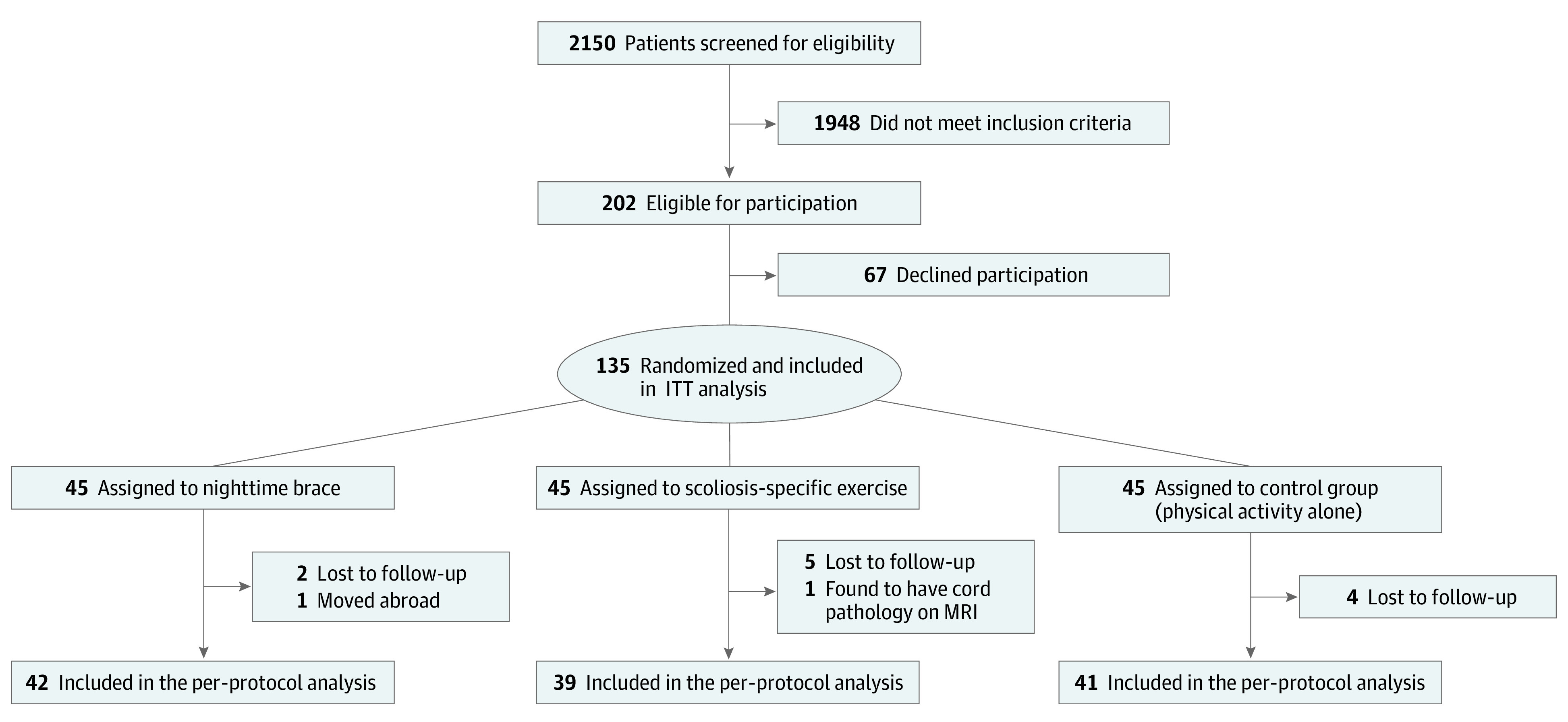
DESIGN, SETTING, AND PARTICIPANTS: The Conservative Treatment for Adolescent Idiopathic Scoliosis (CONTRAIS) randomized clinical trial was conducted from January 10, 2013, through October 23, 2018, in 6 public hospitals across Sweden. Male and female children and adolescents aged 9 to 17 years with an AIS primary curve Cobb angle of 25° to 40°, apex T7 or caudal, and skeletal immaturity based on estimated remaining growth of at least 1 year were included in the study. Dates of analysis were from October 25, 2021, to January 28, 2023.
Interventions included self-mediated physical activity in combination with either NB or SSE or PA (control). Patients with treatment failure were given the option to transition to a full-time brace until skeletal maturity.
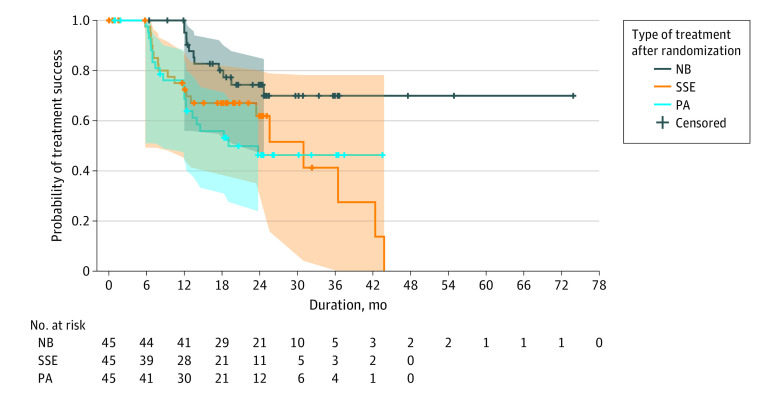
The primary outcome was curve progression of 6° or less (treatment success) or curve progression of more than 6° (treatment failure) seen on 2 consecutive posteroanterior standing radiographs compared with the inclusion radiograph before skeletal maturity. A secondary outcome of curve progression was the number of patients undergoing surgery up until 2 years after the primary outcome.
The CONTRAIS study included 135 patients (45 in each of the 3 groups) with a mean (SD) age of 12.7 (1.4) years; 111 (82%) were female. Treatment success was seen in 34 of 45 patients (76%) in the NB group and in 24 of 45 patients (53%) in the PA group (odds ratio [OR], 2.7; 95% CI, 1.1-6.6). The number needed to treat to prevent curve progression with NB was 4.5 (95% CI, 2.4-33.5). Treatment success occurred in 26 of 45 patients (58%) in the SSE group (OR for SE vs PA, 1.2; 95% CI, 0.5-2.8). Up to 2 years after the primary outcome time point, 9 patients in each of the 3 groups underwent surgery.
In this randomized clinical trial, treatment with NB prevented curve progression of more than 6° to a significantly higher extent than did PA, while SSE did not; in addition, allowing transition to full-time bracing after treatment failure resulted in similar surgical frequencies independent of initial treatment. These results suggest that NB may be an effective alternative intervention in patients rejecting full-time bracing.
ClinicalTrials.gov Identifier: NCT01761305.
对于中度青少年特发性脊柱侧凸 (AIS),可能需要全天支具治疗。对于拒绝全天支具治疗的患者,替代的保守干预措施的效果尚不清楚。
确定自我介导的体育活动与夜间支具 (NB) 或脊柱侧弯特异性运动 (SSE) 相结合,与单纯的体育活动 (PA) 控制相比,是否更能预防中度 AIS 中 Cobb 角的进展。
设计、地点和参与者:青少年特发性脊柱侧凸保守治疗 (CONTRAIS) 随机临床试验于 2013 年 1 月 10 日至 2018 年 10 月 23 日在瑞典 6 家公立医院进行。纳入研究的患者为 9 至 17 岁的男性和女性儿童和青少年,其 AIS 主曲线 Cobb 角为 25°至 40°,顶点 T7 或尾部,根据估计至少有 1 年的剩余生长,骨骼未成熟。分析日期为 2021 年 10 月 25 日至 2023 年 1 月 28 日。
干预措施包括自我介导的体育活动,与 NB 或 SSE 或 PA(对照)相结合。治疗失败的患者可以选择过渡到全天支具,直到骨骼成熟。
主要结果是与骨骼成熟前纳入的放射照片相比,连续 2 张后前位站立放射照片上看到的 6°或更小的曲线进展(治疗成功)或超过 6°的曲线进展(治疗失败)。曲线进展的次要结果是在主要结果后 2 年内进行手术的患者数量。
CONTRAIS 研究纳入了 135 名患者(每组 45 名),平均年龄(SD)为 12.7(1.4)岁;111 名(82%)为女性。NB 组 45 名患者中有 34 名(76%)治疗成功,PA 组 45 名患者中有 24 名(53%)治疗成功(比值比 [OR],2.7;95% CI,1.1-6.6)。预防 NB 曲线进展所需的治疗人数为 4.5(95% CI,2.4-33.5)。SSE 组 45 名患者中有 26 名(58%)治疗成功(SE 与 PA 的 OR,1.2;95% CI,0.5-2.8)。在主要结果时间点后 2 年内,每组各有 9 名患者接受了手术。
在这项随机临床试验中,与 PA 相比,NB 治疗显著更能预防超过 6°的曲线进展,而 SSE 则没有;此外,治疗失败后允许过渡到全天支具治疗会导致相似的手术频率,而与初始治疗无关。这些结果表明,NB 可能是拒绝全天支具治疗的患者的一种有效的替代干预措施。
ClinicalTrials.gov 标识符:NCT01761305。