
使用在线自适应放射治疗改善加速部分乳腺照射的剂量测定和计划质量:一项单机构研究。
Improved Dosimetry and Plan Quality for Accelerated Partial Breast Irradiation Using Online Adaptive Radiation Therapy: A Single Institutional Study.
作者信息
Pogue Joel A, Cardenas Carlos E, Stanley Dennis N, Stanley Courtney, Hotsinpiller Whitney, Veale Christopher, Soike Michael H, Popple Richard A, Boggs Drexell H, Harms Joseph
机构信息
Department of Radiation Oncology, University of Alabama at Birmingham, Birmingham, Alabama.
出版信息
Adv Radiat Oncol. 2023 Dec 3;9(3):101414. doi: 10.1016/j.adro.2023.101414. eCollection 2024 Mar.
PURPOSE
Accelerated partial breast irradiation (APBI) is an attractive treatment modality for eligible patients as it has been shown to result in similar local control and improved cosmetic outcomes compared with whole breast radiation therapy. The use of online adaptive radiation therapy (OART) for APBI is promising as it allows for a reduction of planning target volume margins because breast motion and lumpectomy cavity volume changes are accounted for in daily imaging. Here we present a retrospective, single-institution evaluation on the adequacy of kV-cone beam computed tomography (CBCT) OART for APBI treatments.
METHODS AND MATERIALS
Nineteen patients (21 treatment sites) were treated to 30 Gy in 5 fractions between January of 2022 and May of 2023. Time between simulation and treatment, change in gross tumor (ie, lumpectomy cavity) volume, and differences in dose volume histogram metrics with adaption were analyzed. The Wilcoxon paired, nonparametric test was used to test for dose volume histogram metric differences between the scheduled plans (initial plans recalculated on daily CBCT anatomy) and delivered plans, either the scheduled or adapted plan, which was reoptimized using daily anatomy.
RESULTS
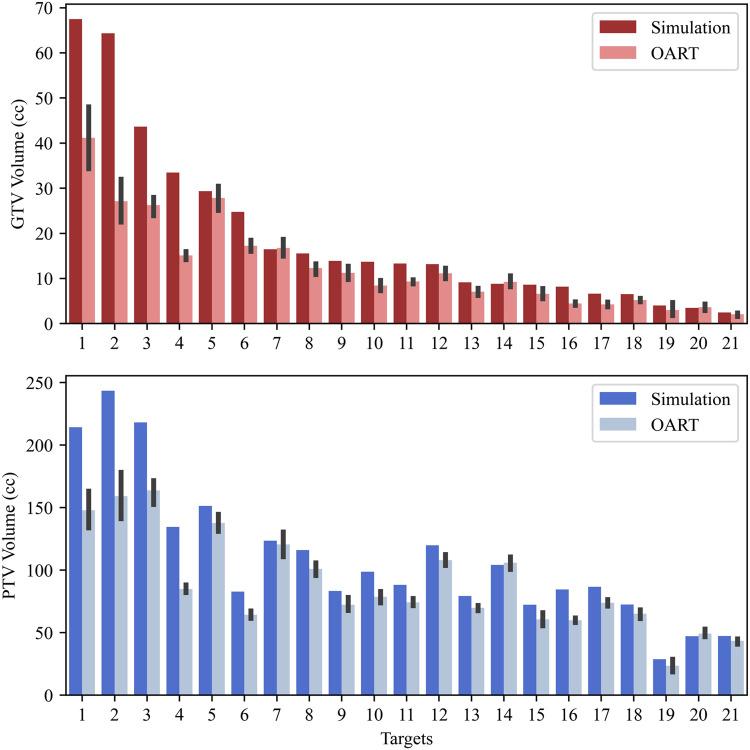
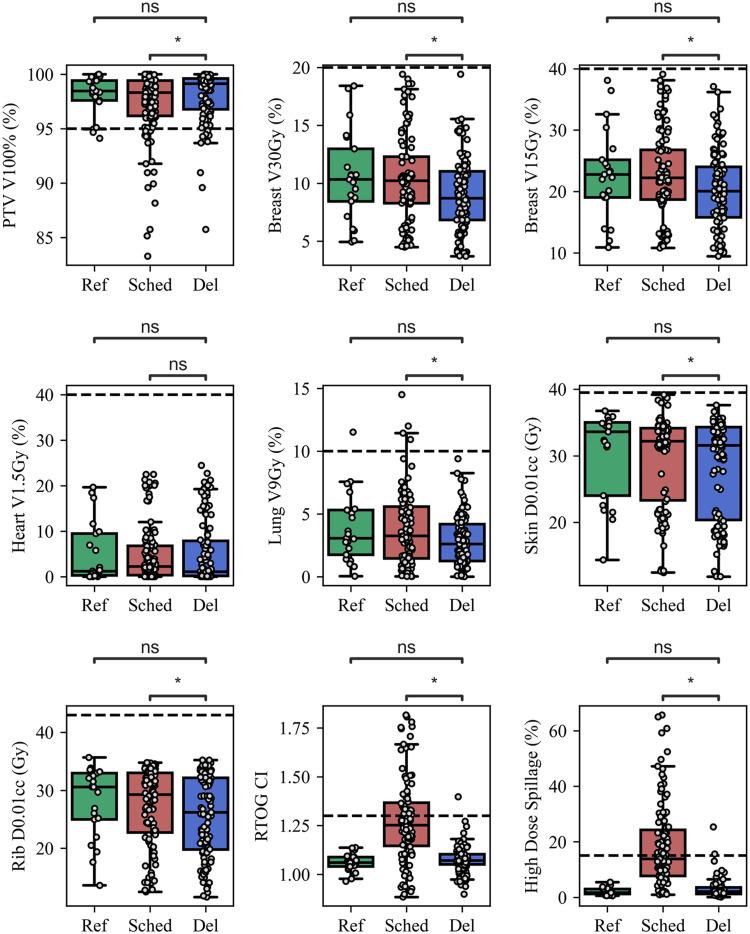
Median (interquartile range) time from simulation to first treatment was 26 days (21-32 days). During this same time, median gross tumor volume reduction was 16.0% (7.3%-23.9%) relative to simulation volume. Adaptive treatments took 31.3 minutes (27.4-36.6 minutes) from start of CBCT to treatment session end. At treatment, the adaptive plan was selected for 86% (89/103) of evaluable fractions. In evaluating plan quality, 78% of delivered plans met all target, organs at risk, and conformity metrics evaluated, compared with 34% of scheduled plans.
CONCLUSIONS
Use of OART for stereotactic linac-based APBI allowed for safe, high-quality treatments in this cohort of 21 treatment courses. Although treatment delivery times were longer than traditional stereotactic body treatments, there were notable improvements in plan quality for APBI using OART.
目的
加速部分乳腺照射(APBI)对于符合条件的患者是一种有吸引力的治疗方式,因为与全乳放疗相比,它已被证明能带来相似的局部控制效果并改善美容效果。在线自适应放射治疗(OART)用于APBI很有前景,因为它考虑了乳房运动和肿块切除腔体积变化,从而可以减少计划靶区体积边界。在此,我们对千伏锥形束计算机断层扫描(CBCT)OART用于APBI治疗的充分性进行了一项单机构回顾性评估。
方法和材料
2022年1月至2023年5月期间,19例患者(21个治疗部位)接受了5次分割、每次6 Gy的治疗。分析了模拟与治疗之间的时间、大体肿瘤(即肿块切除腔)体积的变化以及适应后剂量体积直方图指标的差异。采用Wilcoxon配对非参数检验来测试计划剂量体积直方图指标在预定计划(根据每日CBCT解剖结构重新计算的初始计划)与实际执行计划(预定计划或适应计划,使用每日解剖结构重新优化)之间的差异。
结果
从模拟到首次治疗的中位(四分位间距)时间为26天(21 - 32天)。在此期间,相对于模拟体积,大体肿瘤体积的中位减少量为16.0%(7.3% - 23.9%)。自适应治疗从CBCT开始到治疗结束耗时31.3分钟(27.4 - 36.6分钟)。在治疗时,86%(89/103)的可评估分次选择了自适应计划。在评估计划质量时,78%的实际执行计划达到了所有评估的靶区、危及器官和适形指标,而预定计划的这一比例为34%。
结论
在这21个治疗疗程的队列中,使用基于直线加速器的立体定向APBI的OART实现了安全、高质量的治疗。尽管治疗交付时间比传统立体定向体部治疗更长,但使用OART的APBI计划质量有显著改善。


 Zotero 插件