Johnson Emma C, Austin-Zimmerman Isabelle, Thorpe Hayley Ha, Levey Daniel F, Baranger David Aa, Colbert Sarah Mc, Demontis Ditte, Khokhar Jibran Y, Davis Lea K, Edenberg Howard J, Forti Marta Di, Sanchez-Roige Sandra, Gelernter Joel, Agrawal Arpana
Department of Psychiatry, Washington University School of Medicine, St. Louis, MO USA.
Social, Genetic, and Developmental Psychiatry Centre, Institute of Psychiatry, Psychology and Neuroscience, King's College London, London, UK.
medRxiv. 2024 Jan 18:2024.01.17.24301430. doi: 10.1101/2024.01.17.24301430.
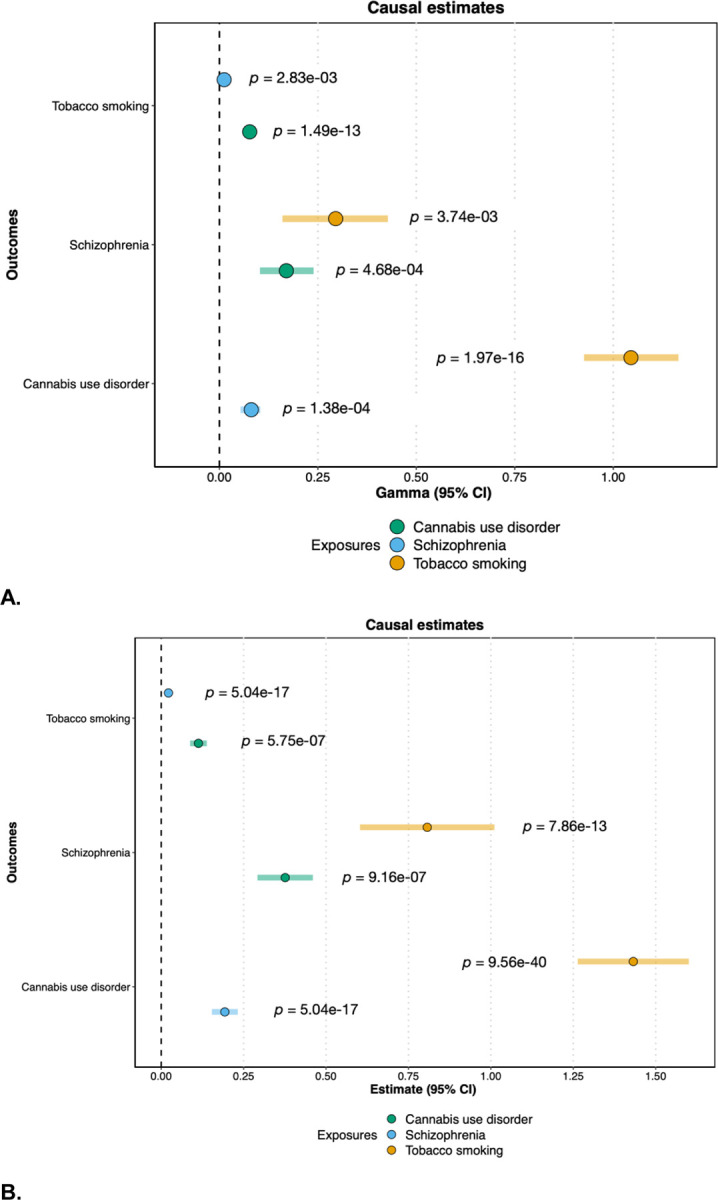
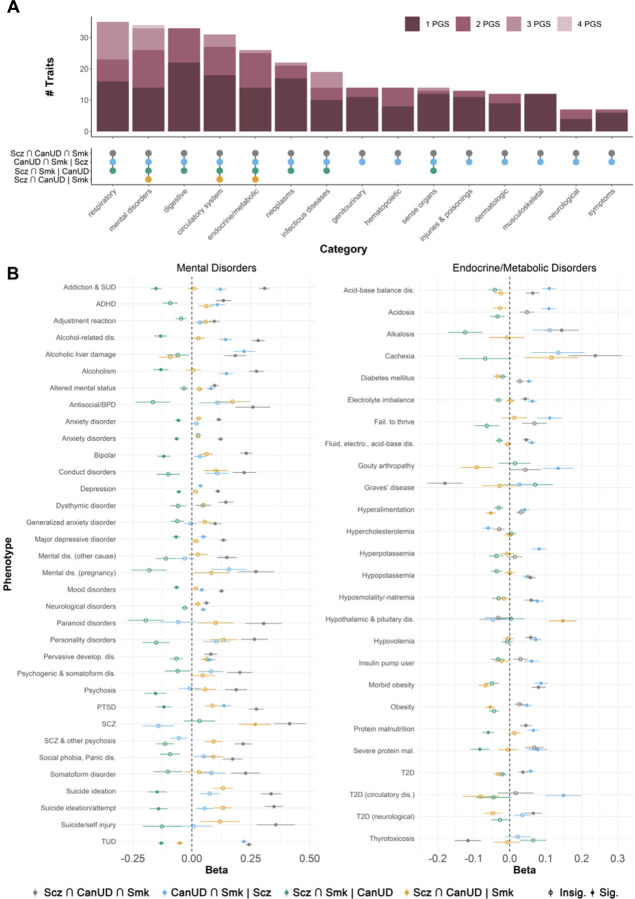
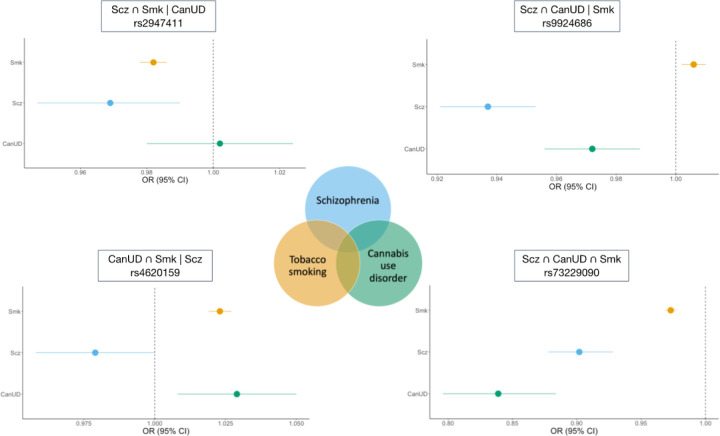
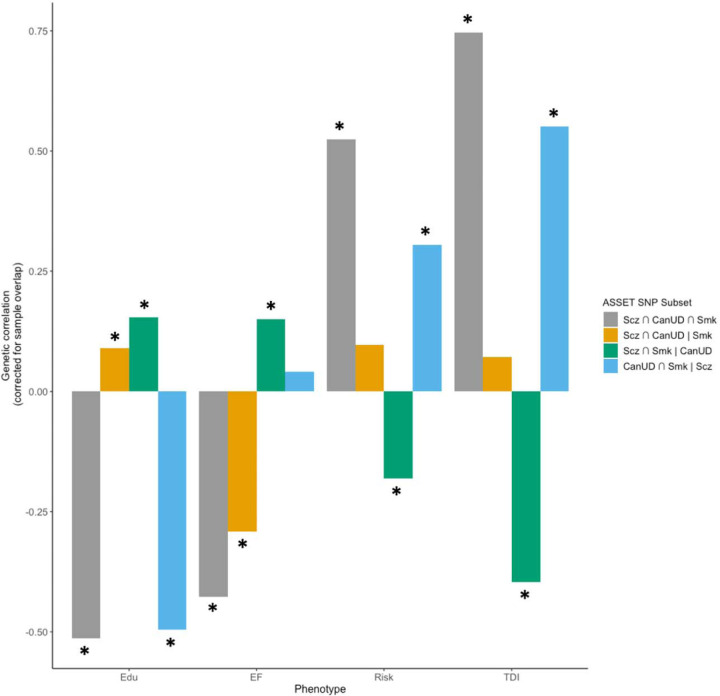
Individuals with schizophrenia frequently experience co-occurring substance use, including tobacco smoking and heavy cannabis use, and substance use disorders. There is interest in understanding the extent to which these relationships are causal, and to what extent shared genetic factors play a role. We explored the relationships between schizophrenia (Scz), cannabis use disorder (CanUD), and ever-regular tobacco smoking (Smk) using the largest available genome-wide studies of these phenotypes in individuals of African and European ancestries. All three phenotypes were positively genetically correlated (rs = 0.17 - 0.62). Causal inference analyses suggested the presence of horizontal pleiotropy, but evidence for bidirectional causal relationships was also found between all three phenotypes even after correcting for horizontal pleiotropy. We identified 439 pleiotropic loci in the European ancestry data, 150 of which were novel (i.e., not genome-wide significant in the original studies). Of these pleiotropic loci, 202 had lead variants which showed convergent effects (i.e., same direction of effect) on Scz, CanUD, and Smk. Genetic variants convergent across all three phenotypes showed strong genetic correlations with risk-taking, executive function, and several mental health conditions. Our results suggest that both horizontal pleiotropy and causal mechanisms may play a role in the relationship between CanUD, Smk, and Scz, but longitudinal, prospective studies are needed to confirm a causal relationship.
精神分裂症患者经常同时存在物质使用问题,包括吸烟和大量使用大麻,以及物质使用障碍。人们有兴趣了解这些关系在多大程度上是因果关系,以及共享的遗传因素在多大程度上起作用。我们利用对非洲和欧洲血统个体中这些表型进行的最大规模全基因组研究,探讨了精神分裂症(Scz)、大麻使用障碍(CanUD)和曾经规律吸烟(Smk)之间的关系。所有这三种表型在遗传上呈正相关(rs = 0.17 - 0.62)。因果推断分析表明存在水平多效性,但即使在纠正水平多效性后,在所有三种表型之间也发现了双向因果关系的证据。我们在欧洲血统数据中鉴定出439个多效性位点,其中150个是新发现的(即在原始研究中未达到全基因组显著性)。在这些多效性位点中,有202个主要变异对Scz、CanUD和Smk表现出趋同效应(即效应方向相同)。在所有三种表型中趋同的基因变异与冒险行为、执行功能和几种心理健康状况表现出很强的遗传相关性。我们的结果表明,水平多效性和因果机制可能在CanUD、Smk和Scz之间的关系中起作用,但需要纵向、前瞻性研究来证实因果关系。