Huysmans Stephanie M D, Senden Rachel, Jacobs Eva, Willems Paul J B, Marcellis Rik G J, Boogaart Mark van den, Meijer Kenneth, Willems Paul C
Department of Orthopedic Surgery and Research School CAPHRI (Care and Public Health Research Institute), Maastricht University Medical Center+ (MUMC+), Maastricht, the Netherlands.
Department of Physiotherapy, Maastricht University Medical Center+ (MUMC+), Maastricht, the Netherlands.
N Am Spine Soc J. 2023 Dec 30;17:100306. doi: 10.1016/j.xnsj.2023.100306. eCollection 2024 Mar.
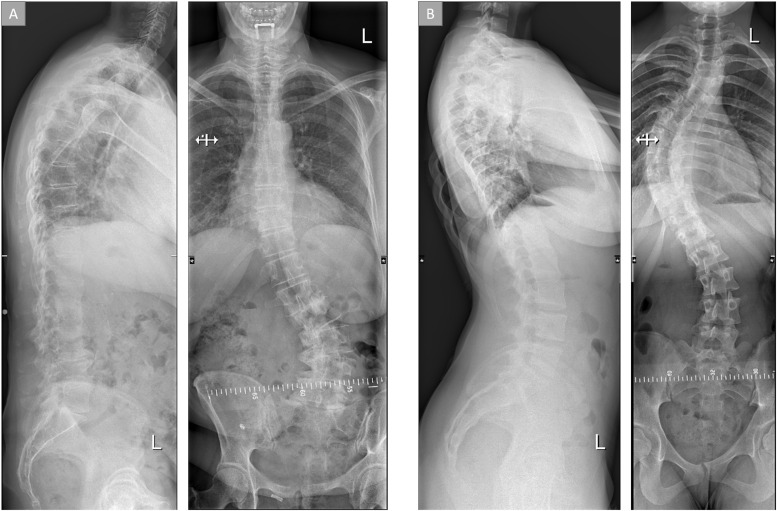
Adult spinal deformity patients (ASD) experience altered spinal alignment affecting spatiotemporal parameters and joint kinematics. Differences in spinal deformity between patients with symptomatic idiopathic scoliosis (ID-ASD) and patients with "de novo" scoliosis (DN-ASD) may affect gait characteristics differently. This study aims to compare gait characteristics between ID-ASD, DN-ASD, and asymptomatic healthy matched controls.
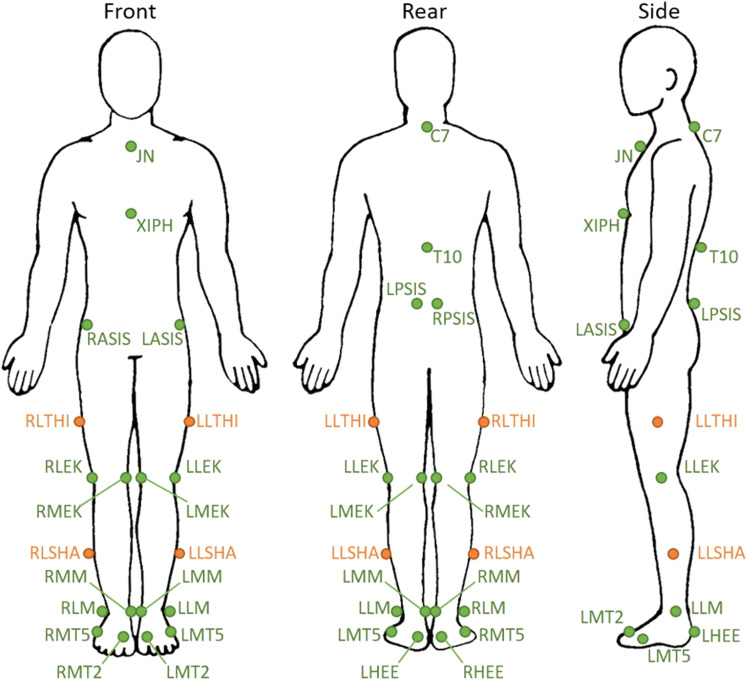
In this observational case-control study, ID-ASD (n = 24) and DN-ASD (n = 26) patients visiting the out-patient spine clinic and scheduled for long-segment spinal fusion were included. Patients were matched, based on age, gender, leg length and BMI, with asymptomatic healthy controls. Gait was measured at comfortable walking speed on an instrumented treadmill with 3D motion capture system. Trunk, pelvic and lower extremities range of motion (ROM) and spatiotemporal parameters (SPT) are presented as median (first and thirds quartile). Independent t-test or Mann-Whitney U test was used to compare ID-ASD, DN-ASD and controls. Statistical Parametric Mapping (independent t-test) was used to compare 3D joint kinematics.
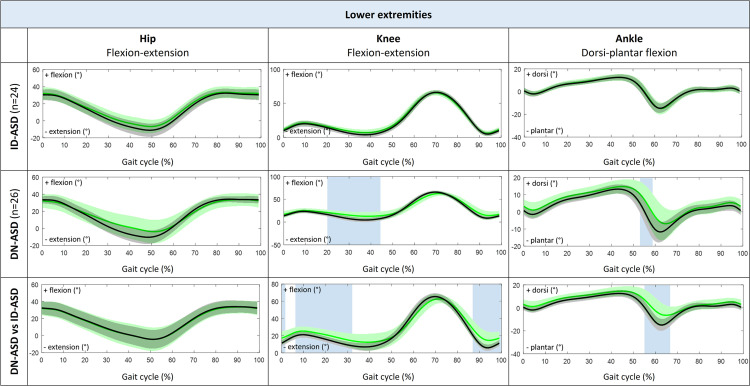
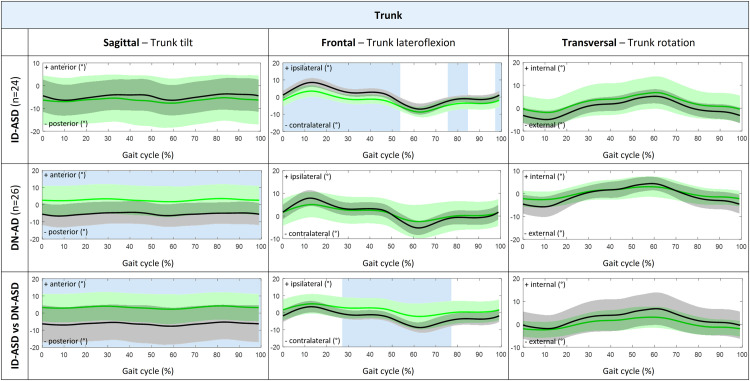
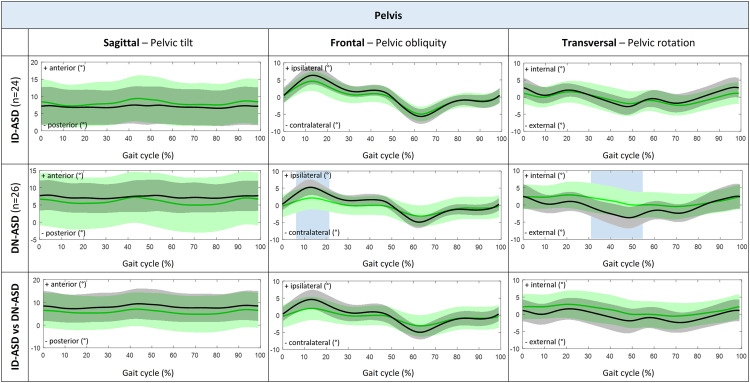
DN-ASD patients walk with increased anterior trunk tilt during the whole gait cycle compared with ID-ASD patients and controls. ID-ASD walk with decreased trunk lateroflexion compared with DN-ASD and controls. DN-ASD showed decreased pelvic obliquity and -rotation, increased knee flexion, and decreased ankle plantar flexion. ID-ASD and DN-ASD displayed decreased trunk, pelvic and lower extremity ROM compared with controls, but increased pelvic tilt ROM. ID-ASD patients walked with comparable SPT to controls, whereas DN-ASD patients walked significantly slower with corresponding changes in SPT and wider steps.
DN-ASD patients exhibit distinct alterations in SPT and kinematic gait characteristics compared with ID-ASD and controls. These alterations seem to be predominantly influenced by sagittal spinal malalignment and kinematic findings in ASD patients should not be generalized as such, but always be interpreted with consideration for the nature of the ASD.
成人脊柱畸形患者(ASD)会出现脊柱排列改变,影响时空参数和关节运动学。有症状的特发性脊柱侧凸患者(ID-ASD)与“新发”脊柱侧凸患者(DN-ASD)之间的脊柱畸形差异可能对步态特征产生不同影响。本研究旨在比较ID-ASD、DN-ASD和无症状健康匹配对照组之间的步态特征。
在这项观察性病例对照研究中,纳入了到门诊脊柱诊所就诊并计划进行长节段脊柱融合的ID-ASD患者(n = 24)和DN-ASD患者(n = 26)。根据年龄、性别、腿长和BMI将患者与无症状健康对照组进行匹配。在配备3D运动捕捉系统的仪器化跑步机上以舒适步行速度测量步态。躯干、骨盆和下肢的运动范围(ROM)及时空参数(SPT)以中位数(第一和第三四分位数)表示。使用独立t检验或曼-惠特尼U检验比较ID-ASD、DN-ASD和对照组。使用统计参数映射(独立t检验)比较3D关节运动学。
与ID-ASD患者和对照组相比,DN-ASD患者在整个步态周期中行走时前躯干倾斜增加。与DN-ASD和对照组相比,ID-ASD患者行走时躯干侧屈减少。DN-ASD表现出骨盆倾斜和旋转减少、膝关节屈曲增加以及踝关节跖屈减少。与对照组相比,ID-ASD和DN-ASD的躯干、骨盆和下肢ROM减少,但骨盆倾斜ROM增加。ID-ASD患者行走时的SPT与对照组相当,而DN-ASD患者行走明显较慢,SPT相应改变且步幅更宽。
与ID-ASD和对照组相比,DN-ASD患者在SPT和运动步态特征方面表现出明显改变。这些改变似乎主要受矢状面脊柱排列不齐影响,ASD患者的运动学结果不应一概而论,而应始终结合ASD的性质进行解释。