Whitehead Institute for Biomedical Research, 455 Main Street, Cambridge, MA 02142, USA; Department of Biology, Massachusetts Institute of Technology, 31 Ames Street, Cambridge, MA 02139, USA.
Whitehead Institute for Biomedical Research, 455 Main Street, Cambridge, MA 02142, USA.
Mol Cell. 2024 Feb 15;84(4):702-714.e10. doi: 10.1016/j.molcel.2024.01.006. Epub 2024 Jan 30.
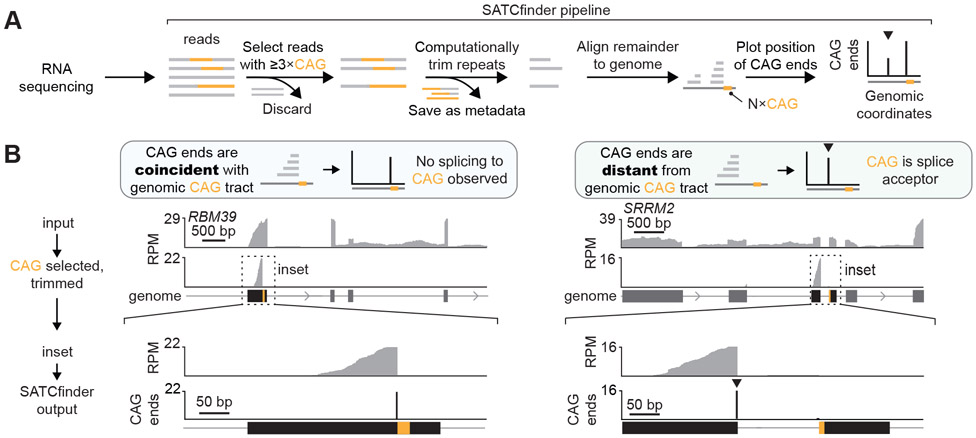
Expansions of CAG trinucleotide repeats cause several rare neurodegenerative diseases. The disease-causing repeats are translated in multiple reading frames and without an identifiable initiation codon. The molecular mechanism of this repeat-associated non-AUG (RAN) translation is not known. We find that expanded CAG repeats create new splice acceptor sites. Splicing of proximal donors to the repeats produces unexpected repeat-containing transcripts. Upon splicing, depending on the sequences surrounding the donor, CAG repeats may become embedded in AUG-initiated open reading frames. Canonical AUG-initiated translation of these aberrant RNAs may account for proteins that have been attributed to RAN translation. Disruption of the relevant splice donors or the in-frame AUG initiation codons is sufficient to abrogate RAN translation. Our findings provide a molecular explanation for the abnormal translation products observed in CAG trinucleotide repeat expansion disorders and add to the repertoire of mechanisms by which repeat expansion mutations disrupt cellular functions.
CAG 三核苷酸重复扩展导致几种罕见的神经退行性疾病。致病重复可以在多个阅读框架中被翻译,且没有可识别的起始密码子。这种重复相关的非 AUG(RAN)翻译的分子机制尚不清楚。我们发现扩展的 CAG 重复序列创造了新的剪接受体位点。近端供体与重复序列的剪接产生了意想不到的含有重复序列的转录本。剪接后,根据供体位点周围的序列,CAG 重复序列可能会嵌入到 AUG 起始的开放阅读框中。这些异常 RNA 的典型 AUG 起始翻译可能解释了归因于 RAN 翻译的蛋白质。破坏相关剪接受体或框架内的 AUG 起始密码子足以阻断 RAN 翻译。我们的发现为 CAG 三核苷酸重复扩展障碍中观察到的异常翻译产物提供了分子解释,并增加了重复扩展突变破坏细胞功能的机制。