Department of Thoracic Surgery, Beijing Hospital, National Center of Gerontology, Institute of Geriatric Medicine, Chinese Academy of Medical Sciences, No.1 Dahua Road, Dong Dan, Beijing, 100730, People's Republic of China.
Department of Neurology, Beijing Hospital, National Center of Gerontology, Institute of Geriatric Medicine, Chinese Academy of Medical Sciences, Beijing, People's Republic of China.
J Cardiothorac Surg. 2024 Jan 31;19(1):37. doi: 10.1186/s13019-024-02511-6.
Thymoma and myasthenia gravis (MG) interact with each other. This study aimed to evaluate the effects of thymoma on neurological outcome of MG patients after thymectomy using the propensity score matching (PSM) method.
Consecutive patients with MG who underwent thymectomy at Beijing Hospital between January 2012 and August 2021 were retrospectively enrolled. Clinical and follow-up data were collected. Statistical analysis was performed using SPSS 23.0 software. PSM was performed to eliminate selection bias.
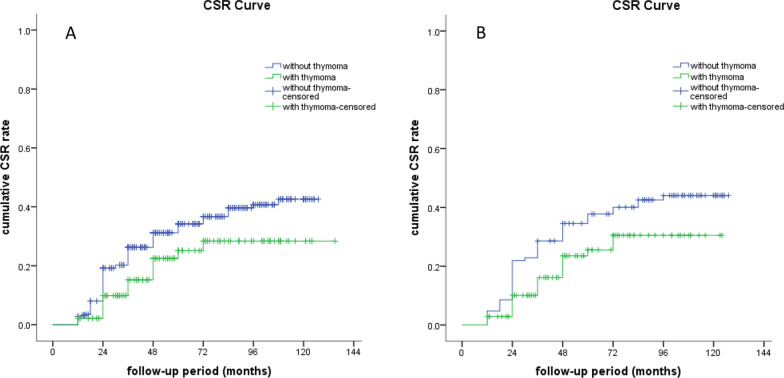
A total of 456 patients were included in this study. Thymoma was present in 138 (30.3%) patients. The median follow-up time was 72 (range, 12-135) months. At the last follow-up, a lower proportion of thymomatous MG patients achieved complete stable remission (CSR) compared with non-thymomatous MG patients (P = 0.011), and the effective rate [CSR + pharmatologic remission (PR) + minimal manifestations (MM)] of thymomatous MG patients was also lower (P = 0.037). Considering time to CSR, Kaplan-Meier analysis showed thymomatous MG patients had lower cumulative CSR rate than non-thymomatous MG patients (log-rank, P = 0.019). After PSM, 105 pairs of patients were matched successfully. For the matched patients, thymomatous MG patients had a lower CSR rate and a lower effective rate (P = 0.002, 0.039, respectively), and K-M analysis still showed thymomatous MG patients had lower cumulative CSR rate (log-rank, P = 0.048). Multivariate Cox analysis demonstrated that thymoma (HR: 0.592, 95% CI 0.389-0.900, P = 0.014), older age at the time of surgery (HR: 0.971, 95% CI 0.953-0.990, P = 0.003), and preoperative course of MG > 12 months (HR: 0.474, 95% CI 0.317-0.708, P = 0.000) were negative predictive factors for CSR.
Thymoma had a negative effect on the neurological outcome of MG after thymectomy. MG patients with old age and a preoperative course of longer than one year had a lower probability of achieving CSR.
胸腺瘤与重症肌无力(MG)相互作用。本研究旨在通过倾向评分匹配(PSM)方法评估胸腺瘤对胸腺切除术后 MG 患者神经功能结局的影响。
回顾性纳入 2012 年 1 月至 2021 年 8 月期间在北京医院接受胸腺切除术的连续 MG 患者。收集临床和随访数据。使用 SPSS 23.0 软件进行统计分析。采用 PSM 消除选择偏倚。
本研究共纳入 456 例患者。138 例(30.3%)患者存在胸腺瘤。中位随访时间为 72(范围 12-135)个月。末次随访时,与非胸腺瘤性 MG 患者相比,胸腺瘤性 MG 患者达到完全稳定缓解(CSR)的比例较低(P=0.011),有效率[CSR+药物缓解(PR)+微小症状(MM)]也较低(P=0.037)。考虑到 CSR 的时间,Kaplan-Meier 分析显示胸腺瘤性 MG 患者的 CSR 累积率低于非胸腺瘤性 MG 患者(对数秩,P=0.019)。PSM 后,成功匹配 105 对患者。对于匹配的患者,胸腺瘤性 MG 患者的 CSR 率和有效率较低(P=0.002,0.039),K-M 分析仍显示胸腺瘤性 MG 患者的 CSR 累积率较低(对数秩,P=0.048)。多变量 Cox 分析表明,胸腺瘤(HR:0.592,95%CI:0.389-0.900,P=0.014)、手术时年龄较大(HR:0.971,95%CI:0.953-0.990,P=0.003)和术前 MG 病程>12 个月(HR:0.474,95%CI:0.317-0.708,P=0.000)是 CSR 的负预测因素。
胸腺瘤对胸腺切除术后 MG 的神经功能结局有负面影响。年龄较大和术前病程超过一年的 MG 患者,达到 CSR 的可能性较低。