Department of Clinical Laboratory, the First Affiliated Hospital of Kunming Medical University, Kunming, China.
Yunnan Key Laboratory of Laboratory Medicine, Kunming, China.
J Clin Lab Anal. 2024 Feb;38(3):e25000. doi: 10.1002/jcla.25000. Epub 2024 Feb 1.
There are big differences in treatments and prognosis between diabetic kidney disease (DKD) and non-diabetic renal disease (NDRD). However, DKD patients couldn't be diagnosed early due to lack of special biomarkers. Urine is an ideal non-invasive sample for screening DKD biomarkers. This study aims to explore DKD special biomarkers by urinary proteomics.
According to the result of renal biopsy, 142 type 2 diabetes mellitus (T2DM) patients were divided into 2 groups: DKD (n = 83) and NDRD (n = 59). Ten patients were selected from each group to define urinary protein profiles by label-free quantitative proteomics. The candidate proteins were further verifyied by parallel reaction monitoring (PRM) methods (n = 40). Proteins which perform the same trend both in PRM and proteomics were verified by enzyme-linked immunosorbent assays (ELISA) with expanding the sample size (n = 82). The area under the receiver operating characteristic curve (AUC) was used to evaluate the accuracy of diagnostic biomarkers.
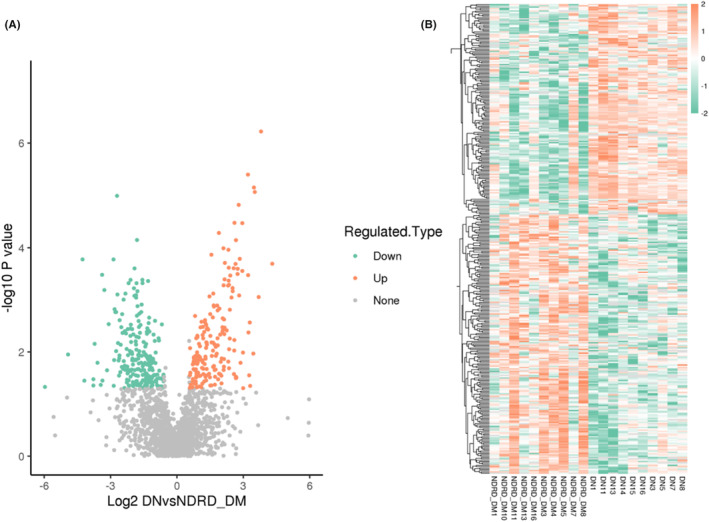
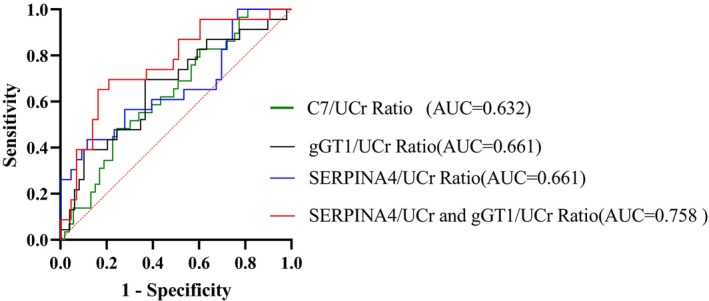
We identified 417 peptides in urinary proteins showing significant difference between DKD and NDRD. PRM verification identified C7, SERPINA4, IGHG1, SEMG2, PGLS, GGT1, CDH2, CDH1 was consistent with the proteomic results and p < 0.05. Three potential biomarkers for DKD, C7, SERPINA4, and gGT1, were verified by ELISA. The combinatied SERPINA4/Ucr and gGT1/Ucr (AUC = 0.758, p = 0.001) displayed higher diagnostic efficiency than C7/Ucr (AUC = 0.632, p = 0.048), SERPINA4/Ucr (AUC = 0.661, p = 0.032), and gGT1/Ucr (AUC = 0.661, p = 0.029) respectively.
The combined index SERPINA4/Ucr and gGT1/Ucr can be considered as candidate biomarkers for diabetic nephropathy after adjusting by urine creatinine.
糖尿病肾病(DKD)和非糖尿病肾病(NDRD)的治疗和预后存在很大差异。然而,由于缺乏特殊的生物标志物,DKD 患者无法早期诊断。尿液是筛选 DKD 生物标志物的理想非侵入性样本。本研究旨在通过尿蛋白质组学探索 DKD 的特殊生物标志物。
根据肾活检结果,将 142 例 2 型糖尿病(T2DM)患者分为 2 组:DKD(n=83)和 NDRD(n=59)。使用无标记定量蛋白质组学方法从每组中选择 10 例患者来定义尿蛋白图谱。通过平行反应监测(PRM)方法(n=40)进一步验证候选蛋白。通过扩大样本量(n=82)用酶联免疫吸附测定(ELISA)验证在 PRM 和蛋白质组学中具有相同趋势的蛋白质。接受者操作特征曲线(ROC)下的面积(AUC)用于评估诊断生物标志物的准确性。
我们在 DKD 和 NDRD 之间的尿蛋白中鉴定出 417 个肽,差异具有统计学意义。PRM 验证确定 C7、SERPINA4、IGHG1、SEMG2、PGLS、GGT1、CDH2、CDH1 与蛋白质组学结果一致,p<0.05。通过 ELISA 验证了 3 种潜在的 DKD 生物标志物,C7、SERPINA4 和 gGT1。组合的 SERPINA4/Ucr 和 gGT1/Ucr(AUC=0.758,p=0.001)比 C7/Ucr(AUC=0.632,p=0.048)、SERPINA4/Ucr(AUC=0.661,p=0.032)和 gGT1/Ucr(AUC=0.661,p=0.029)显示出更高的诊断效率。
调整尿肌酐后,SERPINA4/Ucr 和 gGT1/Ucr 联合指数可作为糖尿病肾病的候选生物标志物。