Maclean Erick S, Bunch T Jared, Freedman Roger A, Piccini Jonathan P, Steinberg Benjamin A
Division of Cardiovascular Medicine, University of Utah Health Sciences Center, Salt Lake City, Utah.
Duke University Medical Center and the Duke Clinical Research Institute, Durham, North Carolina.
Heart Rhythm O2. 2023 Dec 7;5(1):17-23. doi: 10.1016/j.hroo.2023.11.018. eCollection 2024 Jan.
Leadless pacemakers represent a paradigm-changing advancement. However, they required innovative and novel device design, including the use of nitinol tines for fixation.
We aimed to understand the potential for fracture in the novel tine-based fixation mechanism.
A retrospective approach was used to search the MAUDE (Manufacturer and User Facility Device Experience) database for events related to Micra pacemaker tine fracture and damage. Review of each report was performed to ascertain frequency of tine fracture and damage.
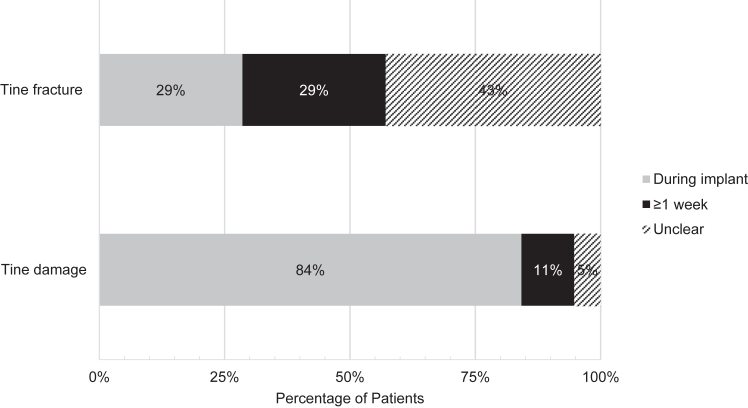
Of 4241 MAUDE reports (2104 Micra VR, 2167 Micra AV), 230 included the terms "fracture" or "tine," which yielded 7 tine fractures and 19 reports of tine damage. Overall, 2 (29%) of 7 tine fractures were noted during implantation, whereas 2 (29%) of 7 were discovered ≥1 week after implantation; 5 (71%) of 7 tine fracture reports described no associated patient signs or symptoms, and 4 (57%) of 7 described no change in pacing parameters. Tine damage occurred during implantation in 16 (84%) of 19, compared with 2 (11%) of 19 noted ≥1 week after implantation; 15 (79%) of 19 tine damage cases reported no associated signs or symptoms, and 7 (37%) of 19 described no changes in pacing parameters. Among all cases, there was 1 case of device embolization.
The novel tine-based fixation mechanism appears susceptible to a novel failure mechanism-tine fracture and/or damage. Our analysis suggests these events may not always be associated with adverse signs or symptoms. Diligent attention at implantation, and future bench or clinical studies are needed to understand the rate, clinical impact, and mechanism of such failures, and role of surveillance.
无导线起搏器代表了一项改变范式的进步。然而,它们需要创新和新颖的设备设计,包括使用镍钛诺尖齿进行固定。
我们旨在了解基于新型尖齿的固定机制中发生骨折的可能性。
采用回顾性方法在MAUDE(制造商和用户设施设备经验)数据库中搜索与美敦力Micra起搏器尖齿骨折和损坏相关的事件。对每份报告进行审查以确定尖齿骨折和损坏的频率。
在4241份MAUDE报告(2104份Micra VR,2167份Micra AV)中,230份包含“骨折”或“尖齿”字样,其中有7例尖齿骨折和19份尖齿损坏报告。总体而言,7例尖齿骨折中有2例(29%)在植入过程中被发现,而7例中有2例(29%)在植入后≥1周被发现;7例尖齿骨折报告中有5例(71%)未描述相关的患者体征或症状,7例中有4例(57%)未描述起搏参数的变化。19例尖齿损坏中有16例(84%)发生在植入过程中,相比之下,19例中有2例(11%)在植入后≥1周被发现;19例尖齿损坏病例中有15例(79%)未报告相关体征或症状,19例中有7例(37%)未描述起搏参数的变化。在所有病例中,有1例设备栓塞。
基于新型尖齿的固定机制似乎易受一种新型故障机制——尖齿骨折和/或损坏的影响。我们的分析表明,这些事件可能并不总是与不良体征或症状相关。植入时需密切关注,并且需要未来的实验台或临床研究来了解此类故障的发生率、临床影响和机制以及监测的作用。