Sun Danhui, Deng Tao, Wang Shiqi
University of Chinese Academy of Sciences, Beijing, China.
Institute of Vertebrate Paleontology and Paleoanthropology, Chinese Academy of Sciences, Beijing, China.
PeerJ. 2024 Jan 31;12:e16822. doi: 10.7717/peerj.16822. eCollection 2024.
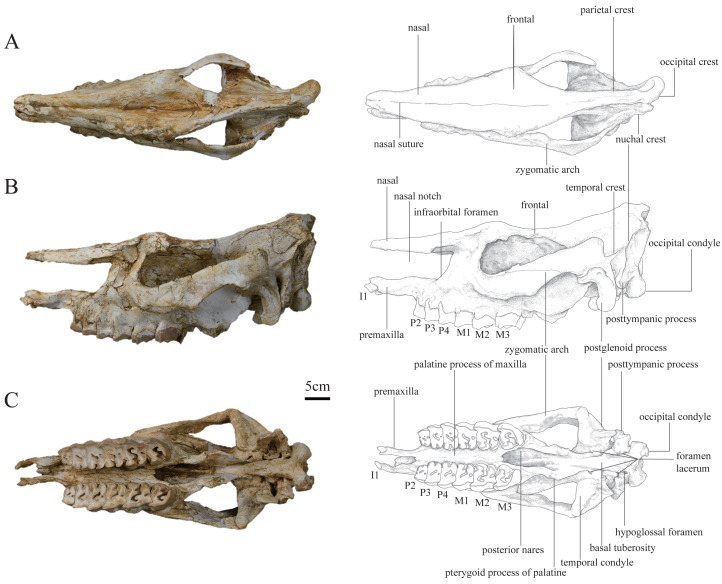
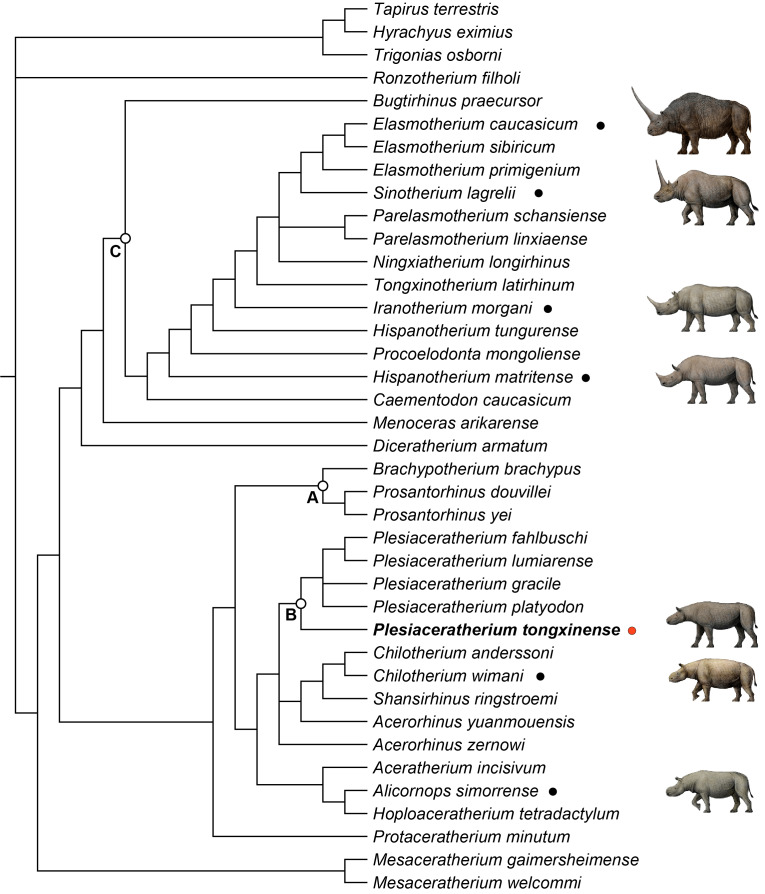
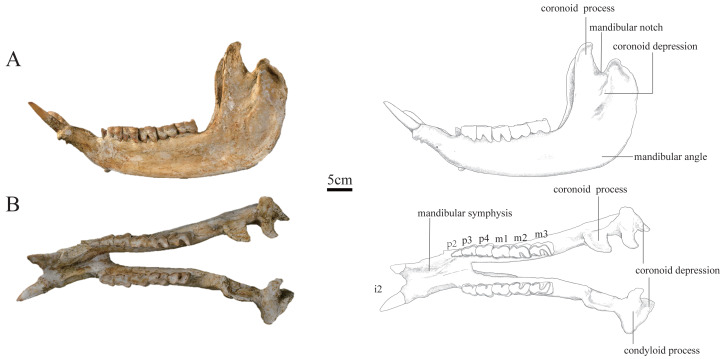
As a member of Aceratheriinae, the genus in Europe is widely distributed and highly diverse. However, only one species of (, ) exists in China with a discontinuous distribution range. Recently, we have discovered new materials of in the lower layers of the Zhang'enbao Formation exposed in Miaoerling in Tongxin County, China. The new materials are well-preserved and can be separated from other species by the following combination of features: the long and generally flat skull, with closed frontoparietal crests; the deep nasal notch at the level of P4; the high supraorbital margin, with its anterior margin at the level of the M1/M2 boundary; the medium-sized upper I1, with an oval abraded surface; the semi-molarized upper premolars with the protocone and hypocone joined by a lingual bridge; the strong constrictions of protocone on the upper molars; the absent buccal cingulum on upper cheek teeth; the cheek teeth are covered by cement on the buccal walls; the convex base of mandibular corpus; the inclined backward ramus; and the mandibular foramen above the teeth neck. Based on the combination of characteristics and phylogenetic analysis, we herein establish the new species as sp. nov. living in the late Early Miocene. Phylogenetic analysis reveals that is in the basal position of the genus , providing more detailed morphological characteristics of the plesiaceratheres.
作为准噶尔犀亚科的成员,该属在欧洲分布广泛且高度多样化。然而,在中国仅有一种(准噶尔犀)存在,其分布范围不连续。最近,我们在中国同心县庙儿岭出露的张恩堡组下层发现了准噶尔犀的新材料。新材料保存完好,可通过以下特征组合与其他准噶尔犀物种区分开来:头骨长且通常扁平,额顶嵴闭合;P4水平处有深鼻凹;眶上缘高,其前缘在M1/M2边界水平;上I1中等大小,磨损面呈椭圆形;上前臼齿半臼齿化,原尖和次尖由舌侧桥相连;上臼齿原尖强烈收缩;上颊齿无颊侧齿带;颊齿颊壁被白垩质覆盖;下颌体基部凸起;下颌支向后倾斜;下颌孔位于齿颈上方。基于这些特征组合和系统发育分析,我们在此将新物种确定为准噶尔犀新种,生活在早中新世晚期。系统发育分析表明,该物种处于准噶尔犀属的基部位置,为准噶尔犀提供了更详细的形态特征。