Kourek Christos, Kanellopoulos Marios, Raidou Vasiliki, Antonopoulos Michalis, Karatzanos Eleftherios, Patsaki Irini, Dimopoulos Stavros
Medical School of Athens, National and Kapodistrian University of Athens, Athens 15772, Greece.
Clinical Ergospirometry, Exercise and Rehabilitation Laboratory, Evangelismos Hospital, Athens 10676, Greece.
World J Cardiol. 2024 Jan 26;16(1):27-39. doi: 10.4330/wjc.v16.i1.27.
Lack of mobilization and prolonged stay in the intensive care unit (ICU) are major factors resulting in the development of ICU-acquired muscle weakness (ICUAW). ICUAW is a type of skeletal muscle dysfunction and a common complication of patients after cardiac surgery, and may be a risk factor for prolonged duration of mechanical ventilation, associated with a higher risk of readmission and higher mortality. Early mobilization in the ICU after cardiac surgery has been found to be low with a significant trend to increase over ICU stay and is also associated with a reduced duration of mechanical ventilation and ICU length of stay. Neuromuscular electrical stimulation (NMES) is an alternative modality of exercise in patients with muscle weakness. A major advantage of NMES is that it can be applied even in sedated patients in the ICU, a fact that might enhance early mobilization in these patients.
To evaluate safety, feasibility and effectiveness of NMES on functional capacity and muscle strength in patients before and after cardiac surgery.
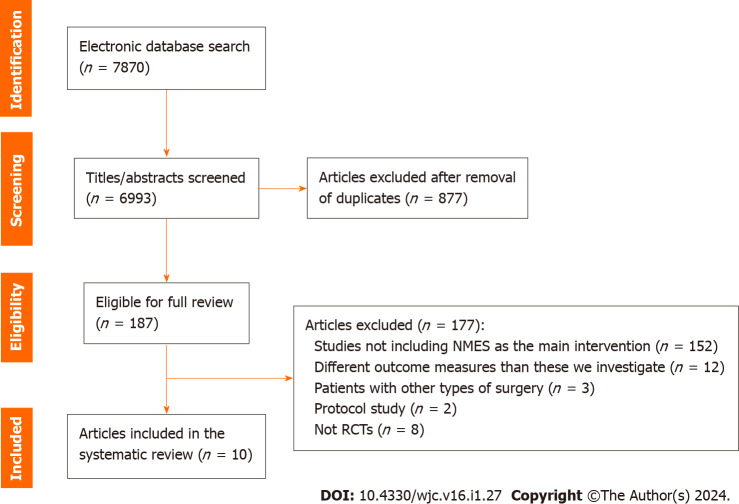
We performed a search on Pubmed, Physiotherapy Evidence Database (PEDro), Embase and CINAHL databases, selecting papers published between December 2012 and April 2023 and identified published randomized controlled trials (RCTs) that included implementation of NMES in patients before after cardiac surgery. RCTs were assessed for methodological rigor and risk of bias the PEDro. The primary outcomes were safety and functional capacity and the secondary outcomes were muscle strength and function.
Ten studies were included in our systematic review, resulting in 703 participants. Almost half of them performed NMES and the other half were included in the control group, treated with usual care. Nine studies investigated patients after cardiac surgery and 1 study before cardiac surgery. Functional capacity was assessed in 8 studies 6MWT or other indices, and improved only in 1 study before and in 1 after cardiac surgery. Nine studies explored the effects of NMES on muscle strength and function and, most of them, found increase of muscle strength and improvement in muscle function after NMES. NMES was safe in all studies without any significant complication.
NMES is safe, feasible and has beneficial effects on muscle strength and function in patients after cardiac surgery, but has no significant effect on functional capacity.
缺乏活动以及在重症监护病房(ICU)的长时间停留是导致ICU获得性肌无力(ICUAW)发生的主要因素。ICUAW是一种骨骼肌功能障碍,是心脏手术后患者的常见并发症,可能是机械通气时间延长的危险因素,与再入院风险增加和死亡率升高相关。心脏手术后在ICU的早期活动率较低,且随着在ICU停留时间的延长有显著增加的趋势,同时也与机械通气时间缩短和ICU住院时间缩短相关。神经肌肉电刺激(NMES)是肌无力患者运动的一种替代方式。NMES的一个主要优点是即使在ICU的镇静患者中也可以应用,这一事实可能会促进这些患者的早期活动。
评估NMES对心脏手术前后患者功能能力和肌肉力量的安全性、可行性和有效性。
我们在PubMed、物理治疗证据数据库(PEDro)、Embase和CINAHL数据库中进行了检索,选择2012年12月至2023年4月发表的论文,并确定已发表的随机对照试验(RCT),这些试验包括在心脏手术前后的患者中实施NMES。根据PEDro对RCT的方法严谨性和偏倚风险进行评估。主要结局是安全性和功能能力,次要结局是肌肉力量和功能。
我们的系统评价纳入了10项研究,共703名参与者。其中近一半进行了NMES,另一半纳入对照组,接受常规护理。9项研究调查了心脏手术后的患者,1项研究调查了心脏手术前的患者。8项研究通过6分钟步行试验(6MWT)或其他指标评估了功能能力,只有1项心脏手术前和1项心脏手术后的研究显示功能能力有所改善。9项研究探讨了NMES对肌肉力量和功能的影响,其中大多数研究发现NMES后肌肉力量增加,肌肉功能改善。在所有研究中,NMES都是安全的,没有任何严重并发症。
NMES对心脏手术后患者的肌肉力量和功能是安全、可行且有益的,但对功能能力没有显著影响。