Ravichandran Ashok, Mohanty Prases K, Asiri Abdullah Naser M, Islam Saiful
Department of Mechanical Engineering, National Institute of Technology, Jote, Arunachal Pradesh 791113, India.
Civil Engineering Department, King Khalid University, Abha 61421, Saudi Arabia.
ACS Omega. 2024 Jan 20;9(4):4395-4411. doi: 10.1021/acsomega.3c04535. eCollection 2024 Jan 30.
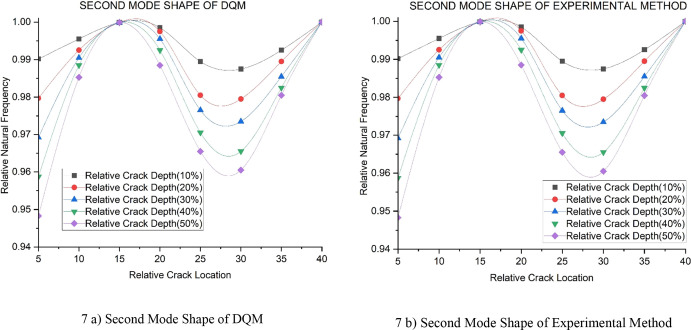
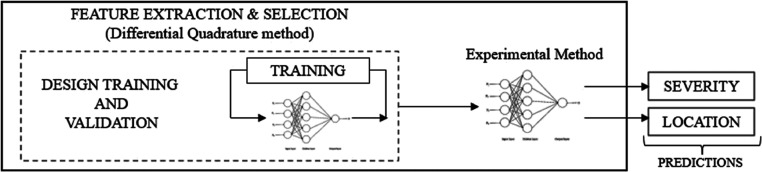
This research focuses on an inclined curved crack model for a recycled aluminum composite beam at various crack depths and locations. The inclined curved crack equation of the motion, by governing a free vibration curved beam with a different depth of crack, is solved computationally via the differential quadrature method (DQM) and experimentally; additionally, the result of the natural frequency has been compared with various depths of curvature. For the first four modes of cracked beams, the computational method's output is used to determine the natural frequencies associated with mode shapes. The outcomes of the computational results suggested a structural health monitoring system to detect deterioration in composite structures when modal parameters have changed. An experimental set of results was validated using MATLAB2019a, and the outcomes were compared with an artificial neural network.
本研究聚焦于再生铝复合梁在不同裂纹深度和位置的倾斜曲线裂纹模型。通过用微分求积法(DQM)对具有不同裂纹深度的自由振动曲梁进行控制,求解了倾斜曲线裂纹的运动方程,并进行了实验研究;此外,还将固有频率的结果与不同曲率深度进行了比较。对于裂纹梁的前四种模态,采用计算方法的输出结果来确定与模态形状相关的固有频率。计算结果表明,当模态参数发生变化时,可利用结构健康监测系统检测复合结构的损伤。利用MATLAB2019a对一组实验结果进行了验证,并将结果与人工神经网络进行了比较。