Li Xia, Li Chen, Liu Ao-Fei, Jiang Chang-Chun, Zhang Yi-Qun, Liu Yun-E, Zhang Ying-Ying, Li Hao-Yang, Jiang Wei-Jian, Lv Jin
The PLA Rocket Force Characteristic Medical Center, Beijing, China.
Department of Neurology, Baotou Center Hospital, Neurointerventional Medical Center of Inner Mongolia Medical University, Institute of Cerebrovascular Disease in Inner Mongolia, Inner Mongolia, China.
Front Neurol. 2024 Jan 19;15:1259973. doi: 10.3389/fneur.2024.1259973. eCollection 2024.
The past decade has witnessed advancements in mechanical thrombectomy (MT) for acute large-vessel occlusions (LVOs). However, only approximately half of the patients with LVO undergoing MT show the best/independent 90-day favorable outcome. This study aimed to develop a nomogram for predicting 90-day poor outcomes in patients with LVO treated with MT.
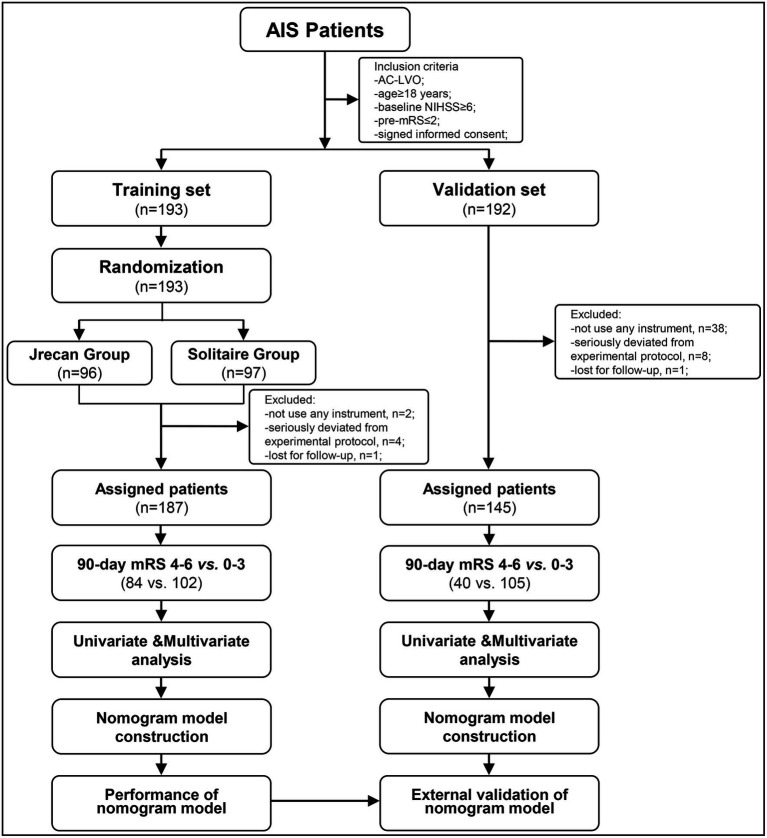
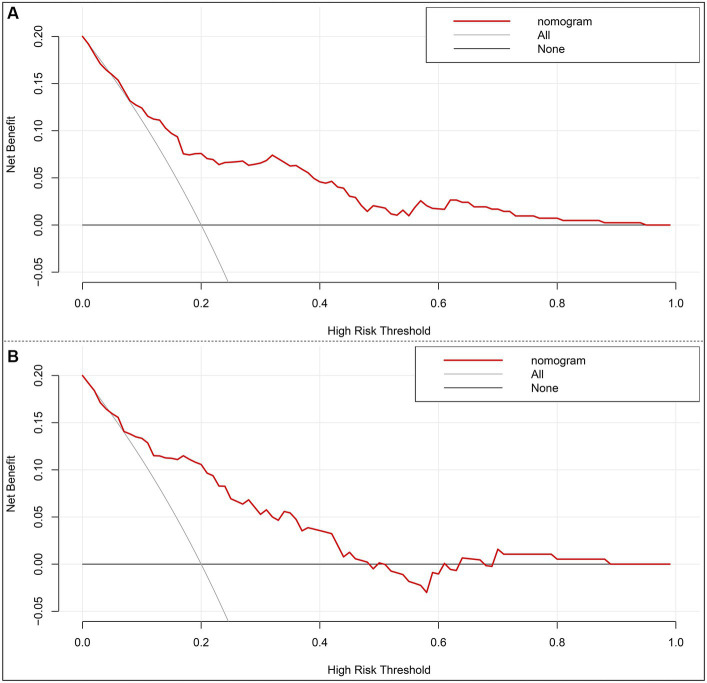
A total of 187 patients who received MT were retrospectively analyzed. Factors associated with 90-day poor outcomes (defined as mRS of 4-6) were determined by univariate and multivariate logistic regression analyzes. One best-fit nomogram was established to predict the risk of a 90-day poor outcome, and a concordance index was utilized to evaluate the performance of the model. Additionally, 145 patients from a single stroke center were retrospectively recruited as the validation cohort to test the newly established nomogram.
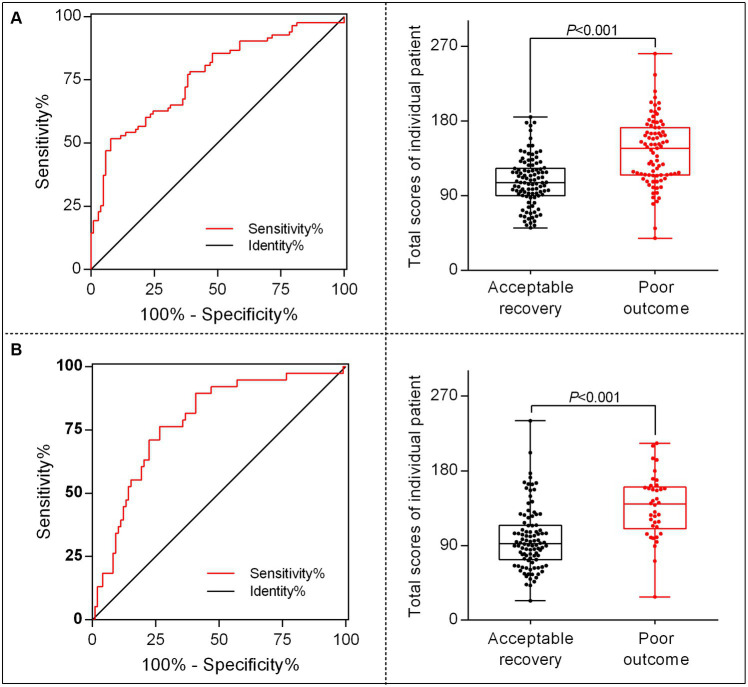
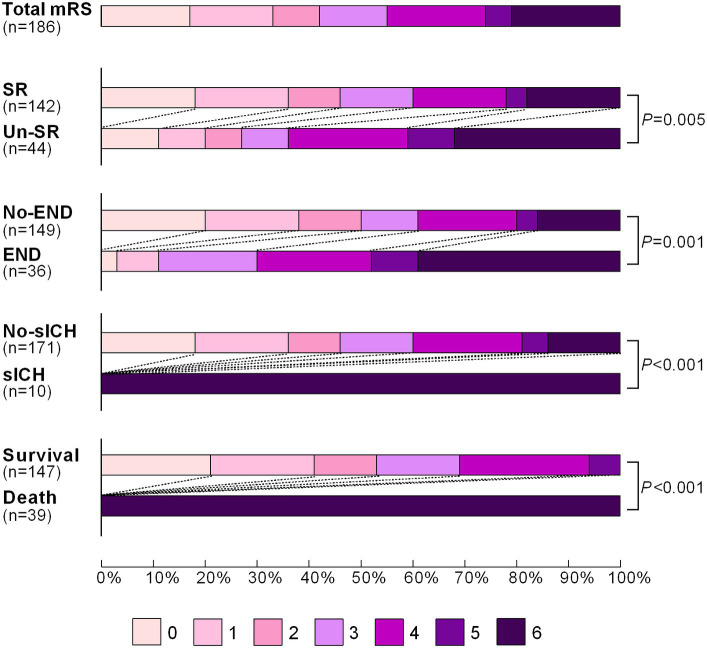
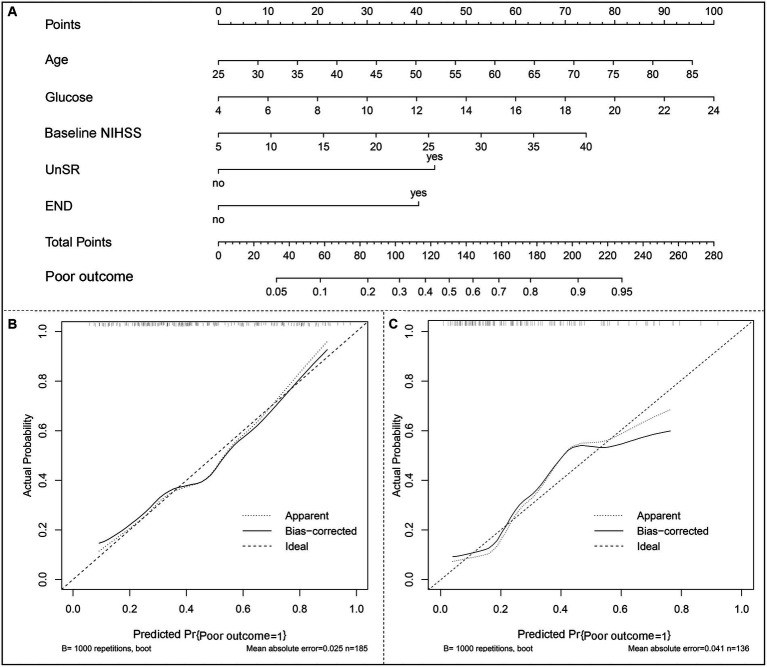
The overall incidence of 90-day poor outcomes was 45.16%, affecting 84 of 186 patients in the training set. Moreover, five variables, namely, age (odds ratio [OR]: 1.049, 95% CI [1.016-1.083]; = 0.003), glucose level (OR: 1.163, 95% CI [1.038-1.303]; = 0.009), baseline National Institute of Health Stroke Scale (NIHSS) score (OR: 1.066, 95% CI [0.995-1.142]; = 0.069), unsuccessful recanalization (defined as a TICI grade of 0 to 2a) (OR: 3.730, 95% CI [1.688-8.245]; = 0.001), and early neurological deterioration (END, defined as an increase of ≥4 points between the baseline NIHSS score and the NIHSS score at 24 h after MT) (OR: 3.383, 95% CI [1.411-8.106]; = 0.006), were included in the nomogram to predict the potential risk of poor outcomes at 90 days following MT in LVO patients, with a C-index of 0.763 (0.693-0.832) in the training set and 0.804 (0.719-0.889) in the validation set.
The proposed nomogram provided clinical evidence for the effective control of these risk factors before or during the process of MT surgery in LVO patients.
在过去十年中,急性大血管闭塞(LVO)的机械取栓术(MT)取得了进展。然而,接受MT治疗的LVO患者中只有约一半显示出最佳/独立的90天良好预后。本研究旨在建立一种列线图,用于预测接受MT治疗的LVO患者90天不良预后。
对187例接受MT治疗的患者进行回顾性分析。通过单因素和多因素逻辑回归分析确定与90天不良预后(定义为改良Rankin量表[mRS]评分为4 - 6分)相关的因素。建立一个最佳拟合列线图来预测90天不良预后的风险,并使用一致性指数评估模型的性能。此外,回顾性招募了来自单一卒中中心的145例患者作为验证队列,以测试新建立的列线图。
90天不良预后的总体发生率为45.16%,在训练集中影响了186例患者中的84例。此外,五个变量,即年龄(比值比[OR]:1.049,95%置信区间[CI][1.016 - 1.083];P = 0.003)、血糖水平(OR:1.163,95% CI[1.038 - 1.303];P = 0.009)、基线美国国立卫生研究院卒中量表(NIHSS)评分(OR:1.066,95% CI[0.995 - 1.142];P = 0.069)、再通失败(定义为脑梗死溶栓分级[TICI]为0至2a级)(OR:3.730,95% CI[1.688 - 8.245];P = 0.001)和早期神经功能恶化(END,定义为基线NIHSS评分与MT后24小时NIHSS评分之间增加≥4分)(OR:3.383,95% CI[1.411 - 8.106];P = 0.006),被纳入列线图以预测LVO患者MT后90天不良预后的潜在风险,训练集中的C指数为0.763(0.693 - 0.832),验证集中为0.804(0.719 - 0.889)。
所提出的列线图为在LVO患者MT手术前或手术过程中有效控制这些风险因素提供了临床证据。