Liu Xianhui, Patil Sandip, Guo Xuemin, Wen Feiqiu, Zhang Xianyan, Zhong Zhixiong, Wang Xinlu
Department of Laboratory Medicine, Meizhou People's Hospital, Meizhou, Guangdong, China.
Guangdong Provincial Key Laboratory of Precision Medicine and Clinical Translation Research of Hakka Population, Meizhou, Guangdong, China.
Front Cell Infect Microbiol. 2024 Jan 19;13:1330826. doi: 10.3389/fcimb.2023.1330826. eCollection 2023.
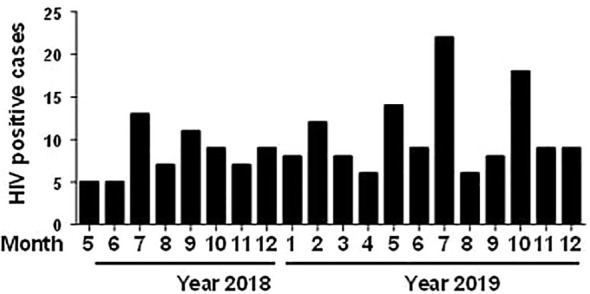
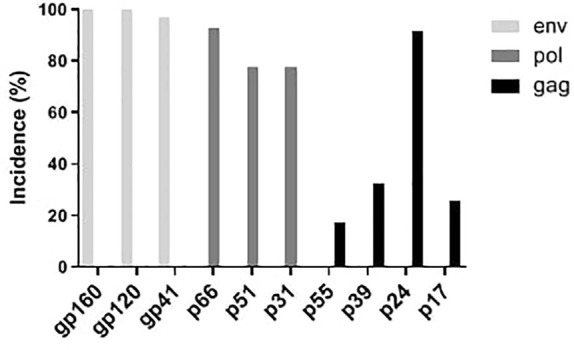
The acquired immunodeficiency syndrome (AIDS) epidemic, resulting from human immunodeficiency virus (HIV) infection, exhibits distinct regional characteristics. This study undertakes a retrospective analysis of the epidemiological and clinical features of 195 HIV-positive cases in Meizhou, China, from May 1, 2018 to December 31, 2019. Western blotting (WB) confirmed and assessed these cases. Notably, the majority of cases emanated from socio-economic groups with comparatively lower levels of education, with 80% being male. Strikingly, 90% of the cases were found to be in the middle to late stages of infection based on CD4+ T cell counts. Among the 30 different serum antibody profiles examined, reactivity with seven bands (p24, p31, gp41, p51, p66, gp120, and gp160) emerged as the most commonly observed WB pattern. The absence of specific bands, specifically p55 (17.44%), p39 (32.31%), and p17 (25.64%) were most frequent, with the detection frequency of p17 bands significantly reduced among cases in the AIDS and middle stages. An analysis of drug resistance genotypes indicated that, despite viral mutations conferring resistance to certain reverse transcriptase inhibitors, the first-line treatment regimen remained effective for patients in Meizhou. Notably, mutations resistant to protease inhibitors were infrequent (2.7%), suggesting that incorporating protease inhibitors into the treatment regimen may enhance therapeutic outcomes for local patients. These findings provide essential insights into the specific epidemiological patterns, serum antibody profiles, and drug resistance genotypes of HIV-infected patients in Meizhou. Significantly, this research contributes to the formulation of future treatment strategies tailored to the local context.
由人类免疫缺陷病毒(HIV)感染引起的获得性免疫缺陷综合征(AIDS)流行呈现出明显的区域特征。本研究对2018年5月1日至2019年12月31日期间中国梅州195例HIV阳性病例的流行病学和临床特征进行了回顾性分析。采用免疫印迹法(WB)对这些病例进行确认和评估。值得注意的是,大多数病例来自教育水平相对较低的社会经济群体,其中80%为男性。令人惊讶的是,根据CD4+T细胞计数,90%的病例处于感染的中晚期。在检测的30种不同血清抗体谱中,与七条带(p24、p31、gp41、p51、p66、gp120和gp160)反应是最常见的WB模式。特定条带的缺失,特别是p55(17.44%)、p39(32.31%)和p17(25.64%)最为常见,在艾滋病期和中期病例中p17条带的检测频率显著降低。耐药基因型分析表明,尽管病毒突变导致对某些逆转录酶抑制剂耐药,但一线治疗方案对梅州患者仍然有效。值得注意的是,对蛋白酶抑制剂耐药的突变很少见(2.7%),这表明将蛋白酶抑制剂纳入治疗方案可能会提高当地患者的治疗效果。这些发现为梅州HIV感染患者的特定流行病学模式、血清抗体谱和耐药基因型提供了重要见解。重要的是,本研究有助于制定适合当地情况的未来治疗策略。