
不同的人类白细胞抗原(HLA)变异和异质性表达,但在晚期儿童实体瘤中反复出现HLA杂合性缺失以及常见的转录沉默。
Divergent HLA variations and heterogeneous expression but recurrent HLA loss-of- heterozygosity and common and transcriptional silencing across advanced pediatric solid cancers.
作者信息
Lim Wan Ching, Marques Da Costa Maria Eugenia, Godefroy Karine, Jacquet Eric, Gragert Loren, Rondof Windy, Marchais Antonin, Nhiri Naima, Dalfovo Davide, Viard Mathias, Labaied Nizar, Khan Asif M, Dessen Philippe, Romanel Alessandro, Pasqualini Claudia, Schleiermacher Gudrun, Carrington Mary, Zitvogel Laurence, Scoazec Jean-Yves, Geoerger Birgit, Salmon Jerome
机构信息
INSERM U1015, Gustave Roussy Cancer Campus, Université Paris-Saclay, Villejuif, France.
Bioinformatics Platform, AMMICA, INSERM US23/CNRS UMS3655, Gustave Roussy Cancer Campus, Université Paris-Saclay, Villejuif, France.
出版信息
Front Immunol. 2024 Jan 22;14:1265469. doi: 10.3389/fimmu.2023.1265469. eCollection 2023.
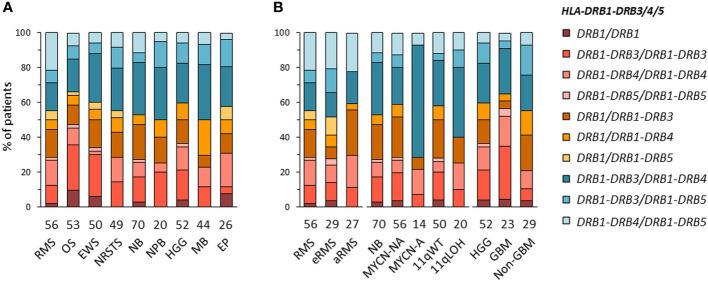
The human leukocyte antigen (HLA) system is a major factor controlling cancer immunosurveillance and response to immunotherapy, yet its status in pediatric cancers remains fragmentary. We determined high-confidence HLA genotypes in 576 children, adolescents and young adults with recurrent/refractory solid tumors from the MOSCATO-01 and MAPPYACTS trials, using normal and tumor whole exome and RNA sequencing data and benchmarked algorithms. There was no evidence for narrowed HLA allelic diversity but discordant homozygosity and allele frequencies across tumor types and subtypes, such as in embryonal and alveolar rhabdomyosarcoma, neuroblastoma and 11q subtypes, and high-grade glioma, and several alleles may represent protective or susceptibility factors to specific pediatric solid cancers. There was a paucity of somatic mutations in HLA and antigen processing and presentation (APP) genes in most tumors, except in cases with mismatch repair deficiency or genetic instability. The prevalence of loss-of-heterozygosity (LOH) ranged from 5.9 to 7.7% in HLA class I and 8.0 to 16.7% in HLA class II genes, but was widely increased in osteosarcoma and glioblastoma (15-25%), and for in Ewing sarcoma (23-28%) and low-grade glioma (~33-50%). HLA class I and HLA-DR antigen expression was assessed in 194 tumors and 44 patient-derived xenografts (PDXs) by immunochemistry, and class I and APP transcript levels quantified in PDXs by RT-qPCR. We confirmed that HLA class I antigen expression is heterogeneous in advanced pediatric solid tumors, with class I loss commonly associated with the transcriptional downregulation of and transporter associated with antigen processing () genes, whereas class II antigen expression is scarce on tumor cells and occurs on immune infiltrating cells. Patients with tumors expressing sufficient HLA class I and TAP levels such as some glioma, osteosarcoma, Ewing sarcoma and non-rhabdomyosarcoma soft-tissue sarcoma cases may more likely benefit from T cell-based approaches, whereas strategies to upregulate HLA expression, to expand the immunopeptidome, and to target TAP-independent epitopes or possibly LOH might provide novel therapeutic opportunities in others. The consequences of HLA class II expression by immune cells remain to be established. Immunogenetic profiling should be implemented in routine to inform immunotherapy trials for precision medicine of pediatric cancers.
人类白细胞抗原(HLA)系统是控制癌症免疫监视和对免疫疗法反应的主要因素,但其在儿童癌症中的状况仍不完整。我们利用正常组织和肿瘤全外显子组及RNA测序数据以及经过基准测试的算法,确定了来自MOSCATO - 01和MAPPYACTS试验的576名患有复发性/难治性实体瘤的儿童、青少年和青年的高可信度HLA基因型。没有证据表明HLA等位基因多样性变窄,但不同肿瘤类型和亚型之间存在杂合性不一致和等位基因频率差异,如胚胎性和肺泡性横纹肌肉瘤、神经母细胞瘤和11q亚型、高级别胶质瘤,并且几个等位基因可能代表特定儿童实体癌的保护或易感因素。除错配修复缺陷或基因不稳定的病例外,大多数肿瘤中HLA及抗原加工和呈递(APP)基因的体细胞突变很少。HLA I类基因的杂合性缺失(LOH)发生率为5.9%至7.7%,HLA II类基因的发生率为8.0%至16.7%,但在骨肉瘤和胶质母细胞瘤中广泛增加(约15 - 25%),在尤因肉瘤中(约23 - 28%)和低级别胶质瘤中(约33 - 50%)也增加。通过免疫化学在194个肿瘤和44个患者来源的异种移植(PDX)中评估了HLA I类和HLA - DR抗原表达,并通过RT - qPCR在PDX中定量了I类和APP转录水平。我们证实,在晚期儿童实体瘤中HLA I类抗原表达是异质性的,I类缺失通常与TAP1和与抗原加工相关的转运体(TAP)基因的转录下调相关,而II类抗原表达在肿瘤细胞上很少见,发生在免疫浸润细胞上。一些胶质瘤、骨肉瘤、尤因肉瘤和非横纹肌肉瘤软组织肉瘤等表达足够HLA I类和TAP水平的肿瘤患者可能更有可能从基于T细胞的方法中获益,而上调HLA表达、扩大免疫肽库以及靶向不依赖TAP的表位或可能的LOH的策略可能为其他患者提供新的治疗机会。免疫细胞表达HLA II类的后果仍有待确定。应在常规中实施免疫遗传学分析,以为儿童癌症的精准医学免疫治疗试验提供信息。




 Zotero 插件