
乳腺癌罕见亚克隆测序表明,假定的转移驱动突变主要是在播散后获得的。
Rare subclonal sequencing of breast cancers indicates putative metastatic driver mutations are predominately acquired after dissemination.
机构信息
2-PREVENT Translational Center of Excellence, Philadelphia, USA.
Abramson Family Cancer Research Institute, Philadelphia, USA.
出版信息
Genome Med. 2024 Feb 6;16(1):26. doi: 10.1186/s13073-024-01293-9.
BACKGROUND
Evolutionary models of breast cancer progression differ on the extent to which metastatic potential is pre-encoded within primary tumors. Although metastatic recurrences often harbor putative driver mutations that are not detected in their antecedent primary tumor using standard sequencing technologies, whether these mutations were acquired before or after dissemination remains unclear.
METHODS
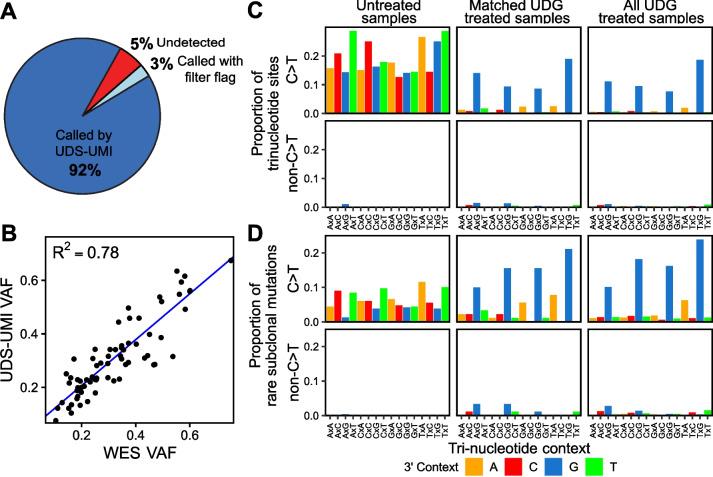
To ascertain whether putative metastatic driver mutations initially deemed specific to the metastasis by whole exome sequencing were, in actuality, present within rare ancestral subclones of the primary tumors from which they arose, we employed error-controlled ultra-deep sequencing (UDS-UMI) coupled with FFPE artifact mitigation by uracil-DNA glycosylase (UDG) to assess the presence of 132 "metastasis-specific" mutations within antecedent primary tumors from 21 patients. Maximum mutation detection sensitivity was ~1% of primary tumor cells. A conceptual framework was developed to estimate relative likelihoods of alternative models of mutation acquisition.
RESULTS
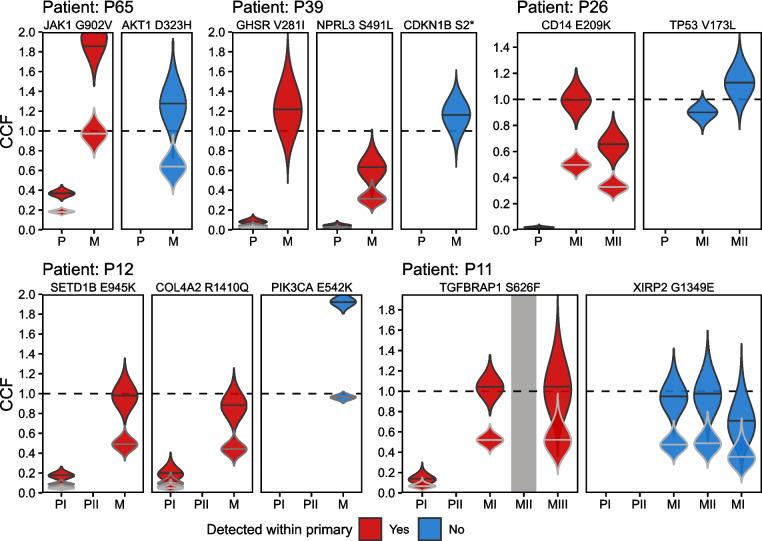
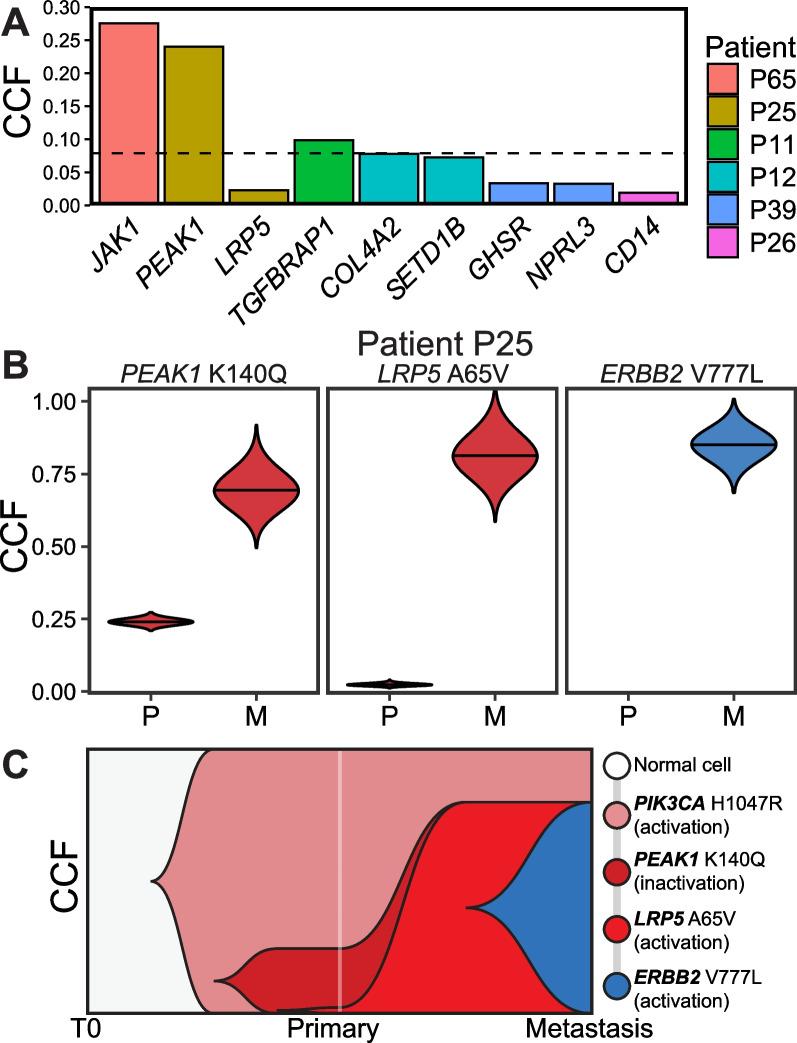
The ancestral primary tumor subclone responsible for seeding the metastasis was identified in 29% of patients, implicating several putative drivers in metastatic seeding including LRP5 A65V and PEAK1 K140Q. Despite this, 93% of metastasis-specific mutations in putative metastatic driver genes remained undetected within primary tumors, as did 96% of metastasis-specific mutations in known breast cancer drivers, including ERRB2 V777L, ESR1 D538G, and AKT1 D323H. Strikingly, even in those cases in which the rare ancestral subclone was identified, 87% of metastasis-specific putative driver mutations remained undetected. Modeling indicated that the sequential acquisition of multiple metastasis-specific driver or passenger mutations within the same rare subclonal lineage of the primary tumor was highly improbable.
CONCLUSIONS
Our results strongly suggest that metastatic driver mutations are sequentially acquired and selected within the same clonal lineage both before, but more commonly after, dissemination from the primary tumor, and that these mutations are biologically consequential. Despite inherent limitations in sampling archival primary tumors, our findings indicate that tumor cells in most patients continue to undergo clinically relevant genomic evolution after their dissemination from the primary tumor. This provides further evidence that metastatic recurrence is a multi-step, mutation-driven process that extends beyond primary tumor dissemination and underscores the importance of longitudinal tumor assessment to help guide clinical decisions.
背景
乳腺癌进展的进化模型在多大程度上存在于原发性肿瘤中存在转移潜能方面存在差异。尽管转移性复发通常携带假定的驱动突变,这些突变在使用标准测序技术的其前体原发性肿瘤中未被检测到,但这些突变是在播散之前还是之后获得的尚不清楚。
方法
为了确定通过全外显子组测序最初被认为是特定于转移的假定转移性驱动突变实际上是否存在于它们起源的原发性肿瘤的罕见祖先亚克隆中,我们采用了误差控制的超深度测序(UDS-UMI)并结合尿嘧啶-DNA 糖基化酶(UDG)来减轻 FFPE 伪影,以评估 21 名患者的前体原发性肿瘤中 132 个“转移性特异性”突变的存在情况。最大的突变检测灵敏度约为原发性肿瘤细胞的 1%。提出了一个概念框架来估计替代突变获取模型的相对可能性。
结果
在 29%的患者中确定了播种转移的祖先后代原发性肿瘤亚克隆,这表明包括 LRP5 A65V 和 PEAK1 K140Q 在内的几个假定驱动因子参与了转移性播种。尽管如此,在原发性肿瘤中仍未检测到假定转移性驱动基因中的 93%的转移特异性突变,在已知的乳腺癌驱动基因中也未检测到 96%的转移特异性突变,包括 ERRB2 V777L、ESR1 D538G 和 AKT1 D323H。引人注目的是,即使在确定了罕见祖先亚克隆的情况下,87%的转移特异性假定驱动突变仍未被检测到。建模表明,在原发性肿瘤的同一罕见亚克隆谱系中,多次获得多个转移特异性驱动或乘客突变的顺序发生的可能性极小。
结论
我们的结果强烈表明,转移性驱动突变是在原发性肿瘤播散之前和之后,在同一克隆谱系中顺序获得和选择的,并且这些突变具有生物学意义。尽管对存档原发性肿瘤进行采样存在固有局限性,但我们的发现表明,大多数患者的肿瘤细胞在从原发性肿瘤播散后仍继续经历具有临床意义的基因组进化。这进一步表明转移复发是一个多步骤的、突变驱动的过程,它不仅限于原发性肿瘤的播散,并且强调了纵向肿瘤评估的重要性,以帮助指导临床决策。

 Zotero 插件