Cancer Research Center, Sheba Medical Center, Tel-Hashomer, Israel.
Breast Oncology Institute, Sheba Medical Center, Tel-Hashomer, Israel.
Breast Cancer Res. 2020 Feb 3;22(1):16. doi: 10.1186/s13058-020-1246-5.
Emerging mutations in the ESR1 gene that encodes for the estrogen receptor (ER) are associated with resistance to endocrine therapy. ESR1 mutations rarely exist in primary tumors (~ 1%) but are relatively common (10-50%) in metastatic, endocrine therapy-resistant cancers and are associated with a shorter progression-free survival. Little is known about the incidence and clinical implication of these mutations in early recurrence events, such as local recurrences or newly diagnosed metastatic disease.
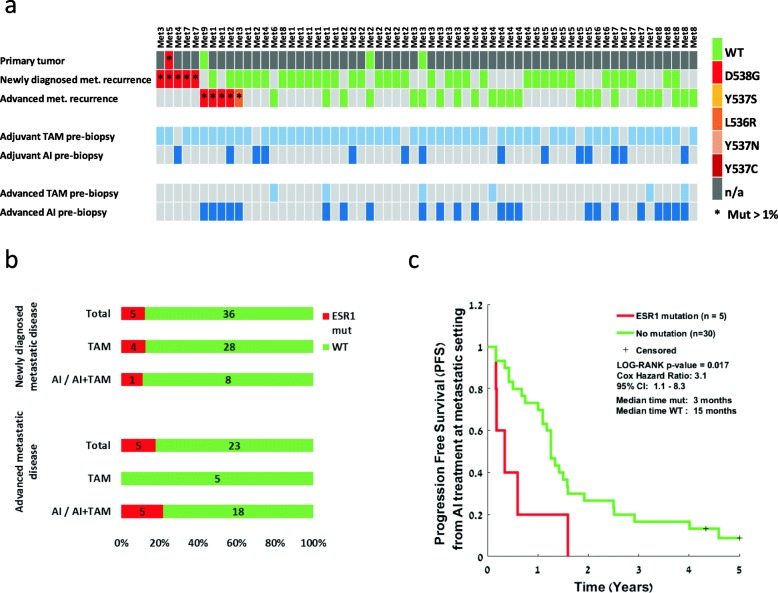
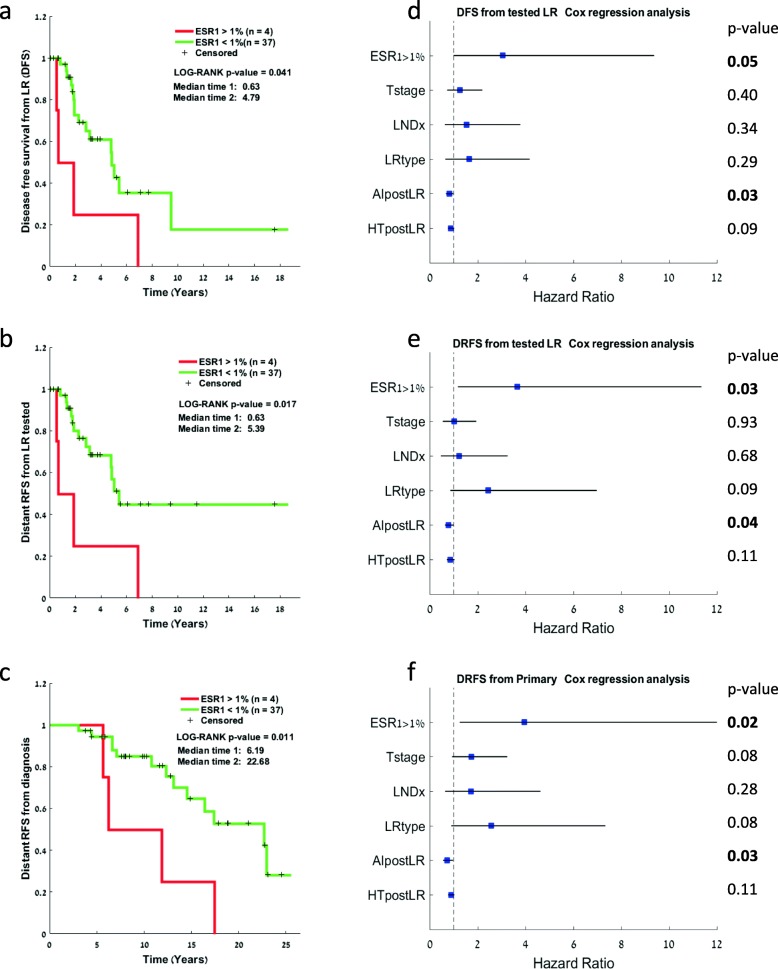
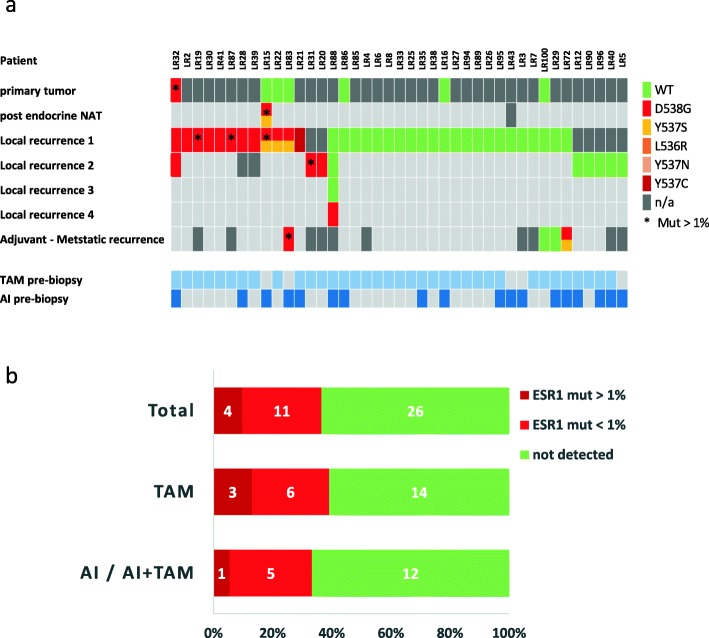
We collected 130 archival tumor samples from 103 breast cancer patients treated with endocrine therapy prior to their local/metastatic recurrence. The cohort consisted of 41 patients having at least 1 sample from local/loco-regional recurrence and 62 patients with metastatic disease (of whom 41 newly diagnosed and 28 with advanced disease). The 5 most common ESR1 hotspot mutations (D538G, L536R, Y537S/N/C) were analyzed either by targeted sequencing or by droplet digital PCR. Progression-free survival (PFS), disease-free survival (DFS), and distant recurrence-free survival (DRFS) were statistically tested by Kaplan-Meier analysis.
The prevalence of ESR1 mutations was 5/41 (12%) in newly diagnosed metastatic patients and 5/28 (18%) for advanced metastases, detected at allele frequency > 1%. All mutations in advanced metastases were detected in patients previously treated with both tamoxifen (TAM) and aromatase inhibitors (AI). However, in newly diagnosed metastatic patients, 4/5 mutations occurred in patients treated with TAM alone. PFS on AI treatment in metastatic patients was significantly shorter for ESR1 mutation carriers (p = 0.017). In the local recurrence cohort, ESR1 mutations were identified in 15/41 (36%) patients but only 4/41 (10%) were detected at allele frequency > 1%. Again, most mutations (3/4) were detected under TAM monotherapy. Notably, 1 patient developed ESR1 mutation while on neoadjuvant endocrine therapy. DFS and DRFS were significantly shorter (p = 0.04 and p = 0.017, respectively) in patients that had ESR1 mutations (> 1%) in their loco-regional recurrence tumor.
Clinically relevant ESR1 mutations are prevalent in newly diagnosed metastatic and local recurrence of endocrine-treated breast cancer. Since local recurrences are amenable to curative therapy, these mutations may inform the selection of subsequent endocrine therapies.
编码雌激素受体(ER)的 ESR1 基因的新出现突变与内分泌治疗耐药有关。ESR1 突变在原发性肿瘤中很少见(~1%),但在转移性、内分泌治疗耐药的癌症中相对常见(10-50%),与无进展生存期缩短有关。关于这些突变在早期复发事件(如局部复发或新诊断的转移性疾病)中的发生率和临床意义知之甚少。
我们收集了 103 例接受内分泌治疗的乳腺癌患者的 130 个存档肿瘤样本,这些患者在局部/远处转移复发之前接受了治疗。该队列包括 41 例至少有 1 例来自局部/局部区域复发的患者和 62 例转移性疾病患者(其中 41 例为新诊断患者,28 例为晚期疾病患者)。通过靶向测序或液滴数字 PCR 分析了 5 种最常见的 ESR1 热点突变(D538G、L536R、Y537S/N/C)。通过 Kaplan-Meier 分析统计测试无进展生存期(PFS)、无病生存期(DFS)和远处无复发生存期(DRFS)。
新诊断的转移性患者中 ESR1 突变的发生率为 5/41(12%),晚期转移患者中为 5/28(18%),等位基因频率>1%。高级别转移患者中的所有突变均在先前接受他莫昔芬(TAM)和芳香化酶抑制剂(AI)治疗的患者中检测到。然而,在新诊断的转移性患者中,5 个突变中有 4 个发生在单独接受 TAM 治疗的患者中。携带 ESR1 突变的转移性患者接受 AI 治疗的 PFS 明显缩短(p=0.017)。在局部复发队列中,41 例患者中有 15/41(36%)检测到 ESR1 突变,但只有 41/41(10%)检测到等位基因频率>1%。同样,大多数突变(3/4)在 TAM 单药治疗下检测到。值得注意的是,1 例患者在新辅助内分泌治疗期间发生 ESR1 突变。在局部区域复发肿瘤中存在 ESR1 突变(>1%)的患者,DFS 和 DRFS 明显缩短(p=0.04 和 p=0.017)。
在接受内分泌治疗的新诊断转移性和局部复发的乳腺癌中,临床上相关的 ESR1 突变很常见。由于局部复发可通过根治性治疗,这些突变可能有助于选择后续的内分泌治疗。