Medical Education Department, Educational Development Center, Shahid Sadoughi University of Medical Sciences, Yazd, Iran.
National Agency for Strategic Research in Medical Education, Tehran, Iran.
BMC Med Educ. 2024 Feb 8;24(1):127. doi: 10.1186/s12909-024-05095-w.
The present study aimed to assess the status of workplace mental health from the viewpoints of educators, and explore their experiences concerning influential factors on occupational mental health at Shahid Sadoughi University of Medical Sciences.
The study was a sequential mixed-method study that was conducted in quantitative and qualitative phases. In the quantitative phase, the perception of educators (n = 205) was assessed by a Workplace Mental Health Questionnaire, including 37 items in 9 categories (including an opportunity to control, an opportunity to use skills, external goals created, environmental diversity, environmental clarity, access to money, physical security, opportunity to contact others, and valuable social status and position). In the qualitative phase, data were collected using semi-structured interviews (n = 21) and were analyzed based on the conventional content analysis approach.
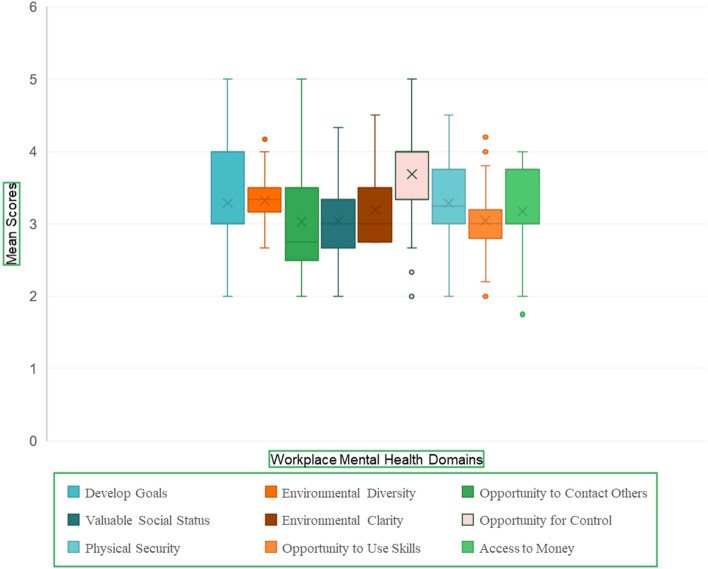
The results showed that the status of workplace mental health of educators was at a moderate level (mean (± SD) = 115.87 (±3.21). The highest and lowest scores of the median were reported in the domains of "opportunity for control" (median = 4) and "opportunity to contact others" (median = 2.75), respectively. The theme of "contrast between preferences and disappointments in the development path" with two categories including "induced demotivation of system elements" and "tendencies of promotion" was explored from the educators' perspective.
The results indicated the moderate level of mental health of educators was influenced by the contrast between preferences and disappointments in the development path. The tendency of educators for promotion was explored as a positive factor in the mental health of educators in the academic environment. A growing desire for creative advancement among educators as a personal factor and a demand to stay updated with all developments as a system factor explained the positive experiences of educators in the university. The results showed the gap between the current situation and the desired state of occupational mental health may result from cultural challenges, lack of adherence to professionalism at the personal level (non-compliance with the principles of well-being and excellence), and interpersonal level (non-compliance with respect, justice, etc.). Moreover, factors disrupting occupational mental health at the system level explored in job stress, a resilient culture, lack of managerial support, ingratitude, lack of reward-effort matching mechanism, and lack of resources.
本研究旨在从教育工作者的角度评估工作场所心理健康状况,并探讨他们在沙希德·萨多希医科大学(Shahid Sadoughi University of Medical Sciences)对职业心理健康有影响因素的经验。
这是一项顺序混合方法研究,包括定量和定性两个阶段。在定量阶段,通过工作场所心理健康问卷评估教育工作者的认知(n=205),该问卷包括 9 个类别的 37 个项目(包括控制机会、使用技能机会、外部目标创造、环境多样性、环境清晰度、获得资金、物理安全、与他人联系机会以及有价值的社会地位和职位)。在定性阶段,采用半结构化访谈(n=21)收集数据,并采用传统的内容分析方法进行分析。
结果表明,教育工作者的工作场所心理健康状况处于中等水平(平均值(±SD)=115.87(±3.21)。中位数的最高和最低分数分别报告在“控制机会”领域(中位数=4)和“与他人联系机会”领域(中位数=2.75)。从教育工作者的角度探讨了“发展路径中偏好与失望的对比”这一主题,该主题包含两个类别,分别是“系统元素的激励缺失”和“晋升倾向”。
结果表明,教育工作者的心理健康水平处于中等水平,受到发展路径中偏好与失望的对比影响。教育工作者的晋升倾向被视为学术环境中教育工作者心理健康的积极因素。教育工作者作为个人因素对创造性进步的渴望增长以及作为系统因素的更新所有发展的需求解释了教育工作者的积极体验。结果表明,职业心理健康的现状与理想状态之间的差距可能是由于文化挑战、个人层面(不遵守幸福和卓越原则)和人际层面(不遵守尊重、正义等原则)缺乏专业性造成的。此外,在工作压力、弹性文化、缺乏管理支持、忘恩负义、缺乏奖励-努力匹配机制和缺乏资源等系统层面探索了破坏职业心理健康的因素。