Substitutive Dental Science Department, College of Dentistry, Taibah University, Al-Madinah, Saudi Arabia.
Department of Prosthodontics, Faculty of Dentistry, Ibb University, Ibb, Yemen.
Clin Exp Dent Res. 2024 Feb;10(1):e858. doi: 10.1002/cre2.858.
The purpose of this study is to investigate the type of ridge (degree of angulation of the lingual concavity) and the buccolingual dimensions in the area of the first and second molars in both genders of different ages and how this will affect implant placement in the posterior mandible.
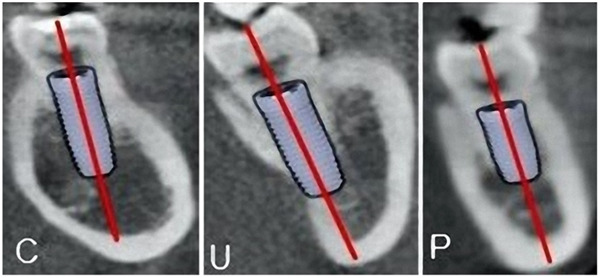
This retrospective cross-sectional study comprised cone beam computed tomography images of 150 dental patients (75 males and 71 aged ≥30). The following were measured/reported: type (morphology) of the ridge (convex [C], parallel [P], or undercut [U]), buccolingual width at the base and the crest of the ridge, and ridge height. The concavity angle, depth, and length of the U-shaped ridge were measured too.
The prevalence of type U ridge ranged from 32.7% in the first molar region to 62.7% in the second molar region. Almost all measurements and ridge type distributions were comparable amongst the age groups (p > .05). Very few significant differences were found when comparing #36 versus #37 and #46 versus #47 teeth, with no differences in the distribution of the ridge types (p > .05). Quite the inverse, all measurements were statistically different when comparing #36 versus #37 and #46 versus #47 teeth, and type U ridge was more frequent in second molar compared to the first molar regions, respectively (p < .05). Many measurements were statistically higher in females; the inverse was true for a few measurements (p < .05). Type U ridge in #36 and #37 was found more frequently among males (p < .001). In contrast, the ridge types in #37 and #47 were not statistically different gender-wise.
The U type of ridge was more prevalent in the investigated population, encountered more frequently in the second molars generally and in the first molars of males than females. Most posterior mandibular measurements are similar age- and side-wise but seem different gender- and tooth-wise.
本研究旨在探讨不同性别、不同年龄患者第一、二磨牙区颊舌向宽度和牙槽嵴形态(颊舌向凹陷角度),及其对下颌后牙区种植体植入的影响。
本回顾性横断面研究纳入了 150 例(75 名男性,71 名年龄≥30 岁)患者的锥形束 CT 图像。报告并测量了以下内容:牙槽嵴形态(凸形[C]、平行形[P]或凹陷形[U])、牙槽嵴底部和顶部的颊舌向宽度、牙槽嵴高度。还测量了 U 形牙槽嵴的凹陷角度、深度和长度。
U 形牙槽嵴的发生率从第一磨牙区的 32.7%到第二磨牙区的 62.7%不等。各年龄组之间的各项测量值和嵴形分布差异均无统计学意义(p>.05)。比较 #36 和 #37 以及 #46 和 #47 时,仅少数测量值和嵴形分布存在显著差异(p>.05)。相比之下,比较 #36 和 #37 以及 #46 和 #47 时,所有测量值均有统计学差异,且第二磨牙区的 U 形嵴发生率明显高于第一磨牙区(p<.05)。女性的多数测量值更高,少数测量值则相反(p<.05)。男性 #36 和 #37 的 U 形嵴更为常见(p<.001)。相比之下,#37 和 #47 的嵴形在性别间无统计学差异。
在所研究的人群中,U 形嵴更为常见,一般而言,第二磨牙区的 U 形嵴更为常见,且男性的第一磨牙区 U 形嵴发生率高于女性。大多数下颌后牙区的测量值在年龄和侧别上相似,但在性别和牙位上存在差异。