
高血压中噻嗪类药物反应的循环微小RNA生物标志物
Circulating microRNA Biomarkers of Thiazide Response in Hypertension.
作者信息
Chekka Lakshmi Manasa S, Tantawy Marwa, Langaee Taimour, Wang Danxin, Renne Rolf, Chapman Arlene B, Gums John G, Boerwinkle Eric, Cooper-DeHoff Rhonda M, Johnson Julie A
机构信息
Department of Pharmacotherapy and Translational Research and Center for Pharmacogenomics and Precision Medicine University of Florida Gainesville FL.
Department of Molecular Genetics and Microbiology, College of Medicine University of Florida Gainesville FL.
出版信息
J Am Heart Assoc. 2024 Feb 20;13(4):e032433. doi: 10.1161/JAHA.123.032433. Epub 2024 Feb 14.
BACKGROUND
Thiazide diuretics are the second most frequently prescribed class of antihypertensives, but up to 50% of patients with hypertension have minimal antihypertensive response to thiazides. We explored circulating microRNAs (miRNAs) in search of predictive biomarkers of thiazide response.
METHODS AND RESULTS
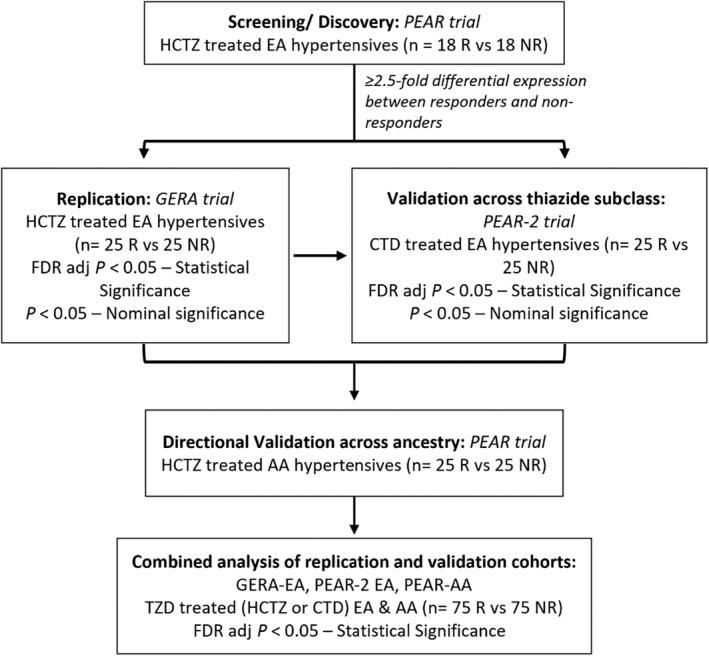
We profiled 754 miRNAs in baseline plasma samples of 36 hypertensive European American adults treated with hydrochlorothiazide, categorized into responders (n=18) and nonresponders (n=18) on the basis of diastolic blood pressure response to hydrochlorothiazide. miRNAs with ≥2.5-fold differential expression between responders and nonresponders were considered for validation in 3 cohorts (n=50 each): hydrochlorothiazide-treated European Americans, chlorthalidone-treated European Americans, and hydrochlorothiazide-treated Black individuals. Different blood pressure phenotypes including categorical (responder versus nonresponder) and continuous diastolic blood pressure and systolic blood pressure were tested for association with the candidate miRNA expression using multivariate regression analyses adjusting for age, sex, and baseline blood pressure. After quality control, 74 miRNAs were available for screening, 19 of which were considered for validation. In the validation cohort, miR-193b-3p and 30d-5p showed significant associations with continuous SBP or diastolic blood pressure response or both, to hydrochlorothiazide in European Americans at Benjamini-Hochberg adjusted <0.05. In the combined analysis of validation cohorts, let-7g (odds ratio, 0.6 [95% CI, 0.4-0.8]), miR-142-3p (odds ratio, 1.1 [95% CI, 1.0, 1.2]), and miR-423-5p (odds ratio, 0.7 [95% CI, 0.5-0.9]) associated with categorical diastolic blood pressure response at Benjamini-Hochberg adjusted <0.05. Predicted target genes of the 5 miRNAs were mapped to key hypertension pathways: lysine degradation, fatty acid biosynthesis, and metabolism.
CONCLUSIONS
The above identified circulating miRNAs may have a potential for clinical use as biomarkers for thiazide diuretic selection in hypertension.
REGISTRATION
URL: ClinicalTrials.gov. Unique identifiers: NCT00246519, NCT01203852, NCT00005520.
背景
噻嗪类利尿剂是第二常用的抗高血压药物类别,但高达50%的高血压患者对噻嗪类药物的降压反应极小。我们探索了循环微RNA(miRNA),以寻找噻嗪类反应的预测生物标志物。
方法与结果
我们对36名接受氢氯噻嗪治疗的欧美高血压成年患者的基线血浆样本中的754种miRNA进行了分析,根据对氢氯噻嗪的舒张压反应将其分为反应者(n = 18)和无反应者(n = 18)。反应者与无反应者之间差异表达≥2.5倍的miRNA被纳入在3个队列(各n = 50)中进行验证:接受氢氯噻嗪治疗的欧美人群、接受氯噻酮治疗的欧美人群以及接受氢氯噻嗪治疗的黑人个体。使用多变量回归分析对年龄、性别和基线血压进行校正,测试包括分类(反应者与无反应者)以及连续的舒张压和收缩压在内的不同血压表型与候选miRNA表达之间的关联。经过质量控制后,有74种miRNA可用于筛选,其中19种被纳入验证。在验证队列中,miR-193b-3p和30d-5p在Benjamini-Hochberg校正P<0.05时,与欧美人群对氢氯噻嗪的连续收缩压或舒张压反应或两者均有显著关联。在验证队列的联合分析中,let-7g(比值比,0.6 [95% CI,0.4 - 0.8])、miR-142-3p(比值比,1.1 [95% CI,1.0,1.2])和miR-423-5p(比值比,0.7 [95% CI,0.5 - 0.9])在Benjamini-Hochberg校正P<0.05时与分类舒张压反应相关。这5种miRNA的预测靶基因被映射到关键的高血压途径:赖氨酸降解、脂肪酸生物合成和代谢。
结论
上述鉴定出的循环miRNA可能有潜力作为高血压中噻嗪类利尿剂选择的生物标志物用于临床。
注册信息
网址:ClinicalTrials.gov。唯一标识符:NCT00246519、NCT01203852、NCT00005520。


 Zotero 插件