Translational and Clinical Research Institute, Faculty of Medical Sciences, Newcastle University, Newcastle Upon Tyne, UK.
Biosciences, Faculty of Medical Sciences, Newcastle University, Newcastle Upon Tyne, UK.
Acta Neuropathol. 2024 Feb 14;147(1):40. doi: 10.1007/s00401-024-02691-4.
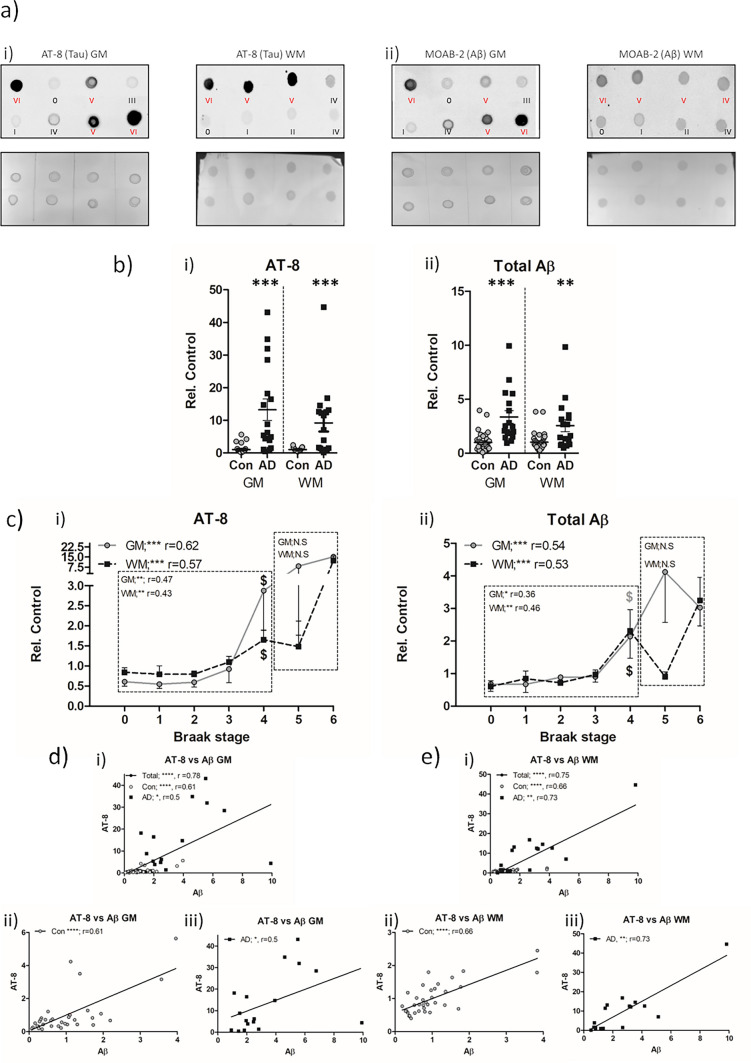
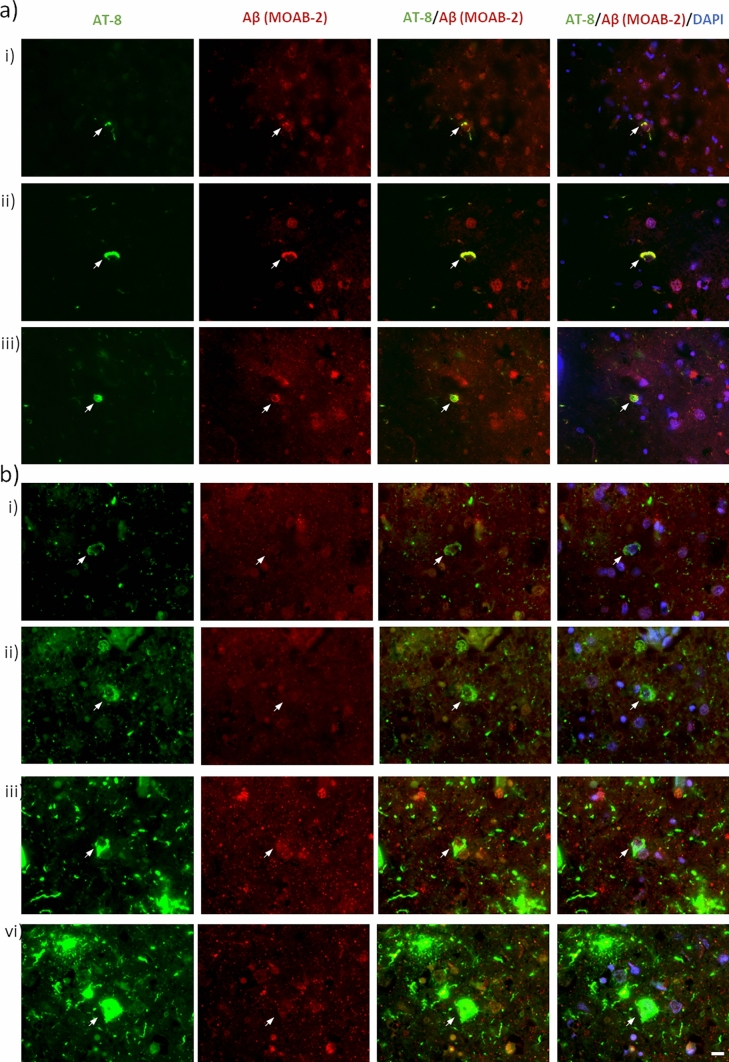
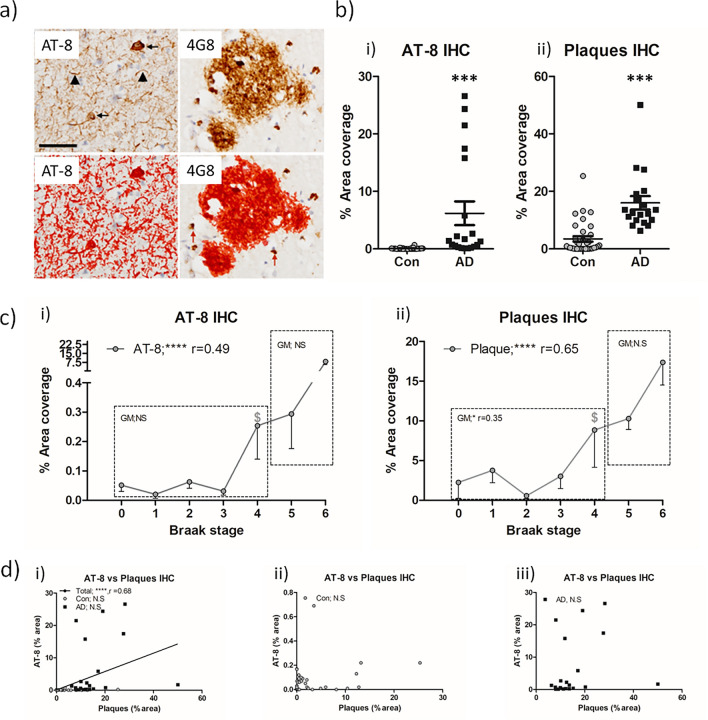
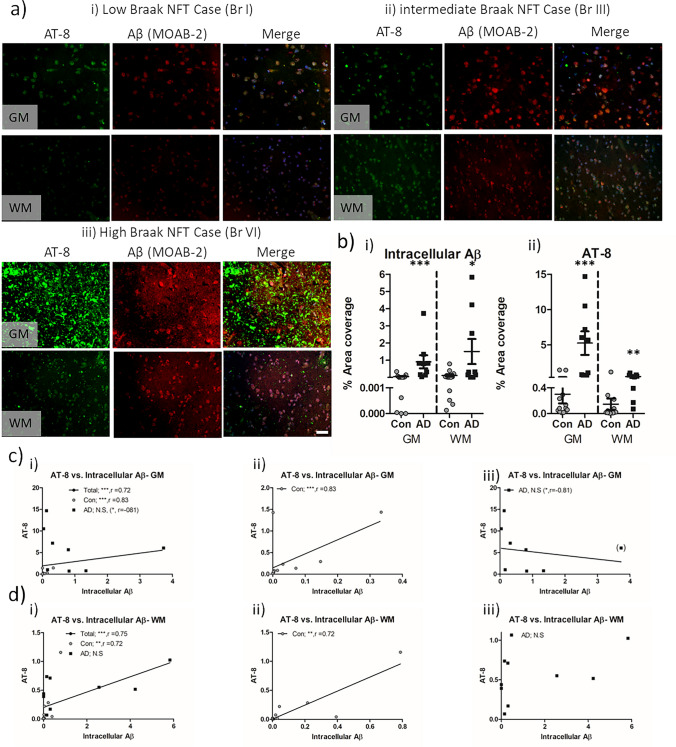
The amyloid cascade hypothesis states that Aβ aggregates induce pathological changes in tau, leading to neurofibrillary tangles (NFTs) and cell death. A caveat with this hypothesis is the spatio-temporal divide between plaques and NFTs. This has been addressed by the inclusion of soluble Aβ and tau species in the revised amyloid cascade hypothesis. Nevertheless, despite the potential for non-plaque Aβ to contribute to tau pathology, few studies have examined relative correlative strengths between total Aβ, plaque Aβ and intracellular Aβ with tau pathology within a single tissue cohort. Employing frozen and fixed frontal cortex grey and white matter tissue from non-AD controls (Con; n = 39) and Alzheimer's disease (AD) cases (n = 21), biochemical and immunohistochemical (IHC) measures of Aβ and AT-8 phosphorylated tau were assessed. Biochemical native-state dot blots from crude tissue lysates demonstrated robust correlations between total Aβ and AT-8 tau, when considered as a combined cohort (Con and AD) and when as Con and AD cases, separately. In contrast, no associations between Aβ plaques and AT-8 were reported when using IHC measurements in either Con or AD cases. However, when intracellular Aβ was measured via the Aβ specific antibody MOAB-2, a correlative relationship with AT-8 tau was reported in non-AD controls but not in AD cases. Collectively the data suggests that accumulating intracellular Aβ may influence AT-8 pathology, early in AD-related neuropathological change. Despite the lower levels of phospho-tau and Aβ in controls, the robust correlative relationships observed suggest a physiological association of Aβ production and tau phosphorylation, which may be modified during disease. This study is supportive of a revised amyloid cascade hypothesis and demonstrates regional associative relationships between tau pathology and intracellular Aβ, but not extracellular Aβ plaques.
淀粉样蛋白级联假说指出,Aβ 聚集诱导 tau 发生病理性变化,导致神经原纤维缠结(NFT)和细胞死亡。该假说存在一个问题,即斑块和 NFT 之间存在时空分离。这一问题已通过在修正的淀粉样蛋白级联假说中纳入可溶性 Aβ 和 tau 物种得到解决。然而,尽管非斑块 Aβ 有可能导致 tau 病理学改变,但很少有研究在单个组织队列中检查总 Aβ、斑块 Aβ 和细胞内 Aβ 与 tau 病理学之间的相对相关性。本研究使用来自非 AD 对照(Con;n = 39)和阿尔茨海默病(AD)病例(n = 21)的冷冻和固定额皮质灰质和白质组织,评估了 Aβ 和 AT-8 磷酸化 tau 的生化和免疫组织化学(IHC)测量。从粗组织裂解物的天然状态点印迹显示,当考虑到总 Aβ 和 AT-8 tau 作为一个综合队列(Con 和 AD)时,以及当分别考虑 Con 和 AD 病例时,两者之间存在很强的相关性。相比之下,在用 IHC 测量 Con 或 AD 病例时,均未报道 Aβ 斑块与 AT-8 之间存在相关性。然而,当通过 Aβ 特异性抗体 MOAB-2 测量细胞内 Aβ 时,在非 AD 对照中报告了与 AT-8 tau 的相关性,但在 AD 病例中没有报告。总的来说,数据表明,在 AD 相关神经病理学变化的早期,积累的细胞内 Aβ 可能会影响 AT-8 病理学。尽管对照者的磷酸化 tau 和 Aβ 水平较低,但观察到的强相关性表明 Aβ 产生和 tau 磷酸化之间存在生理关联,这种关联可能在疾病过程中发生改变。这项研究支持修正的淀粉样蛋白级联假说,并证明了 tau 病理学与细胞内 Aβ 之间存在区域性关联,但与细胞外 Aβ 斑块无关。