Iyer Priyanka, Mok Valerie, Sehmbi Arjan Singh, Kessaris Nicos, Zakri Rhana, Dasgupta Prokar, Chandak Pankaj
Faculty of Life Sciences and Medicine King's College London London UK.
Faculty of Medicine University of British Columbia Vancouver British Columbia Canada.
Health Sci Rep. 2024 Feb 13;7(2):e1889. doi: 10.1002/hsr2.1889. eCollection 2024 Feb.
The coronavirus disease 2019 (COVID-19) pandemic stimulated a paradigm shift in medical and surgical education from in-person teaching to online teaching. It is unclear whether an in-person or online approach to surgical teaching for medical students is superior. We aim to compare the outcomes of in-person versus online surgical teaching in generating interest in and improving knowledge of surgery in medical students. We also aim the quantify the impact of a peer-run surgical teaching course.
A six-session course was developed by medical students and covered various introductory surgical topics. The first iteration was offered online to 70 UK medical students in March 2021, and the second iteration was in-person for 20 students in November 2021. Objective and subjective knowledge was assessed through questionnaires before and after each session, and also for the entire course. Data were analyzed from this mixed-methods study to compare the impact of online versus in-person teaching on surgical knowledge and engagement.
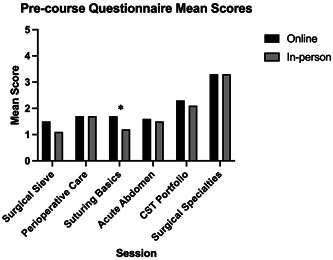
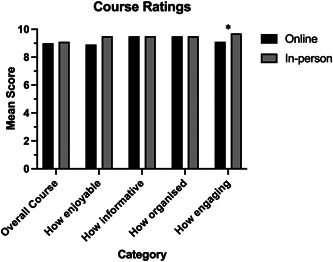
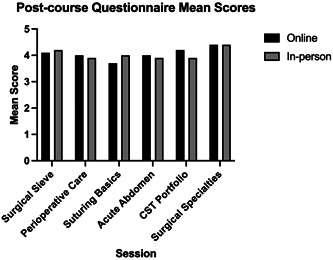
Students in both iterations showed significant improvement of 33%-282% across the six sessions in knowledge and confidence after completing the course ( < 0.001). There was no significant difference in the level of objective knowledge, enjoyment, or organization of the course between online and in-person groups, although the in-person course was rated as more engaging (mean Likert score 9.1 vs. 9.7, = 0.033).
Similar objective and subjective surgical teaching outcomes were achieved in both iterations, including in "hands-on" topics such as suturing, gowning, and gloving. Students who completed the online course did not have any lower knowledge or confidence in their surgical skills; however, the in-person course was reported to be more engaging. Surgical teaching online and in-person may be similarly effective and can be delivered according to what is most convenient for the circumstances, such as in COVID-19.
2019年冠状病毒病(COVID-19)大流行促使医学和外科教育从面对面教学向在线教学发生了范式转变。目前尚不清楚针对医学生的外科教学采用面对面教学还是在线教学更为优越。我们旨在比较面对面教学与在线外科教学在激发医学生对手术的兴趣和提高其手术知识方面的效果。我们还旨在量化同伴主导的外科教学课程的影响。
医学生开发了一个为期六节的课程,涵盖了各种外科入门主题。第一次授课于2021年3月在线提供给70名英国医学生,第二次授课于2021年11月面对面进行,有20名学生参加。在每节课前后以及整个课程结束后,通过问卷调查评估客观知识和主观知识。对这项混合方法研究的数据进行分析,以比较在线教学与面对面教学对手术知识和参与度的影响。
在完成课程后,两个班次的学生在六节课中的知识和信心方面均有显著提高,提高幅度在33%至282%之间(<0.001)。在线组和面对面组在客观知识水平、课程趣味性或课程组织方面没有显著差异,尽管面对面课程的参与度评分更高(平均李克特量表得分9.1对9.7,=0.033)。
两个班次都取得了相似的客观和主观外科教学效果,包括在缝合、穿手术衣和戴手套等“实践操作”主题方面。完成在线课程的学生在手术技能方面的知识或信心并不更低;然而,据报告面对面课程更具吸引力。在线和面对面的外科教学可能同样有效,可以根据具体情况选择最方便的方式进行,例如在COVID-19疫情期间。