Leonard Alexis, Weiss Mitchell J
Department of Hematology, St. Jude Children's Research Hospital, Memphis, Tennessee, USA.
Curr Opin Hematol. 2024 May 1;31(3):104-114. doi: 10.1097/MOH.0000000000000807. Epub 2024 Feb 9.
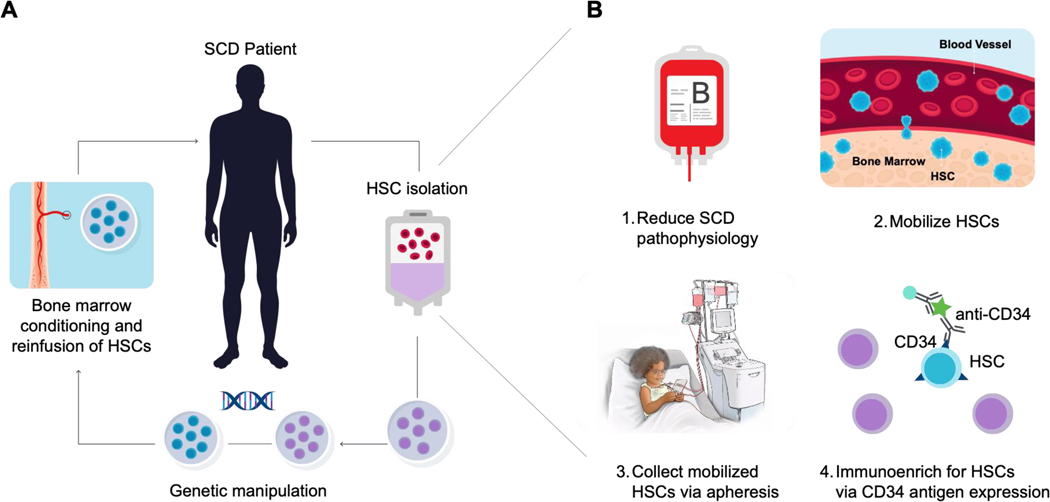
Gene therapy for sickle cell disease (SCD) is advancing rapidly, with two transformative products recently approved by the US Food and Drug Administration and numerous others under study. All current gene therapy protocols require ex vivo modification of autologous hematopoietic stem cells (HSCs). However, several SCD-related problems impair HSC collection, including a stressed and damaged bone marrow, potential cytotoxicity by the major therapeutic drug hydroxyurea, and inability to use granulocyte colony stimulating factor, which can precipitate severe vaso-occlusive events.
Peripheral blood mobilization of HSCs using the CXCR4 antagonist plerixafor followed by apheresis collection was recently shown to be safe and effective for most SCD patients and is the current strategy for mobilizing HSCs. However, exceptionally large numbers of HSCs are required to manufacture an adequate cellular product, responses to plerixafor are variable, and most patients require multiple mobilization cycles, increasing the risk for adverse events. For some, gene therapy is prohibited by the failure to obtain adequate numbers of HSCs.
Here we review the current knowledge on HSC collection from individuals with SCD and potential improvements that may enhance the safety, efficacy, and availability of gene therapy for this disorder.
镰状细胞病(SCD)的基因治疗正在迅速发展,美国食品药品监督管理局最近批准了两种具有变革性的产品,还有许多其他产品正在研究中。目前所有的基因治疗方案都需要对自体造血干细胞(HSC)进行体外修饰。然而,一些与SCD相关的问题会影响HSC的采集,包括骨髓应激和损伤、主要治疗药物羟基脲的潜在细胞毒性,以及无法使用粒细胞集落刺激因子,因为它可能引发严重的血管闭塞事件。
最近研究表明,使用CXCR4拮抗剂普乐沙福进行外周血造血干细胞动员,随后进行单采术采集,对大多数SCD患者来说是安全有效的,这也是目前动员造血干细胞的策略。然而,制备足够的细胞产品需要大量的造血干细胞,对普乐沙福的反应存在差异,大多数患者需要多个动员周期,这增加了不良事件的风险。对于一些患者来说,由于无法获得足够数量的造血干细胞,基因治疗是被禁止的。
在此,我们综述了目前关于从SCD患者中采集造血干细胞的知识,以及可能提高该疾病基因治疗安全性、有效性和可及性的潜在改进措施。