School of Public Health, Capital Medical University, Beijing, China.
Department of Health Education, Beijing Huairou Hospital of University of Chinese Academy of Sciences, Beijing, China.
BMC Health Serv Res. 2024 Feb 15;24(1):213. doi: 10.1186/s12913-024-10606-y.
Family doctor contract services (FDCS) have been introduced in China in 2009 [1] and rapidly expanded recently. This study sought to investigate factors that influenced the willingness of Chinese residents to use FDCS.
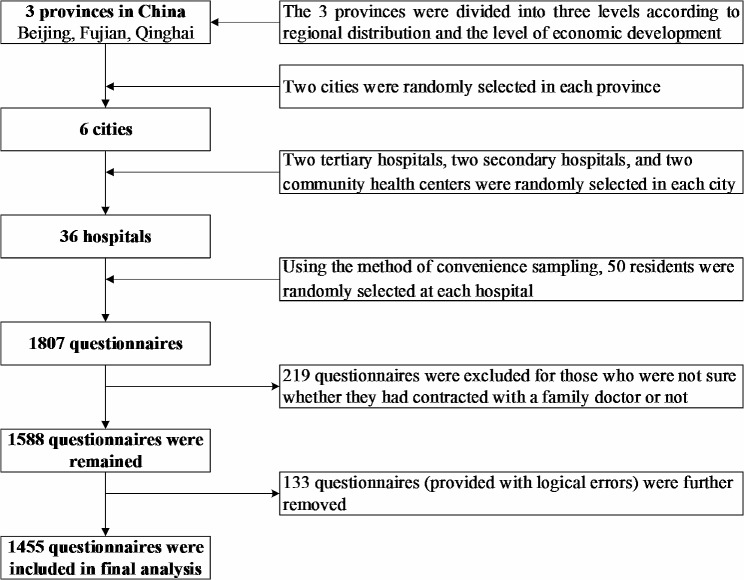
We employed multistage stratified and convenience sampling to administer questionnaires to 1455 Beijing, Qinghai, and Fujian residents. The willingness of residents in each province to contract family doctors was analyzed using the chi-square test and binary logistic regression.
The analysis in this study found that the signing rate of family doctors in China was about 27.77%, with differences in the signing up levels in Beijing (13.68%), Fujian (64.49%) and Qinghai (11.22%). In addition, the binary logistic regression results emphasized the relative importance of age, education, medical preference and policy knowledge on the willingness to sign up. Distrust of family doctors' medical skills (65.7%), not knowing how to contract (47.8%), and not knowing what medical problems can be solved (41.1%) were the top three reasons accounting for the reluctance of residents to contract with family doctors.
Residents from different backgrounds have different willingness to sign up, so the specific circumstances and needs of different groups should be taken into account. In order to increase the signing-up rate, consideration can be given to promoting the family doctor model in Fujian throughout the country. Individual hesitation can be eliminated by increasing the reimbursement rate of health insurance, reducing the out-of-pocket expenses of contracted patients, and providing incentives of certain discounts for consecutive contracted patients.
家庭医生签约服务(FDCS)于 2009 年在中国推出[1],并于近期迅速扩张。本研究旨在探讨影响中国居民使用 FDCS 的意愿的因素。
我们采用多阶段分层和便利抽样的方法,对北京、青海和福建的 1455 名居民进行问卷调查。采用卡方检验和二项逻辑回归分析各省居民签约家庭医生的意愿。
本研究分析发现,中国家庭医生的签约率约为 27.77%,北京(13.68%)、福建(64.49%)和青海(11.22%)的签约水平存在差异。此外,二项逻辑回归结果强调了年龄、教育、医疗偏好和政策知识对签约意愿的相对重要性。不信任家庭医生的医疗技能(65.7%)、不知道如何签约(47.8%)以及不知道哪些医疗问题可以解决(41.1%)是居民不愿意签约的前三大原因。
不同背景的居民签约意愿不同,因此应考虑不同群体的具体情况和需求。为了提高签约率,可以考虑在全国推广福建的家庭医生模式。通过提高医疗保险的报销率、降低签约患者的自付费用,并为连续签约患者提供一定折扣的激励措施,可以消除个人的犹豫。