Pedemonte B, Pereira C W, Borghesani V, Ebbert M, Allen I E, Pinheiro-Chagas P, De Leon J, Miller Z, Tee B L, Gorno-Tempini M L
Memory and Aging Center, Department of Neurology, University of California, San Francisco, CA, USA.
Dyslexia Center, University of California, San Francisco, CA, USA.
NPJ Sci Learn. 2024 Feb 15;9(1):7. doi: 10.1038/s41539-024-00217-x.
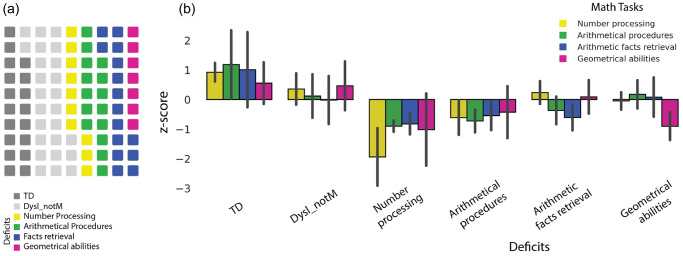
Despite a high rate of concurrent mathematical difficulties among children with dyslexia, we still have limited information regarding the prevalence and severity of mathematical deficits in this population. To address this gap, we developed a comprehensive battery of cognitive tests, known as the UCSF Mathematical Cognition Battery (MCB), with the aim of identifying deficits in four distinct mathematical domains: number processing, arithmetical procedures, arithmetic facts retrieval, and geometrical abilities. The mathematical abilities of a cohort of 75 children referred to the UCSF Dyslexia Center with a diagnosis of dyslexia, along with 18 typically developing controls aged 7 to 16, were initially evaluated using a behavioral neurology approach. A team of professional clinicians classified the 75 children with dyslexia into five groups, based on parents' and teachers' reported symptoms and clinical history. These groups included children with no mathematical deficits and children with mathematical deficits in number processing, arithmetical procedures, arithmetic facts retrieval, or geometrical abilities. Subsequently, the children underwent evaluation using the MCB to determine concordance with the clinicians' impressions. Additionally, neuropsychological and cognitive standardized tests were administered. Our study reveals that within a cohort of children with dyslexia, 66% exhibit mathematical deficits, and among those with mathematical deficits, there is heterogeneity in the nature of these deficits. If these findings are confirmed in larger samples, they can potentially pave the way for new diagnostic approaches, consistent subtype classification, and, ultimately personalized interventions.
尽管阅读障碍儿童中并发数学困难的比例很高,但我们对该人群中数学缺陷的患病率和严重程度的了解仍然有限。为了填补这一空白,我们开发了一套全面的认知测试组合,称为加州大学旧金山分校数学认知测试组合(MCB),旨在识别四个不同数学领域的缺陷:数字处理、算术程序、算术事实检索和几何能力。最初,我们采用行为神经学方法对75名被转介到加州大学旧金山分校阅读障碍中心且被诊断为阅读障碍的儿童以及18名7至16岁发育正常的对照儿童的数学能力进行了评估。一组专业临床医生根据家长和教师报告的症状及临床病史,将这75名阅读障碍儿童分为五组。这些组包括没有数学缺陷的儿童以及在数字处理、算术程序、算术事实检索或几何能力方面存在数学缺陷的儿童。随后,这些儿童接受了MCB评估,以确定与临床医生判断的一致性。此外,还进行了神经心理学和认知标准化测试。我们的研究表明,在一群阅读障碍儿童中,66%表现出数学缺陷,在那些有数学缺陷的儿童中,这些缺陷的性质存在异质性。如果这些发现在更大的样本中得到证实,它们可能为新的诊断方法、一致的亚型分类以及最终的个性化干预铺平道路。