Department of Biostatistics, Harvard T.H. Chan School of Public Health, Boston, MA, USA.
Leyden Laboratories BV, Leiden, The Netherlands.
Sci Rep. 2024 Feb 15;14(1):3818. doi: 10.1038/s41598-024-53049-5.
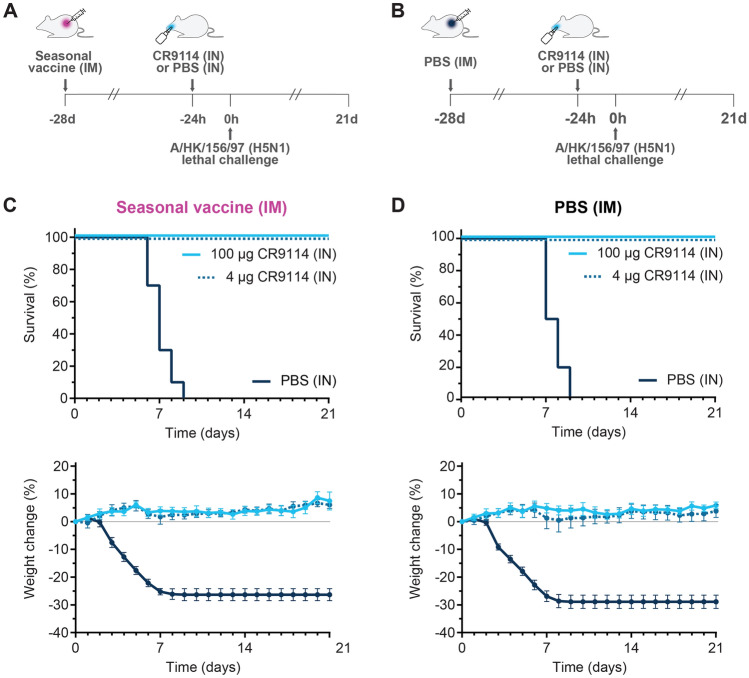
Avian A(H5N1) influenza virus poses an elevated zoonotic threat to humans, and no pharmacological products are currently registered for fast-acting pre-exposure protection in case of spillover leading to a pandemic. Here, we show that an epitope on the stem domain of H5 hemagglutinin is highly conserved and that the human monoclonal antibody CR9114, targeting that epitope, potently neutralizes all pseudotyped H5 viruses tested, even in the rare case of substitutions in its epitope. Further, intranasal administration of CR9114 fully protects mice against A(H5N1) infection at low dosages, irrespective of pre-existing immunity conferred by the quadrivalent seasonal influenza vaccine. These data provide a proof-of-concept for broad, pre-exposure protection against a potential future pandemic using the intranasal administration route. Studies in humans should assess if autonomous administration of a broadly-neutralizing monoclonal antibody is safe and effective and can thus contribute to pandemic preparedness.
禽流感(H5N1)病毒对人类构成了高等级的人畜共患病威胁,目前尚无针对溢出导致大流行情况下的快速暴露前保护作用的药理学产品。在这里,我们表明,血凝素茎域上的一个表位高度保守,针对该表位的人源单克隆抗体 CR9114 能够有效地中和所有测试的假型 H5 病毒,即使在其表位发生罕见的取代的情况下也是如此。此外,低剂量鼻内给予 CR9114 可完全保护小鼠免受 A(H5N1)感染,而与四价季节性流感疫苗赋予的预先存在的免疫无关。这些数据为使用鼻内给药途径对未来潜在大流行进行广泛的暴露前保护提供了概念验证。应在人类中开展研究,以评估自主给予广泛中和性单克隆抗体是否安全有效,从而为大流行防范做出贡献。