Kuenzig M Ellen, Bitton Alain, Carroll Matthew W, Otley Anthony R, Singh Harminder, Kaplan Gilaad G, Stukel Therese A, Mack David R, Jacobson Kevan, Griffiths Anne M, El-Matary Wael, Targownik Laura E, Nguyen Geoffrey C, Jones Jennifer L, Murthy Sanjay K, Bernstein Charles N, Lix Lisa M, Peña-Sánchez Juan Nicolás, Dummer Trevor J B, Spruin Sarah, Fung Stephen G, Nugent Zoann, Coward Stephanie, Cui Yunsong, Coulombe Janie, Filliter Christopher, Benchimol Eric I
SickKids Inflammatory Bowel Disease Centre, Division of Gastroenterology, Hepatology and Nutrition, The Hospital for Sick Children, Toronto, ON, Canada.
Child Health Evaluative Sciences, SickKids Research Institute, The Hospital for Sick Children, Toronto, ON, Canada.
Inflamm Bowel Dis. 2024 Dec 5;30(12):2356-2369. doi: 10.1093/ibd/izae010.
Patterns of health services utilization among children with inflammatory bowel disease (IBD) are important to understand as the number of children with IBD continues to increase. We compared health services utilization and surgery among children diagnosed <10 years of age (Paris classification: A1a) and between 10 and <16 years of age (A1b).
Incident cases of IBD diagnosed <16 years of age were identified using validated algorithms from deterministically linked health administrative data in 5 Canadian provinces (Alberta, Manitoba, Nova Scotia, Ontario, Quebec) to conduct a retrospective cohort study. We compared the frequency of IBD-specific outpatient visits, emergency department visits, and hospitalizations across age groups (A1a vs A1b [reference]) using negative binomial regression. The risk of surgery was compared across age groups using Cox proportional hazards models. Models were adjusted for sex, rural/urban residence location, and mean neighborhood income quintile. Province-specific estimates were pooled using random-effects meta-analysis.
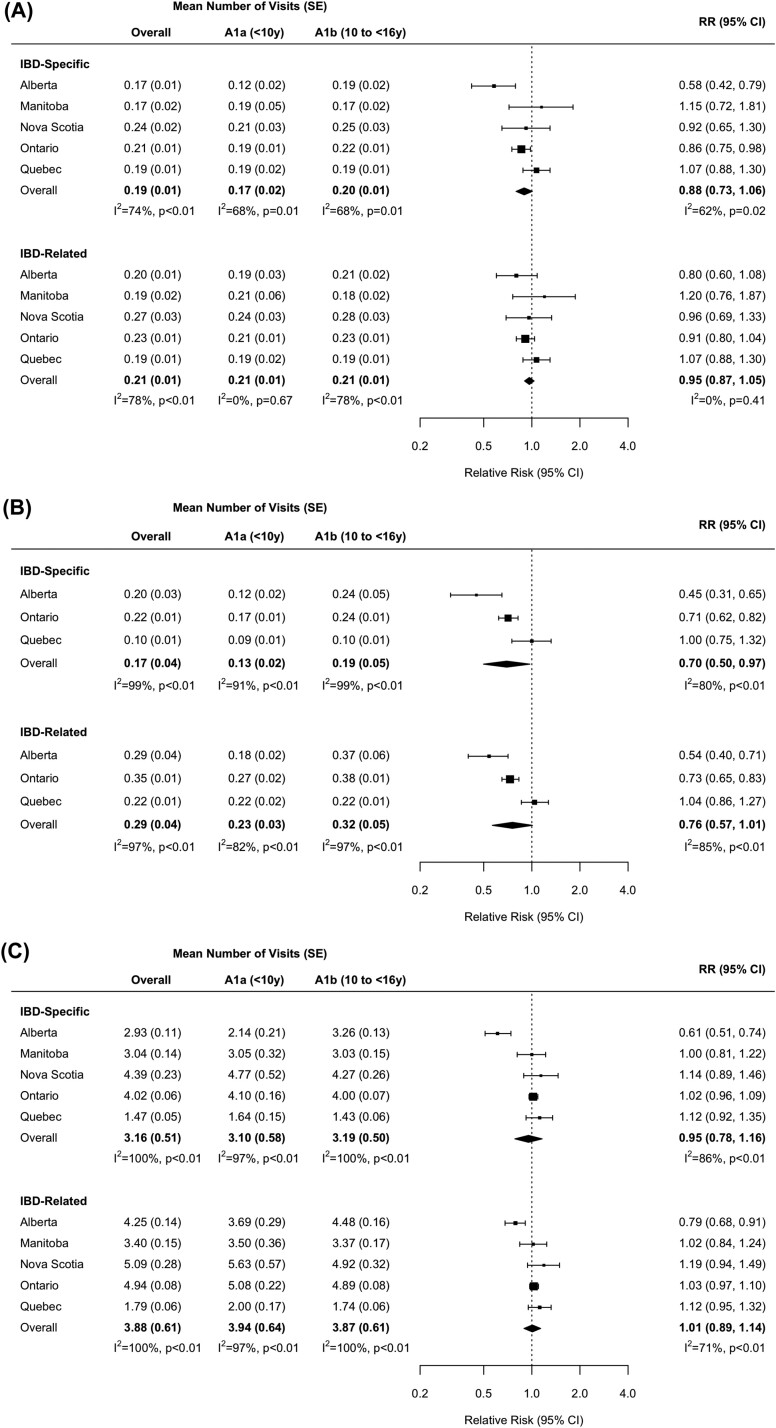
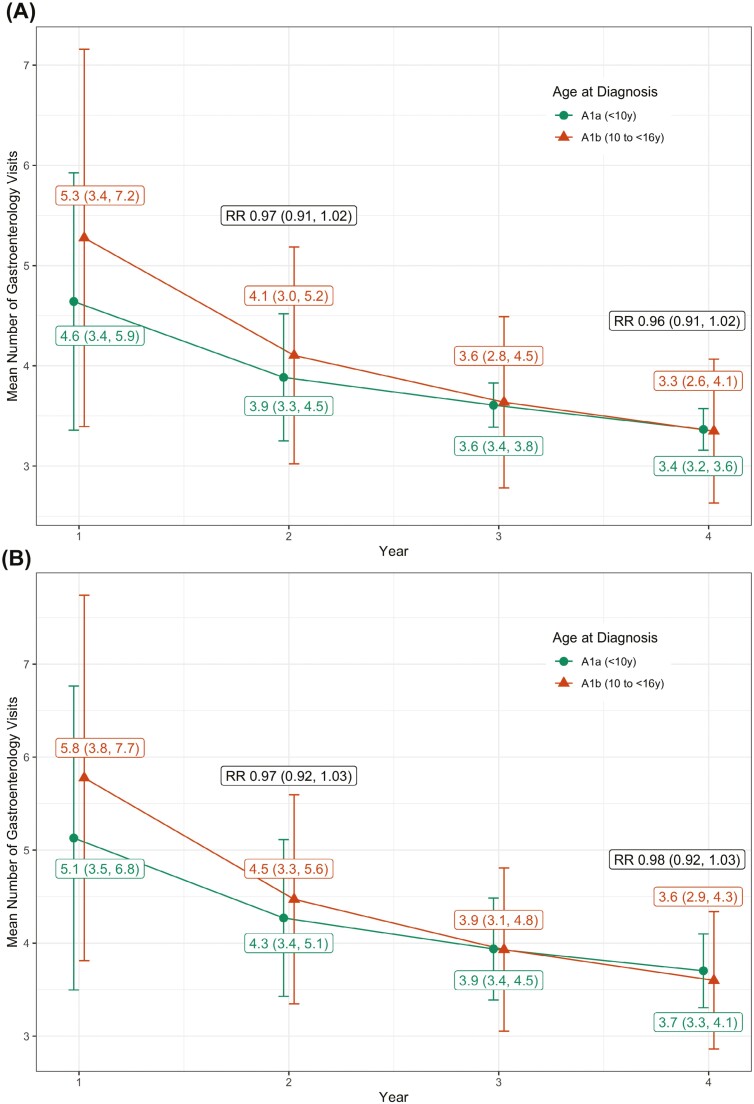
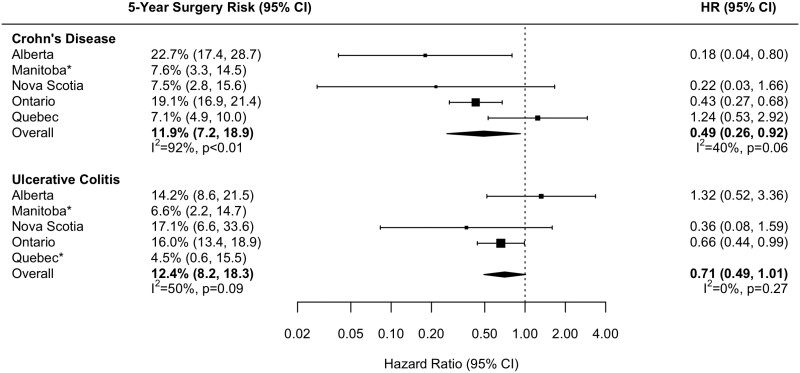
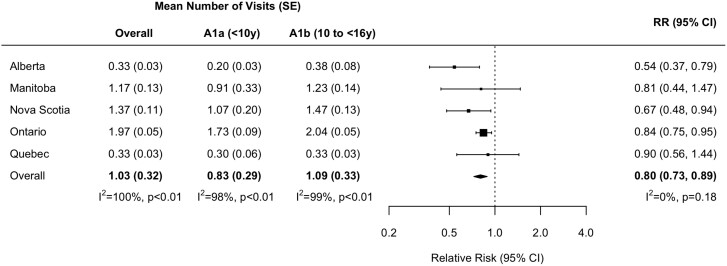
Among the 1165 (65.7% Crohn's) children with IBD included in our study, there were no age differences in the frequency of hospitalizations (rate ratio [RR], 0.88; 95% confidence interval [CI], 0.74-1.06) or outpatient visits (RR, 0.95; 95% CI, 0.78-1.16). A1a children had fewer emergency department visits (RR, 0.70; 95% CI, 0.50-0.97) and were less likely to require a Crohn's-related surgery (hazard ratio, 0.49; 95% CI, 0.26-0.92). The risk of colectomy was similar among children with ulcerative colitis in both age groups (hazard ratio, 0.71; 95% CI, 0.49-1.01).
Patterns of health services utilization are generally similar when comparing children diagnosed across age groups.
随着炎症性肠病(IBD)患儿数量持续增加,了解IBD患儿的卫生服务利用模式很重要。我们比较了10岁以下(巴黎分类:A1a)和10至16岁(A1b)确诊的IBD患儿的卫生服务利用情况和手术情况。
利用来自加拿大5个省份(艾伯塔省、曼尼托巴省、新斯科舍省、安大略省、魁北克省)确定性关联的卫生行政数据中的验证算法,识别出16岁以下确诊的IBD新发病例,进行回顾性队列研究。我们使用负二项回归比较了不同年龄组(A1a与A1b[参照组])的IBD特异性门诊就诊、急诊科就诊和住院频率。使用Cox比例风险模型比较不同年龄组的手术风险。模型对性别、农村/城市居住地点和邻里平均收入五分位数进行了调整。使用随机效应荟萃分析汇总了各省的估计值。
在我们研究纳入的1165例IBD患儿(65.7%为克罗恩病)中,住院频率(率比[RR],0.88;95%置信区间[CI],0.74 - 1.06)或门诊就诊频率(RR,0.95;95%CI,0.78 - 1.16)在年龄组之间没有差异。A1a组患儿的急诊科就诊次数较少(RR,0.70;95%CI,0.50 - 0.97),且需要进行克罗恩病相关手术的可能性较小(风险比,0.49;95%CI,0.26 - 0.92)。两个年龄组的溃疡性结肠炎患儿结肠切除术风险相似(风险比,0.71;95%CI,0.49 - 1.01)。
比较不同年龄组确诊的患儿时,卫生服务利用模式总体相似。