
复合氨基酸矿物质与双甘氨酸螯合矿物质:对老龄蛋鸡生产性能的影响
Complexed amino acid minerals vs. bis-glycinate chelated minerals: Impact on the performance of old laying hens.
作者信息
Santos Marcos J B, Ludke Maria C M M, Silva Leandro M, Rabello Carlos B V, Barros Mércia R, Costa Fabiano S, Santos Clariana S, Wanderley Jamille S S
机构信息
Department of Animal Science, Rural Federal University of Pernambuco, Recife, PE, Brazil.
Department of Veterinary Science, Rural Federal University of Pernambuco, Recife, PE, Brazil.
出版信息
Anim Nutr. 2023 Dec 4;16:395-408. doi: 10.1016/j.aninu.2023.11.006. eCollection 2024 Mar.
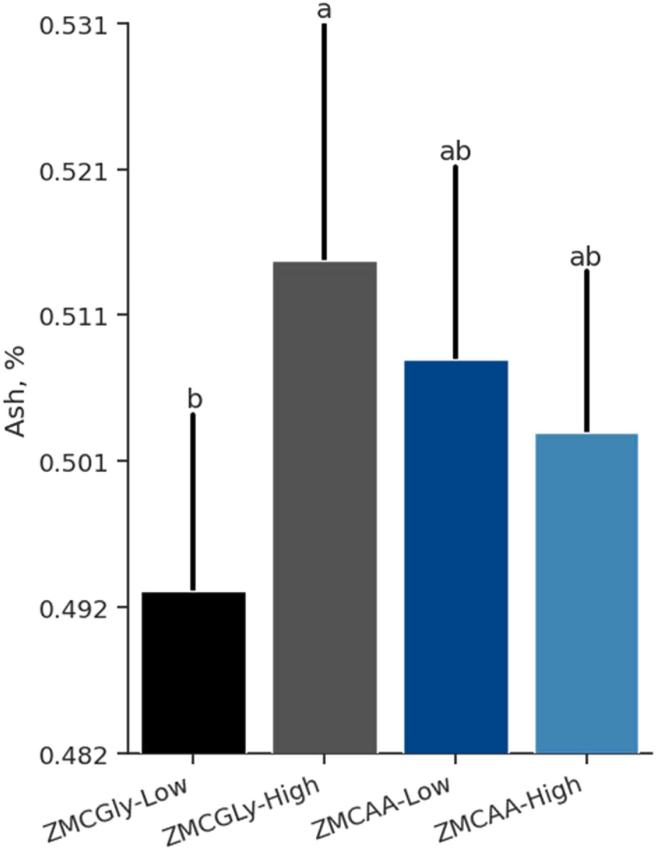
The present study was to evaluate the effect of trace minerals (Zn, Mn, and Cu) from complexed amino acid minerals (ZMCAA) and bis-glycinate chelated minerals (ZMCGly) in laying hen diets on performance, internal and external egg quality, yolk mineral deposition, intestinal morphometry, and bone characteristics. From 78 to 98 weeks of age, 400 White LSL-Lite strain laying hens were distributed in a randomized design with 4 treatments with 10 replicates per treatment. Treatments were distributed in a 2 × 2 factorial arrangement using either Zn, Mn, and Cu of ZMCAA or ZMCGly source at 2 levels: low (20, 20, and 3.5 mg/kg of Zn, Mn, and Cu, respectively) or high (40, 40, and 7 mg/kg of Zn, Mn, and Cu, respectively). The analysis of variance was performed, and in cases where differences were observed, the means were compared using Tukey's test ( < 0.05). The source and level of trace mineral supplementation had a significant impact on the performance of laying hens. Hens fed ZMCAA had higher egg production ( = 0.01), egg weight ( = 0.02), egg mass ( = 0.01), and lower feed conversion ratio ( 0.05) compared to those fed ZMCGly. The ZMCAA supplementation showed higher albumen height ( = 0.01), albumen weight ( = 0.01), and eggshell thickness ( < 0.01). The deposition of Zn ( < 0.01), Mn ( < 0.01), and Cu ( < 0.01) in the egg yolk was greater for hens received ZMCAA. Tibia weight ( = 0.04) and bone densitometry ( < 0.01) in the tibia were higher with ZMCAA supplementation. In the small intestine, ZMCAA resulted in longer villi ( = 0.02) and shorter crypt depth ( = 0.01) in the duodenum. Jejunum and ileum measurements were influenced by the level and source of trace minerals ( < 0.05). Laying hens fed ZMCAA exhibited superior performance, egg quality, deposition of trace minerals in the egg yolk, and bone density compared to hens fed ZMCGly. In this study, older laying hens supplemented with ZMCAA at lower levels demonstrated adequate levels of supplementation.
本研究旨在评估复合氨基酸矿物质(ZMCAA)和双甘氨酸螯合矿物质(ZMCGly)中的微量矿物质(锌、锰和铜)对蛋鸡日粮的生产性能、蛋的内外品质、蛋黄矿物质沉积、肠道形态以及骨骼特性的影响。从78周龄至98周龄,400只白来航LSL-Lite品系蛋鸡采用随机设计,分为4个处理组,每个处理组10个重复。处理组采用2×2析因设计,使用ZMCAA或ZMCGly来源的锌、锰和铜,分为2个水平:低水平(锌、锰和铜分别为20、20和3.5毫克/千克)或高水平(锌、锰和铜分别为40、40和7毫克/千克)。进行方差分析,若观察到差异,则使用Tukey检验比较均值(P<0.05)。微量矿物质补充的来源和水平对蛋鸡的生产性能有显著影响。与饲喂ZMCGly的蛋鸡相比,饲喂ZMCAA的蛋鸡产蛋量更高(P = 0.01)、蛋重更大(P = 0.02)、产蛋总量更高(P = 0.01),且饲料转化率更低(P<0.05)。补充ZMCAA的蛋鸡蛋清高度更高(P = 0.01)、蛋清重量更大(P = 0.01)、蛋壳厚度更厚(P<0.01)。摄入ZMCAA的蛋鸡的蛋黄中锌(P<0.01)、锰(P<0.01)和铜(P<0.01)的沉积量更大。补充ZMCAA的蛋鸡胫骨重量更高(P = 0.04),胫骨骨密度更高(P<0.01)。在小肠中,ZMCAA使十二指肠绒毛更长(P = 0.02)、隐窝深度更短(P = 0.01)。空肠和回肠的测量结果受微量矿物质的水平和来源影响(P<0.05)。与饲喂ZMCGly的蛋鸡相比,饲喂ZMCAA的蛋鸡在生产性能、蛋品质、蛋黄中微量矿物质沉积以及骨密度方面表现更优。在本研究中,低水平补充ZMCAA的老龄蛋鸡显示出充足的补充水平。




 Zotero 插件