Unit of Anatomy, Department of Biomedicine, Faculty of Medicine, University of Porto, Alameda Professor Hernâni Monteiro, 4200‑319, Porto, Portugal.
CINTESIS@RISE, Rua Dr. Plácido da Costa, s/n, 4200‑450, Porto, Portugal.
Surg Radiol Anat. 2024 Mar;46(3):271-283. doi: 10.1007/s00276-024-03312-1. Epub 2024 Feb 19.
Endoscopic third ventriculostomy (ETV) is a surgical procedure that can lead to complications and requires detailed preoperative planning. This study aimed to provide a more accurate understanding of the anatomy of the third ventricle and the location of important structures to improve the safety and success of ETV.
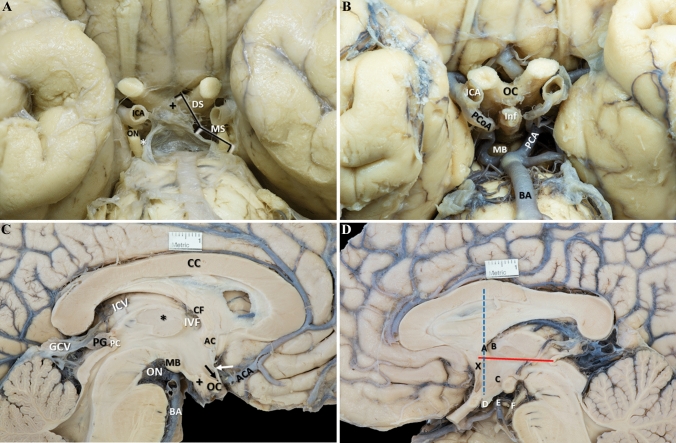
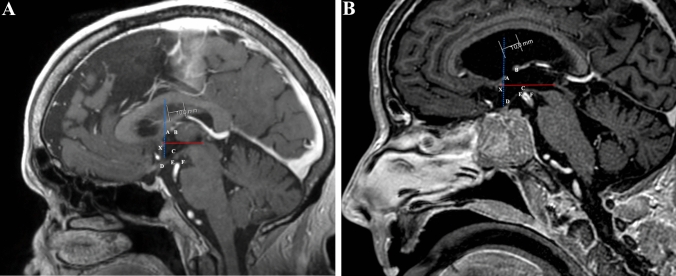
We measured the stereotactic coordinates of six points of interest relative to a predefined stereotactic reference point in 23 cadaver brain hemi-sections, 200 normal brain magnetic resonance imaging (MRI) scans, and 24 hydrocephalic brain MRI scans. The measurements were statistically analyzed, and comparisons were made.
We found some statistically significant differences between genders in MRIs from healthy subjects. We also found statistically significant differences between MRIs from healthy subjects and both cadaver brains and MRIs with hydrocephalus, though their magnitude is very small and not clinically relevant. Some stereotactic points were more posteriorly and inferiorly located in cadaver brains, particularly the infundibular recess and the basilar artery. It was found that all stereotactic points studied were more posteriorly located in brains with hydrocephalus.
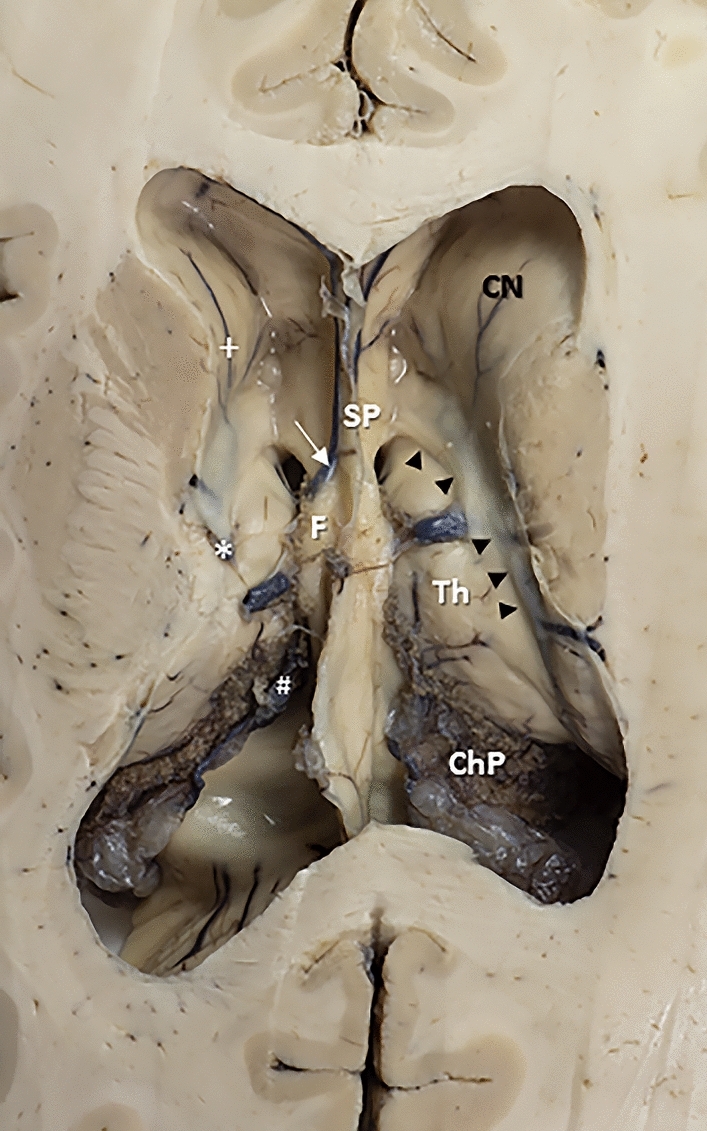
The study describes periventricular structures in cadaver brains and MRI scans from healthy and hydrocephalic subjects, which can guide neurosurgeons in planning surgical approaches to the third ventricle. Overall, the study contributes to understanding ETV and provides insights for improving its safety and efficacy. The findings also support that practicing on cadaveric brains can still provide valuable information and is valid for study and training of neurosurgeons unfamiliar with the ETV technique.
内镜第三脑室造瘘术(ETV)是一种可能导致并发症的手术,需要详细的术前规划。本研究旨在更准确地了解第三脑室的解剖结构和重要结构的位置,以提高 ETV 的安全性和成功率。
我们在 23 个尸脑半脑切片、200 个正常脑磁共振成像(MRI)扫描和 24 个脑积水脑 MRI 扫描中,测量了六个感兴趣点相对于预定立体定向参考点的立体定向坐标。对测量结果进行了统计学分析,并进行了比较。
我们发现,健康受试者的 MRI 存在一些统计学上的性别差异。我们还发现,健康受试者的 MRI 与尸脑和脑积水 MRI 之间存在统计学上的显著差异,尽管其幅度很小,且无临床意义。在尸脑中,一些立体定向点的位置更靠后和更低,特别是漏斗隐窝和基底动脉。所有研究的立体定向点在脑积水脑内的位置都更靠后。
本研究描述了尸脑和健康及脑积水受试者的 MRI 扫描中的脑室周围结构,可指导神经外科医生规划第三脑室手术入路。总体而言,该研究有助于理解 ETV,并为提高其安全性和有效性提供了思路。研究结果还表明,在不熟悉 ETV 技术的神经外科医生中,在尸脑上进行操作仍然可以提供有价值的信息,并且是有效的研究和培训方法。