Mortelmans Laura, Dilles Tinne
Department of Nursing Science and Midwifery, Centre for Research and Innovation in Care (CRIC), Nurse and Pharmaceutical Care (NuPhaC), Faculty of Medicine and Health Sciences, University of Antwerp, Antwerp, Belgium.
Research Foundation Flanders (FWO), Brussels, Belgium.
Heliyon. 2024 Feb 9;10(4):e26127. doi: 10.1016/j.heliyon.2024.e26127. eCollection 2024 Feb 29.
The study aimed to develop and evaluate a medication diary for patients to report problems with medication use to enable shared-decision making and improve medication adherence.
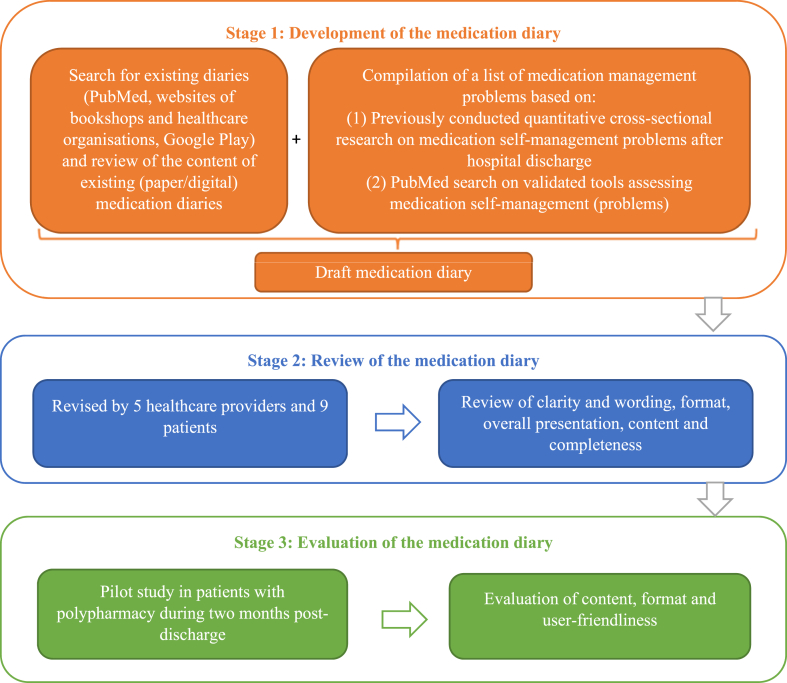
Based on a search for existing diaries, a review of the content, and a list of medication self-management problems compiled from previous research, a paper and pencil version of a medication diary was developed. The diary was reviewed for clarity and overall presentation by five healthcare providers and nine patients. Afterwards, user-friendliness was evaluated by 69 patients with polypharmacy discharged from hospital during a quantitative prospective study.
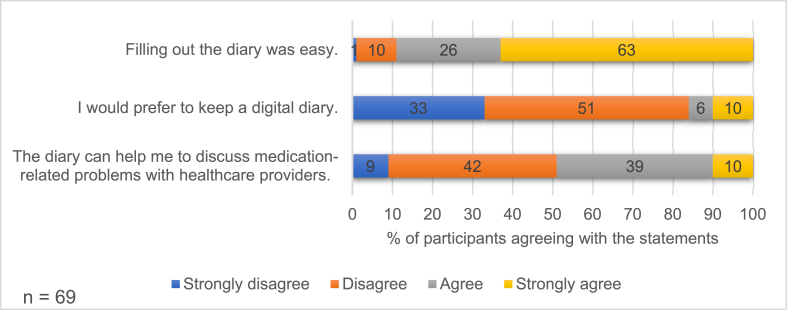
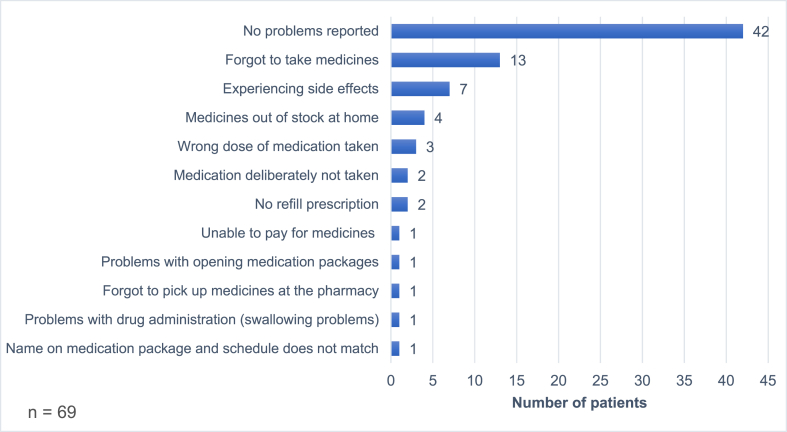
The medication diary consists of several parts: (1) a medication schedule allowing patients to list their medicines, (2) information sheets allowing patients to write down specific medication-related information, (3) a monthly overview to indicate daily whether medication-related problems were experienced, (4) problem sheets elaborating on the problems encountered, (5) space for specific medication-related questions for healthcare providers to facilitate shared-decision making. The review phase resulted in minor textual adjustments and one extra problem in the problem sheet. Most participants, who tested the medication diary for two months, found the diary user-friendly (80%) and easy to fill in (89%). About 40% of participants reported problems with medication use. Half of the patients indicated that the diary can facilitate discussing problems with healthcare providers.
The medication diary offers patients the opportunity to report problems regarding their medication use in a proven user-friendly manner and to discuss these problems with healthcare providers. Reporting and discussing problems with medication use can serve as a first step towards making shared decisions on how to address the problems encountered.
本研究旨在开发并评估一种供患者使用的用药日记,以便他们报告用药问题,从而实现共同决策并提高用药依从性。
在检索现有日记、审查其内容以及根据先前研究编制的用药自我管理问题清单的基础上,开发了纸质版用药日记。五名医疗服务提供者和九名患者对该日记的清晰度和整体呈现进行了审查。之后,在一项定量前瞻性研究中,对69名出院的多重用药患者进行了用户友好性评估。
用药日记包括几个部分:(1)用药时间表,供患者列出他们的药物;(2)信息表,供患者写下特定的用药相关信息;(3)月度概览,用于每日指示是否遇到用药相关问题;(4)问题表,详细说明遇到的问题;(5)为医疗服务提供者留出特定用药相关问题的空间,以促进共同决策。审查阶段导致了文本上的小调整以及问题表中增加了一个问题。大多数试用用药日记两个月的参与者认为该日记用户友好(80%)且易于填写(89%)。约40%的参与者报告了用药问题。一半的患者表示该日记有助于与医疗服务提供者讨论问题。
用药日记为患者提供了以经证实的用户友好方式报告用药问题并与医疗服务提供者讨论这些问题的机会。报告和讨论用药问题可以作为就如何解决所遇到问题做出共同决策的第一步。