Kaplan-Marans Elie, Zhang Tenny R, Hu Jim C
Division of Urology, Maimonides Medical Center, New York, NY, USA.
Department of Urology, NewYork-Presbyterian Hospital, New York, NY, USA.
Eur Urol Open Sci. 2024 Jan 31;60:36-43. doi: 10.1016/j.euros.2024.01.005. eCollection 2024 Feb.
There is insufficient evidence on the oncologic risks of testosterone therapy for men with prostate cancer managed with active surveillance. We carried out a retrospective study to assess the effect of testosterone therapy on oncologic outcomes for men on active surveillance for prostate cancer.
Surveillance, Epidemiology and End Results (SEER)-Medicare linked data were used to identify men diagnosed with prostate cancer from 2008 to 2017 who were managed with active surveillance and received testosterone ( = 167) or no testosterone ( = 6658) therapy. Outcomes included conversion from active surveillance to active treatment (radical prostatectomy, cryotherapy, radiation, or androgen deprivation therapy), prostate cancer-specific mortality, and overall mortality. Statistically significant factors on univariable analysis were included in a Cox proportional-hazards regression model for multivariable analysis.
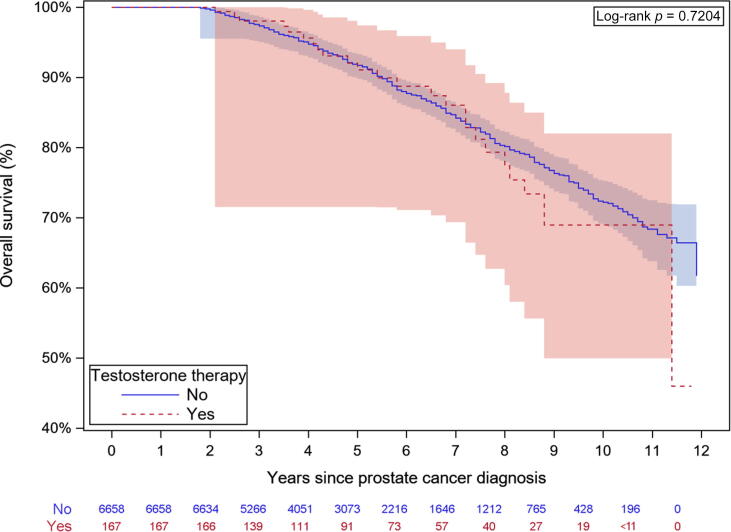
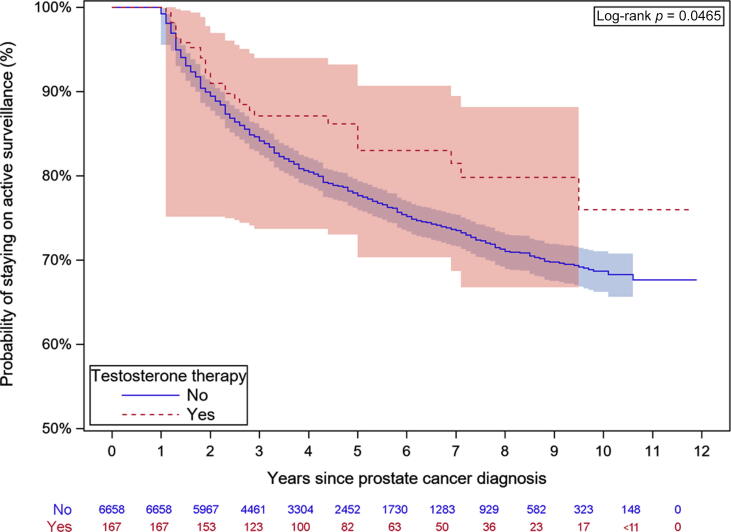
The median age was 71 yr (interquartile range [IQR] 68-74) in the testosterone group and 72 yr (IQR 69-75) in the no-testosterone group, with corresponding median follow-up after prostate cancer diagnosis of 5.2 yr (IQR 3.4-7.8) and 4.7 yr (IQR 3.2-6.9). There were no prostate cancer-specific deaths in the testosterone group and 39 (0.6%) in the no-testosterone group. Testosterone therapy was not associated with conversion to active treatment (hazard ratio [HR] 0.66, 95% confidence interval [CI] 0.46-0.97; = 0.033) or overall mortality (HR 1.02, 95% CI 0.68-1.53; > 0.9).
In the first population-based, nationally representative study of testosterone therapy for men on active surveillance for prostate cancer, testosterone therapy did not increase the risk of conversion to active therapy or worsen mortality. Prospective studies are needed to confirm these findings.
For men on active surveillance for prostate cancer, we assessed the effect of testosterone therapy. We found that testosterone therapy did not increase the risk of proceeding to active therapy or of death from prostate cancer.
对于接受主动监测的前列腺癌男性患者,睾酮治疗的肿瘤学风险证据不足。我们开展了一项回顾性研究,以评估睾酮治疗对接受前列腺癌主动监测男性患者肿瘤学结局的影响。
利用监测、流行病学与最终结果(SEER)-医疗保险链接数据,确定2008年至2017年期间被诊断为前列腺癌且接受主动监测并接受睾酮治疗(n = 167)或未接受睾酮治疗(n = 6658)的男性患者。结局包括从主动监测转为积极治疗(根治性前列腺切除术、冷冻疗法、放疗或雄激素剥夺疗法)、前列腺癌特异性死亡率和总死亡率。单变量分析中有统计学意义的因素纳入Cox比例风险回归模型进行多变量分析。
睾酮治疗组的中位年龄为71岁(四分位间距[IQR]68 - 74),未接受睾酮治疗组为72岁(IQR 69 - 75),前列腺癌诊断后的相应中位随访时间分别为5.2年(IQR 3.4 - 7.8)和4.7年(IQR 3.2 - 6.9)。睾酮治疗组无前列腺癌特异性死亡病例,未接受睾酮治疗组有39例(0.6%)。睾酮治疗与转为积极治疗(风险比[HR]0.66,95%置信区间[CI]0.46 - 0.97;P = 0.033)或总死亡率(HR 1.02,95% CI 0.68 - 1.53;P > 0.9)无关。
在第一项基于人群的、具有全国代表性的针对接受前列腺癌主动监测男性患者的睾酮治疗研究中,睾酮治疗并未增加转为积极治疗的风险或使死亡率恶化。需要前瞻性研究来证实这些发现。
对于接受前列腺癌主动监测的男性患者,我们评估了睾酮治疗的效果。我们发现睾酮治疗并未增加进行积极治疗或死于前列腺癌的风险。