Bromm Jenna J, Tokach Mike D, Woodworth Jason C, Goodband Robert D, DeRouchey Joel M, Hastad Chad W, Post Zach B, Flohr Josh R, Schmitt Raymond A, Zarate Ledesma Jose F, Gebhardt Jordan T
Department of Animal Sciences and Industry, College of Agriculture, Kansas State University, Manhattan, KS 66506, USA.
New Fashion Pork, Jackson, MN 56143, USA.
Transl Anim Sci. 2024 Jan 5;8:txae002. doi: 10.1093/tas/txae002. eCollection 2024.
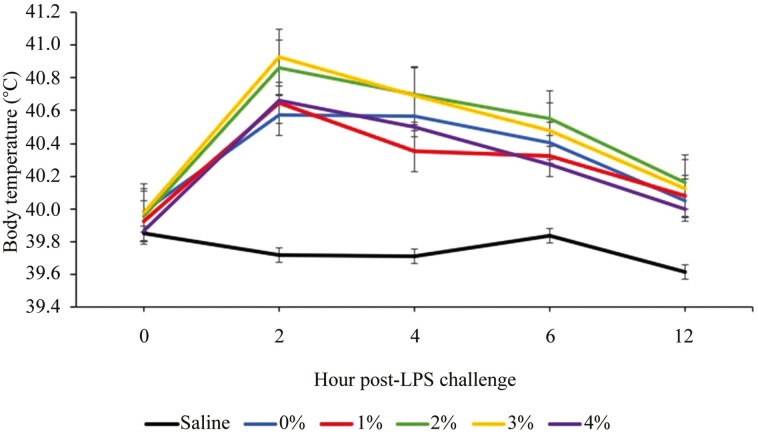
Three experiments evaluated omega-3 fatty acids, provided by O3 trial feed, on nursery pig growth performance, mortality, and response to an LPS immune challenge or natural Porcine reproductive and respiratory virus (PRRSV) outbreak. In experiment 1, 350 pigs (241 × 600, DNA; initially 5.8 kg) were used. Pens of pigs were randomly assigned to one of the five dietary treatments containing increasing omega-3 fatty acids (0%, 1%, 2%, 3%, and 4% O3 trial feed) with 14 replications per treatment. On day 25, two pigs per pen were injected intramuscularly with 20 μg LPS per kg BW and one pig per pen was injected with saline as a control. Body temperature was taken from all three pigs prior to and 2, 4, 6, and 12 h post-LPS challenge. Serum IL-1β and TNF-α concentrations were determined in LPS-challenged pigs 24 h prior and 4 h post-LPS challenge. There was no interaction between treatment and time for change in body temperature ( > 0.10). Overall, increasing the O3 trial feed did not affect ( > 0.10) ADG, ADFI, G:F, IL-1β, or TNF-α. In experiment 2, 1,056 pigs (PIC TR4 × [Fast LW × PIC L02] initially 7.3 kg) were used. Pens of pigs were randomly assigned to one of the four dietary treatments containing increasing omega-3 fatty acids (0%, 0.75%, 1.5%, and 3% O3 trial feed) with 12 replications per treatment. Oral fluids tested negative on days 7 and 14, but then positive for North American PRRSV virus via PCR on days 21, 28, 35, and 42. Overall, increasing O3 trial feed increased (linear, < 0.001) ADG, ADFI, and G:F and decreased (linear, = 0.027) total removals and mortality. In experiment 3, 91,140 pigs (DNA 600 × PIC 1050; initially 5.1 kg), originating from PRRSV-positive sow farms, were used across eight nursery sites. Each site contained five barns with two rooms per barn and ~1,100 pigs per room. Rooms of pigs were blocked by nursery site and allocated within sow source to one of the two dietary treatments (control or 3% O3 trial feed) with 40 replications per treatment. Oral fluids from 61 of the 80 rooms tested positive for North American PRRSV virus 1 wk postweaning and 78 of the 80 rooms tested positive 3 wk after weaning. Overall, O3 trial feed did not affect ADG, ADFI, or G:F but increased ( < 0.001) total removals and mortalities. In summary, increasing omega-3 fatty acids, sourced by O3 trial feed, did not improve growth performance or immune response in healthy pigs given an LPS challenge. However, it appears that if omega-3 fatty acids are fed prior to a natural PRRSV break (as in experiment 2), growth performance may be improved, and mortality reduced.
三项试验评估了由O3试验饲料提供的ω-3脂肪酸对保育猪生长性能、死亡率以及对脂多糖(LPS)免疫挑战或自然感染猪繁殖与呼吸综合征病毒(PRRSV)疫情的反应。在试验1中,使用了350头猪(241×600,DNA;初始体重5.8千克)。将猪栏随机分配到五种日粮处理之一,这些处理含有递增剂量的ω-3脂肪酸(0%、1%、2%、3%和4%的O3试验饲料),每个处理重复14次。在第25天,每栏中的两头猪每千克体重肌肉注射20微克LPS,每栏中的一头猪注射生理盐水作为对照。在LPS挑战前以及挑战后2、4、6和12小时,对所有三头猪测量体温。在LPS挑战前24小时和挑战后4小时,测定LPS挑战猪的血清白细胞介素-1β(IL-1β)和肿瘤坏死因子-α(TNF-α)浓度。体温变化在处理和时间之间没有交互作用(P>0.10)。总体而言,增加O3试验饲料对平均日增重(ADG)、平均日采食量(ADFI)、料重比(G:F)、IL-1β或TNF-α没有影响(P>0.10)。在试验2中,使用了1056头猪(PIC TR4×[Fast LW×PIC L02],初始体重7.3千克)。将猪栏随机分配到四种日粮处理之一,这些处理含有递增剂量的ω-3脂肪酸(0%、0.75%、1.5%和3%的O3试验饲料),每个处理重复12次。在第7天和第14天,口腔液体检测为阴性,但在第21、28、35和42天通过聚合酶链反应(PCR)检测出北美PRRSV病毒呈阳性。总体而言,增加O3试验饲料可提高(线性,P<0.001)ADG、ADFI和G:F,并降低(线性,P=0.027)总淘汰数和死亡率。在试验3中,来自PRRSV阳性母猪场的91140头猪(DNA 600×PIC 1050;初始体重