Basak Bristy, Akashi-Takamura Sachiko
Department of Microbiology and Immunology, School of Medicine, Aichi Medical University, Nagakute, Aichi, Japan.
Front Immunol. 2024 Feb 5;15:1336813. doi: 10.3389/fimmu.2024.1336813. eCollection 2024.
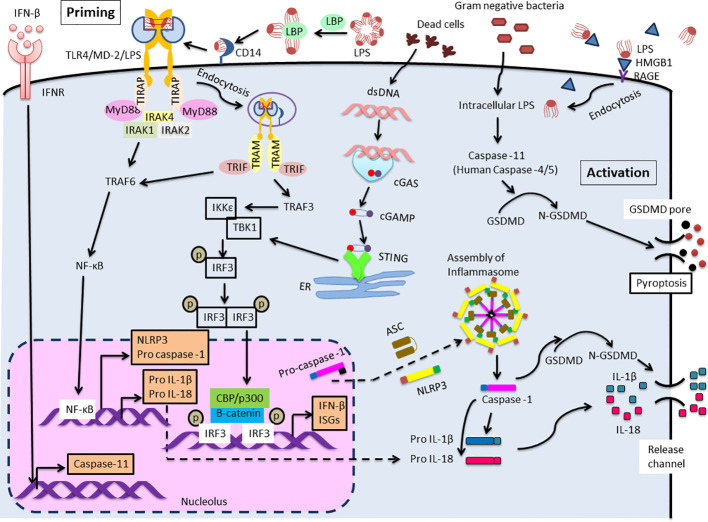
Lipopolysaccharide (LPS) induces potent cell activation via Toll-like receptor 4/myeloid differentiation protein 2 (TLR4/MD-2), often leading to septic death and cytokine storm. TLR4 signaling is diverted to the classical acute innate immune, inflammation-driving pathway in conjunction with the classical NF-κB pivot of MyD88, leading to epigenetic linkage shifts in nuclear pro-inflammatory transcription and chromatin structure-function; in addition, TLR4 signaling to the TIR domain-containing adapter-induced IFN-β (TRIF) apparatus and to nuclear pivots that signal the association of interferons alpha and beta (IFN-α and IFN-β) with acute inflammation, often coupled with oxidants favor inhibition or resistance to tissue injury. Although the immune response to LPS, which causes sepsis, has been clarified in this manner, there are still many current gaps in sepsis immunology to reduce mortality. Recently, selective agonists and inhibitors of LPS signals have been reported, and there are scattered reports on LPS tolerance and control of sepsis development. In particular, IRF3 signaling has been reported to be involved not only in sepsis but also in increased pathogen clearance associated with changes in the gut microbiota. Here, we summarize the LPS recognition system, main findings related to the IRF3, and finally immunological gaps in sepsis.
脂多糖(LPS)通过Toll样受体4/髓样分化蛋白2(TLR4/MD-2)诱导强烈的细胞活化,常常导致脓毒症死亡和细胞因子风暴。TLR4信号传导与MyD88的经典核因子κB枢纽一起转向经典的急性固有免疫、炎症驱动途径,导致核促炎转录和染色质结构功能中的表观遗传连锁变化;此外,TLR4向含TIR结构域的接头诱导IFN-β(TRIF)装置以及向信号干扰素α和β(IFN-α和IFN-β)与急性炎症关联的核枢纽发出信号,通常与氧化剂一起有利于抑制或抵抗组织损伤。尽管以这种方式已经阐明了对引起脓毒症的LPS的免疫反应,但脓毒症免疫学中目前仍存在许多降低死亡率方面的空白。最近,已经报道了LPS信号的选择性激动剂和抑制剂,并且有关于LPS耐受性和脓毒症发展控制的零散报道。特别是,据报道IRF3信号传导不仅参与脓毒症,还参与与肠道微生物群变化相关的病原体清除增加。在此,我们总结了LPS识别系统、与IRF3相关的主要发现,以及最后脓毒症中的免疫学空白。