Verburgt Esmée, Hilkens Nina A, Ekker Merel S, Schellekens Mijntje M I, Boot Esther M, Immens Maikel H M, van Alebeek Mayte E, Brouwers Paul J A M, Arntz Renate M, van Dijk Gert W, Gons Rob A R, van Uden Inge W M, den Heijer Tom, van Tuijl Julia H, de Laat Karlijn F, van Norden Anouk G W, Vermeer Sarah E, van Zagten Marian S G, van Oostenbrugge Robert J, Wermer Marieke J H, Nederkoorn Paul J, Kerkhoff Henk, Rooyer Fergus A, van Rooij Frank G, van den Wijngaard Ido R, Ten Cate Tim J F, Tuladhar Anil M, de Leeuw Frank-Erik, Verhoeven Jamie I
Donders Institute for Brain, Cognition, and Behaviour, Department of Neurology, Radboud University Medical Centre, Nijmegen, the Netherlands.
Department of Neurology, Gelre Hospital, Apeldoorn, the Netherlands.
JAMA Netw Open. 2024 Feb 5;7(2):e240054. doi: 10.1001/jamanetworkopen.2024.0054.
Cause of ischemic stroke in young people is highly variable; however, the risk of recurrence is often presented with all subtypes of stroke grouped together in classification systems such as the Trial of ORG (danaparoid sodium [Orgaran]) 10172 in Acute Stroke Treatment (TOAST) criteria, which limits the ability to individually inform young patients with stroke about their risk of recurrence.
To determine the short-term and long-term risk of recurrent vascular events after ischemic stroke at a young age by stroke cause and to identify factors associated with recurrence.
DESIGN, SETTING, AND PARTICIPANTS: This cohort study used data from the Observational Dutch Young Symptomatic Stroke Study, a prospective, multicenter, hospital-based cohort study, conducted at 17 hospitals in the Netherlands between 2013 and 2021. Eligible participants included 30-day survivors of an initial, neuroimaging-proven ischemic stroke (aged 18-49 years). Data analysis was conducted from June to July 2023.
Diagnosis of a first-ever, ischemic stroke via neuroimaging.
The primary outcome was short-term (within 6 months) and long-term (within 5 years) recurrence risk of any vascular event, defined as fatal or nonfatal recurrent ischemic stroke, transient ischemic attack, myocardial infarction, and revascularization procedure. Predefined characteristics were chosen to identify factors associated with risk of recurrence (cause of stroke, age, sex, stroke severity, and cardiovascular health factors).
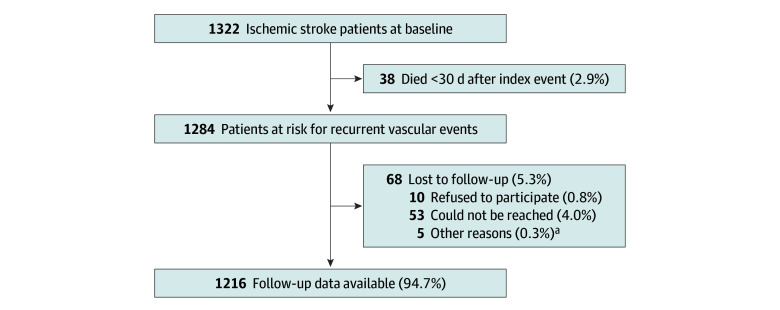
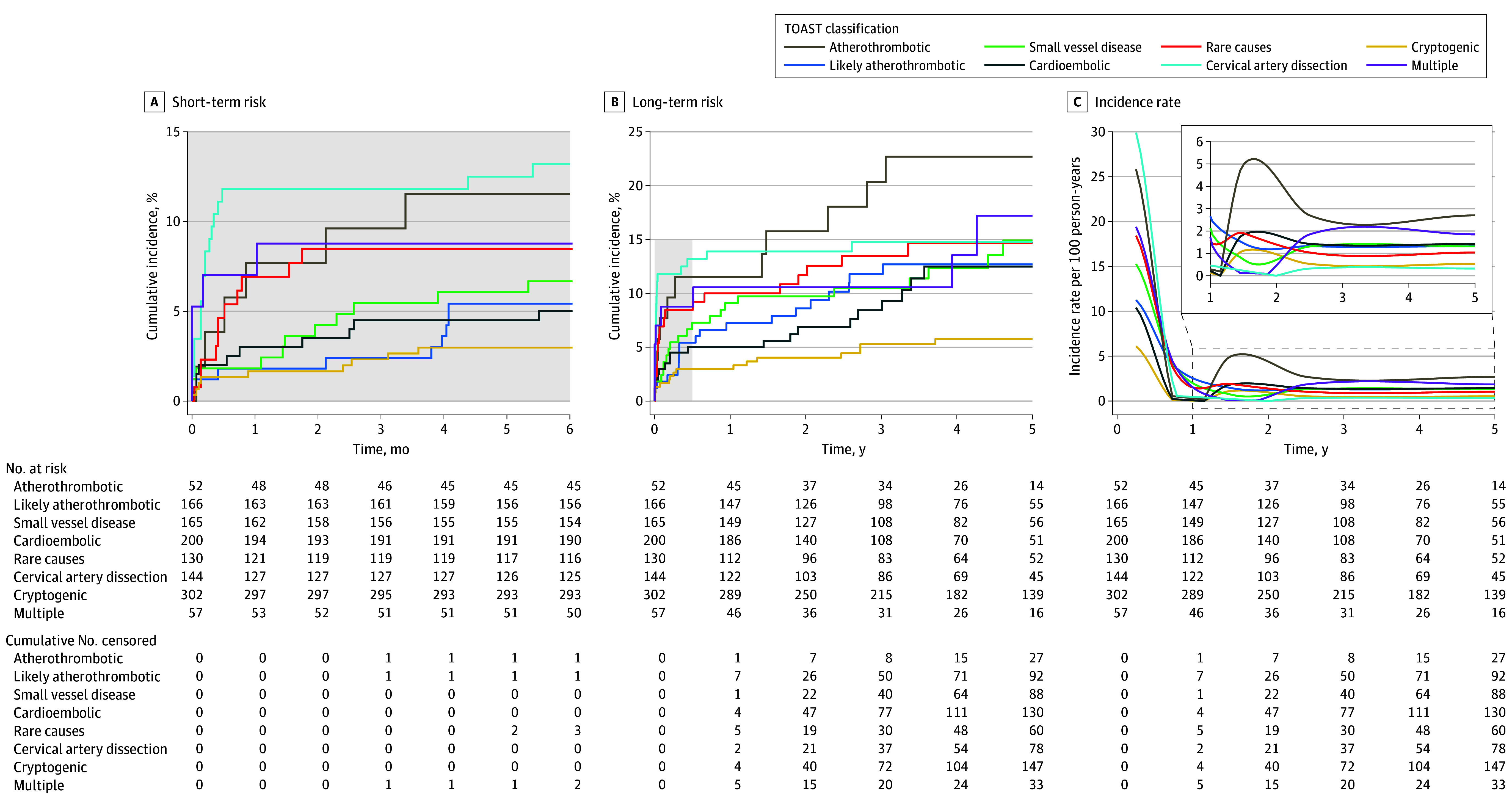
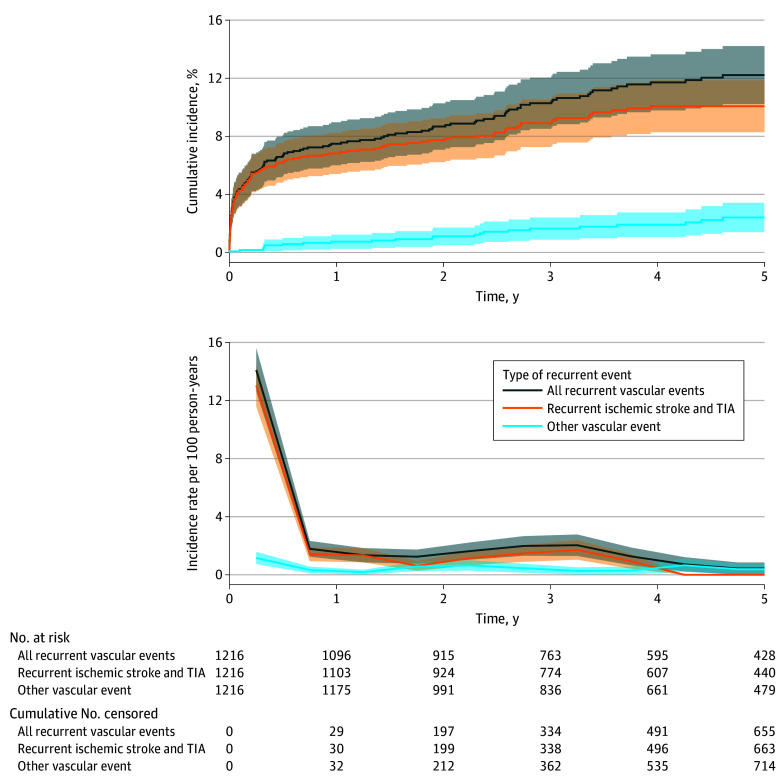
A total of 1216 patients (median [IQR] age, 44.2 [38.4-47.7] years; 632 male [52.0%]; 584 female [48.0%]) were included, with a median (IQR) follow-up of 4.3 (2.6-6.0) years. The 6-month risk of any recurrent ischemic event was 6.7% (95% CI, 5.3%-8.1%), and the 5-year risk was 12.2% (95% CI, 10.2%-14.2%)The short-term risk was highest for patients with cervical artery dissections (13.2%; 95% CI, 7.6%-18.7%). Other factors associated with a recurrent short-term event were atherothrombotic stroke, rare causes of stroke, and hypertension. The long-term cumulative risk was highest for patients with atherothrombotic stroke (22.7%; 95% CI, 10.6%-34.7%) and lowest for patients with cryptogenic stroke (5.8%; 95% CI, 3.0%-8.5%). Cardioembolic stroke was associated with a recurrent long-term event, as were diabetes and alcohol abuse.
The findings of this cohort study of 1216 patients with an ischemic stroke at a young age suggest that the risk of recurrent vascular events was high and varied by cause of stroke both for short-term and long-term follow-up, including causes that remained concealed when combined into 1 category in the routinely used TOAST criteria. This knowledge will allow for more personalized counseling of young patients with stroke.
年轻人缺血性中风的病因高度多样;然而,在诸如急性中风治疗中ORG(达那肝素钠[Orgaran])10172试验(TOAST)标准等分类系统中,复发风险通常是将所有中风亚型合并在一起呈现的,这限制了向年轻中风患者单独告知其复发风险的能力。
按中风病因确定年轻时缺血性中风后复发性血管事件的短期和长期风险,并确定与复发相关的因素。
设计、设置和参与者:这项队列研究使用了荷兰年轻有症状中风观察性研究的数据,这是一项前瞻性、多中心、基于医院的队列研究,于2013年至2021年在荷兰的17家医院进行。符合条件的参与者包括首次经神经影像学证实的缺血性中风的30天幸存者(年龄18 - 49岁)。数据分析于2023年6月至7月进行。
通过神经影像学诊断首次缺血性中风。
主要结局是任何血管事件的短期(6个月内)和长期(5年内)复发风险,定义为致命或非致命性复发性缺血性中风、短暂性脑缺血发作、心肌梗死和血管重建手术。选择预定义特征以确定与复发风险相关的因素(中风病因、年龄、性别、中风严重程度和心血管健康因素)。
共纳入1216例患者(年龄中位数[四分位间距]为44.2[38.4 - 47.7]岁;男性632例[52.0%];女性584例[48.0%]),中位(四分位间距)随访时间为4.3(2.6 - 6.0)年。任何复发性缺血事件的6个月风险为6.7%(95%置信区间,5.3% - 8.1%),5年风险为12.2%(95%置信区间,10.2% - 14.2%)。颈内动脉夹层患者的短期风险最高(13.2%;95%置信区间,7.6% - 18.7%)。与短期复发性事件相关的其他因素包括动脉粥样硬化血栓形成性中风、罕见中风病因和高血压。动脉粥样硬化血栓形成性中风患者的长期累积风险最高(22.7%;95%置信区间,10.6% - 34.7%),隐源性中风患者最低(5.8%;95%置信区间,3.0% - 8.5%)。心源性栓塞性中风与长期复发性事件相关,糖尿病和酗酒也是如此。
这项对1216例年轻时缺血性中风患者的队列研究结果表明,复发性血管事件的风险很高,并且在短期和长期随访中因中风病因而异,包括在常用的TOAST标准中合并为一类时仍隐匿的病因。这些知识将有助于为年轻中风患者提供更个性化的咨询。