Sha Yuhui, Wang Qiqi, Tang Mingyu, Yao Ming, Zhu Yicheng, Zhou Lixin, Ni Jun
Department of Neurology, Peking Union Medical College Hospital, Peking Union Medical College and Chinese Academy of Medical Sciences, Beijing, China.
Department of General Medicine, Peking Union Medical College Hospital, Peking Union Medical College and Chinese Academy of Medical Sciences, Beijing, China.
Brain Behav. 2025 Apr;15(4):e70479. doi: 10.1002/brb3.70479.
Young patients with ischemic stroke often present with more complex etiologies and risk factors, making their long-term prognosis particularly challenging. This study aims to investigate the long-term prognosis and identify factors associated with recurrent ischemic cerebrovascular events and unfavorable functional outcome in a prospective, single-center cohort.
We consecutively enrolled young adults (aged 18-49) with ischemic stroke in the single-center cohort at Peking Union Medical College Hospital (PUMCH) from March 2017 to March 2023. Follow-up was conducted through face-to-face visits or telephone interviews. Main outcomes were recurrent ischemic cerebrovascular events and unfavorable functional outcome (an mRS score ≥ 2). Kaplan-Meier analysis was used to estimate the 5-year cumulative recurrence risk, and multivariate logistic analysis was used to identify predictors of recurrent ischemic cerebrovascular events and unfavorable functional outcome.
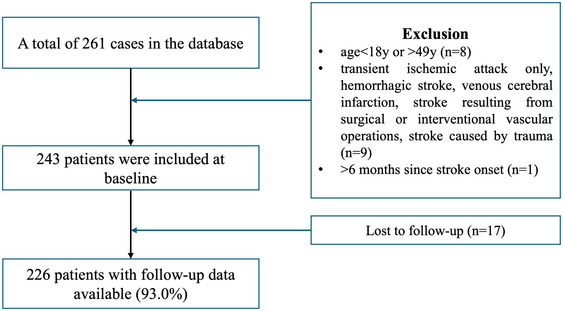
A total of 226 patients (median (IQR) age, 35 (30-41) years; 148 male (65.5%)) were included to the final analysis. According to the TOAST classification, large-artery atherosclerosis was identified as the most common subtype (38.1%). The 5-year cumulative recurrence rate for ischemic cerebrovascular events was 13.5% (95% CI: 6.7%-19.9%), with no significant difference between patients with different etiologies. Low education level (OR 12.016, 95% CI: 2.805-51.469, p < 0.001), previous TIA (OR 9.594, 95% CI: 2.500-36.824, p < 0.001), previous ischemic stroke (OR 3.177, 95% CI: 1.128-8.946, p = 0.029), and mRS score at follow-up (OR 3.339, 95% CI: 1.714-6.502, p < 0.001) were independent risk factors of ischemic cerebrovascular event recurrence after adjusting for sex and age. Baseline mRS scores was identified as an independent predictor of long-term poor functional outcome (OR 2.264, 95%CI: 1.207-4.246, p = 0.011) after adjusting for sex, age, receiving antiplatelet treatment and having recurrent ischemic stroke or TIA.
Young patients with ischemic stroke were at risk of recurrent ischemic cerebrovascular events, enhancing the need to enhance stroke prevention and treatment, particularly among young Chinese individuals with low education levels.
年轻的缺血性中风患者通常病因和危险因素更为复杂,这使得他们的长期预后极具挑战性。本研究旨在对一个前瞻性单中心队列进行调查,以探讨其长期预后,并确定与复发性缺血性脑血管事件及不良功能结局相关的因素。
我们于2017年3月至2023年3月在北京协和医院的单中心队列中连续纳入了年龄在18 - 49岁的缺血性中风青年成人患者。通过面对面访视或电话访谈进行随访。主要结局为复发性缺血性脑血管事件和不良功能结局(改良Rankin量表评分≥2分)。采用Kaplan-Meier分析估计5年累积复发风险,并采用多因素logistic分析确定复发性缺血性脑血管事件和不良功能结局的预测因素。
共有226例患者(年龄中位数(四分位间距)为35(30 - 41)岁;男性148例(65.5%))纳入最终分析。根据TOAST分类,大动脉粥样硬化被确定为最常见的亚型(38.1%)。缺血性脑血管事件的5年累积复发率为13.5%(95%置信区间:6.7% - 19.9%),不同病因患者之间无显著差异。调整性别和年龄后,低教育水平(比值比12.016,95%置信区间:2.805 - 51.469,p < 0.001)、既往短暂性脑缺血发作(比值比9.594,95%置信区间:2.500 - 36.824,p < 0.001)、既往缺血性中风(比值比3.177,95%置信区间:1.128 - 8.946,p = 0.029)以及随访时的改良Rankin量表评分(比值比3.339,95%置信区间:1.714 - 6.502,p < 0.001)是缺血性脑血管事件复发的独立危险因素。调整性别、年龄、接受抗血小板治疗以及有无复发性缺血性中风或短暂性脑缺血发作后,基线改良Rankin量表评分被确定为长期不良功能结局的独立预测因素(比值比2.264,95%置信区间:1.207 - 4.246,p = 0.011)。
年轻的缺血性中风患者存在复发性缺血性脑血管事件的风险,这凸显了加强中风预防和治疗的必要性,尤其是在教育水平较低的年轻中国人群体中。