• 文献检索
  • 文档翻译
  • 深度研究
  • 学术资讯
  • Suppr Zotero 插件Zotero 插件
  • 邀请有礼
  • 套餐&价格
  • 历史记录
应用&插件
Suppr Zotero 插件Zotero 插件浏览器插件Mac 客户端Windows 客户端微信小程序
定价
高级版会员购买积分包购买API积分包
服务
文献检索文档翻译深度研究API 文档MCP 服务
关于我们
关于 Suppr公司介绍联系我们用户协议隐私条款
关注我们

Suppr 超能文献

核心技术专利:CN118964589B侵权必究
粤ICP备2023148730 号-1Suppr @ 2026

文献检索

告别复杂PubMed语法,用中文像聊天一样搜索,搜遍4000万医学文献。AI智能推荐,让科研检索更轻松。

立即免费搜索

文件翻译

保留排版,准确专业,支持PDF/Word/PPT等文件格式,支持 12+语言互译。

免费翻译文档

深度研究

AI帮你快速写综述,25分钟生成高质量综述,智能提取关键信息,辅助科研写作。

立即免费体验

赤道雨林中非洲木鸽的邻里-陌生歧视。

Neighbour-stranger discrimination in an African wood dove inhabiting equatorial rainforest.

机构信息

Department of Behavioural Ecology, Institute of Environmental Biology, Faculty of Biology, Adam Mickiewicz University, Uniwersytetu Poznańskiego 6, 61-614, Poznań, Poland.

出版信息

Sci Rep. 2024 Feb 21;14(1):4252. doi: 10.1038/s41598-024-53867-7.

DOI:10.1038/s41598-024-53867-7
PMID:38378955
原文链接:https://pmc.ncbi.nlm.nih.gov/articles/PMC10879109/
Abstract

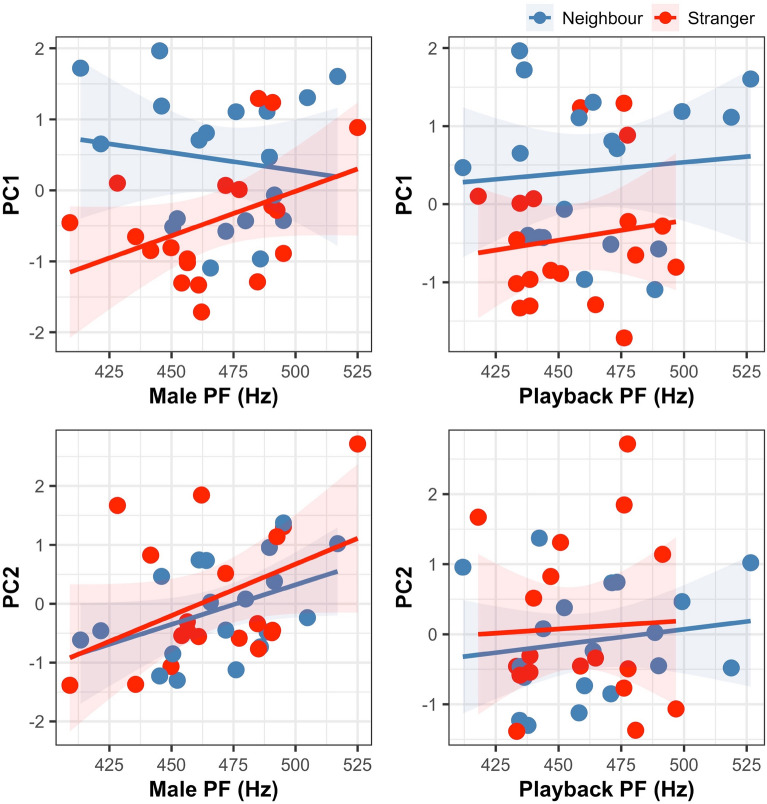
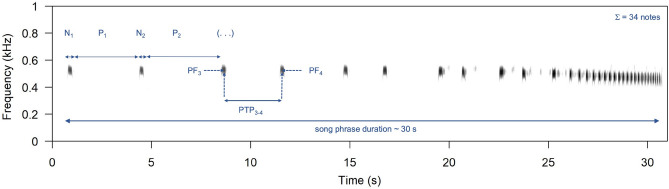
We investigated within- and between-individual song variation and song-based neighbour-stranger discrimination in a non-learning bird species, the blue-headed wood-dove (Turtur brehmeri), which inhabits lowland rainforests of West and Central Africa. We found that songs of this species are individually specific and have a high potential for use in individual recognition based on the time-frequency pattern of note distribution within song phrases. To test whether these differences affect behaviour, we conducted playback experiments with 19 territorial males. Each male was tested twice, once with the songs of a familiar neighbour and once with the songs of an unfamiliar stranger. We observed that males responded more aggressively to playback of a stranger's songs: they quickly approached close to the speaker and spent more time near it. However, no significant differences between treatments were observed in the vocal responses. In addition, we explored whether responses differed based on the song frequency of the focal male and/or that of the simulated intruder (i.e., playback), as this song parameter is inversely related to body size and could potentially affect males' decisions to respond to other birds. Song frequency parameters (of either the focal male or the simulated intruder) had no effect on the approaching response during playback. However, we found that the pattern of response after playback was significantly affected by the song frequency of the focal male: males with lower-frequency songs stayed closer to the simulated intruder for a longer period of time without singing, while males with higher-frequency songs returned more quickly to their initial song posts and resumed singing. Together, these results depict a consistently strong response to strangers during and after playback that is dependent on a male's self-assessment rather than assessment of a rival's strength based on his song frequency. This work provides the first experimental evidence that doves (Columbidae) can use songs for neighbour-stranger discrimination and respond according to a "dear enemy" scheme that keeps the cost of territory defence at a reasonable level.

摘要

我们研究了一种非学习型鸟类,蓝头木鸽(Turtur brehmeri),在个体和个体间歌曲变化以及基于歌曲的邻居-陌生者辨别能力。我们发现,这种物种的歌曲具有个体特异性,并且基于歌曲短语中音符分布的时频模式,具有很高的个体识别潜力。为了测试这些差异是否会影响行为,我们对 19 只领地雄性进行了播放实验。每个雄性都接受了两次测试,一次是播放熟悉邻居的歌曲,一次是播放陌生陌生者的歌曲。我们观察到,雄性对陌生者的歌曲播放反应更为激烈:它们迅速接近扬声器,并在其附近停留的时间更长。但是,在处理方面,在发声反应方面没有观察到明显的差异。此外,我们还探讨了响应是否基于焦点雄性和/或模拟入侵者(即播放)的歌曲频率而有所不同,因为该歌曲参数与体型成反比,并且可能会影响雄性对其他鸟类做出反应的决定。歌曲频率参数(无论是焦点雄性还是模拟入侵者的)在播放期间对接近反应没有影响。但是,我们发现播放后的反应模式受到焦点雄性歌曲频率的显著影响:具有较低频率歌曲的雄性在不唱歌的情况下,更接近模拟入侵者并停留更长时间,而具有较高频率歌曲的雄性则更快地返回其初始歌曲帖子并恢复唱歌。总的来说,这些结果描绘了一种在播放期间和之后对陌生者始终保持强烈反应的模式,这种反应依赖于雄性的自我评估,而不是根据他的歌曲频率评估竞争对手的实力。这项工作首次提供了实验证据,表明鸽子(Columbidae)可以使用歌曲进行邻居-陌生者辨别,并根据“亲爱的敌人”计划做出反应,该计划使领地防御的成本保持在合理水平。
https://cdn.ncbi.nlm.nih.gov/pmc/blobs/d54a/10879109/4031f2d1b827/41598_2024_53867_Fig4_HTML.jpg
https://cdn.ncbi.nlm.nih.gov/pmc/blobs/d54a/10879109/5b62bae5a3a9/41598_2024_53867_Fig1_HTML.jpg
https://cdn.ncbi.nlm.nih.gov/pmc/blobs/d54a/10879109/3650abc7df65/41598_2024_53867_Fig2_HTML.jpg
https://cdn.ncbi.nlm.nih.gov/pmc/blobs/d54a/10879109/cdacd9057337/41598_2024_53867_Fig3_HTML.jpg
https://cdn.ncbi.nlm.nih.gov/pmc/blobs/d54a/10879109/4031f2d1b827/41598_2024_53867_Fig4_HTML.jpg
https://cdn.ncbi.nlm.nih.gov/pmc/blobs/d54a/10879109/5b62bae5a3a9/41598_2024_53867_Fig1_HTML.jpg
https://cdn.ncbi.nlm.nih.gov/pmc/blobs/d54a/10879109/3650abc7df65/41598_2024_53867_Fig2_HTML.jpg
https://cdn.ncbi.nlm.nih.gov/pmc/blobs/d54a/10879109/cdacd9057337/41598_2024_53867_Fig3_HTML.jpg
https://cdn.ncbi.nlm.nih.gov/pmc/blobs/d54a/10879109/4031f2d1b827/41598_2024_53867_Fig4_HTML.jpg

相似文献

1
Neighbour-stranger discrimination in an African wood dove inhabiting equatorial rainforest.赤道雨林中非洲木鸽的邻里-陌生歧视。
Sci Rep. 2024 Feb 21;14(1):4252. doi: 10.1038/s41598-024-53867-7.
2
Response of forest Turtur doves to conspecific and congeneric songs in sympatry and allopatry.林斑鸠在同域和异域对同种和同属歌声的反应。
Sci Rep. 2023 Sep 24;13(1):15948. doi: 10.1038/s41598-023-43035-8.
3
The day after: effects of vocal interactions on territory defence in nightingales.次日:鸣声互动对夜莺领地防御的影响
J Anim Ecol. 2007 Jan;76(1):168-73. doi: 10.1111/j.1365-2656.2006.01182.x.
4
Anthropogenic noise affects male house wren response to but not detection of territorial intruders.人为噪声会影响雄性画眉对领地入侵的反应,但不会影响其对领地入侵的察觉。
PLoS One. 2019 Jul 31;14(7):e0220576. doi: 10.1371/journal.pone.0220576. eCollection 2019.
5
How to identify dear enemies: the group signature in the complex song of the skylark Alauda arvensis.如何识别“亲爱的敌人”:云雀(Alauda arvensis)复杂歌声中的群体特征
J Exp Biol. 2008 Feb;211(Pt 3):317-26. doi: 10.1242/jeb.013359.
6
Memory-dependent adjustment of vocal response latencies in a territorial songbird.领地鸣禽中声音反应潜伏期的记忆依赖型调整
J Physiol Paris. 2013 Jun;107(3):203-9. doi: 10.1016/j.jphysparis.2012.05.004. Epub 2012 Jun 4.
7
Male song sparrows have elevated testosterone in response to neighbors versus strangers.雄性歌带鹀在面对邻居而非陌生人时,其睾酮水平会升高。
Horm Behav. 2017 Jul;93:47-52. doi: 10.1016/j.yhbeh.2017.04.006. Epub 2017 May 12.
8
Song duration mediates responses of territory owner in a songbird species with a small song repertoire.在一种鸣禽曲目较少的鸣禽物种中,歌曲时长调节领地所有者的反应。
Acta Ethol. 2017;20(2):137-145. doi: 10.1007/s10211-017-0257-4. Epub 2017 Mar 29.
9
Effects of personality on territory defence in communication networks: a playback experiment with radio-tagged great tits.个性对通讯网络中领地防御的影响:一项使用无线电标记的大山雀的回放实验。
Proc Biol Sci. 2010 Dec 7;277(1700):3685-92. doi: 10.1098/rspb.2010.0598. Epub 2010 Jun 30.
10
Response to displaced neighbours in a territorial songbird with a large repertoire.领地性鸣禽对大量曲目移位邻居的反应。
Naturwissenschaften. 2009 Sep;96(9):1067-77. doi: 10.1007/s00114-009-0567-0. Epub 2009 Jun 3.

引用本文的文献

1
Territorial song frequency does not signal body size in a song-learning passerine.在一种鸣禽学习鸣叫的雀形目鸟类中,领地鸣声频率并不表明体型大小。
Sci Rep. 2025 Jul 16;15(1):25774. doi: 10.1038/s41598-025-11589-4.

本文引用的文献

1
Response of forest Turtur doves to conspecific and congeneric songs in sympatry and allopatry.林斑鸠在同域和异域对同种和同属歌声的反应。
Sci Rep. 2023 Sep 24;13(1):15948. doi: 10.1038/s41598-023-43035-8.
2
AVONET: morphological, ecological and geographical data for all birds.雅文鸟:所有鸟类的形态学、生态学和地理学数据。
Ecol Lett. 2022 Mar;25(3):581-597. doi: 10.1111/ele.13898.
3
The Allometry of Sound Frequency Bandwidth in Songbirds.鸣禽声音频带宽度的异速生长
Am Nat. 2021 May;197(5):607-614. doi: 10.1086/713708. Epub 2021 Mar 11.
4
The ARRIVE guidelines 2.0: Updated guidelines for reporting animal research.ARRIVE 指南 2.0:报告动物研究的更新指南。
PLoS Biol. 2020 Jul 14;18(7):e3000410. doi: 10.1371/journal.pbio.3000410. eCollection 2020 Jul.
5
Individual vocal recognition across taxa: a review of the literature and a look into the future.跨物种的个体声音识别:文献综述及未来展望。
Philos Trans R Soc Lond B Biol Sci. 2020 Jul 6;375(1802):20190479. doi: 10.1098/rstb.2019.0479. Epub 2020 May 18.
6
Responses of collared doves to playback of coos.珠颈斑鸠对咕咕叫声回放的反应。
Behav Processes. 1996 Nov;38(2):169-74. doi: 10.1016/s0376-6357(96)00023-x.
7
Integrative physiology of fundamental frequency control in birds.鸟类基频控制的整合生理学
J Physiol Paris. 2013 Jun;107(3):230-42. doi: 10.1016/j.jphysparis.2012.11.001. Epub 2012 Dec 11.
8
Revisiting the syntactic abilities of non-human animals: natural vocalizations and artificial grammar learning.重新审视非人类动物的句法能力:自然发声和人工语法学习。
Philos Trans R Soc Lond B Biol Sci. 2012 Jul 19;367(1598):1984-94. doi: 10.1098/rstb.2012.0055.
9
Male territorial vocalizations and responses are decoupled in an avian hybrid zone.在一个鸟类杂交区中,雄性的领地发声与反应是解耦的。
Philos Trans R Soc Lond B Biol Sci. 2008 Sep 12;363(1505):2879-89. doi: 10.1098/rstb.2008.0046.
10
How to identify dear enemies: the group signature in the complex song of the skylark Alauda arvensis.如何识别“亲爱的敌人”:云雀(Alauda arvensis)复杂歌声中的群体特征
J Exp Biol. 2008 Feb;211(Pt 3):317-26. doi: 10.1242/jeb.013359.